Build an email list for your tarot deck launch
An email list you own beats social followers for a tarot deck launch because you can reach every buyer directly on the day you open orders. No algorithm decides who sees it. No platform keeps the addresses. You paint the deck for years, then send one email, and the people who asked to hear from you actually hear from you.
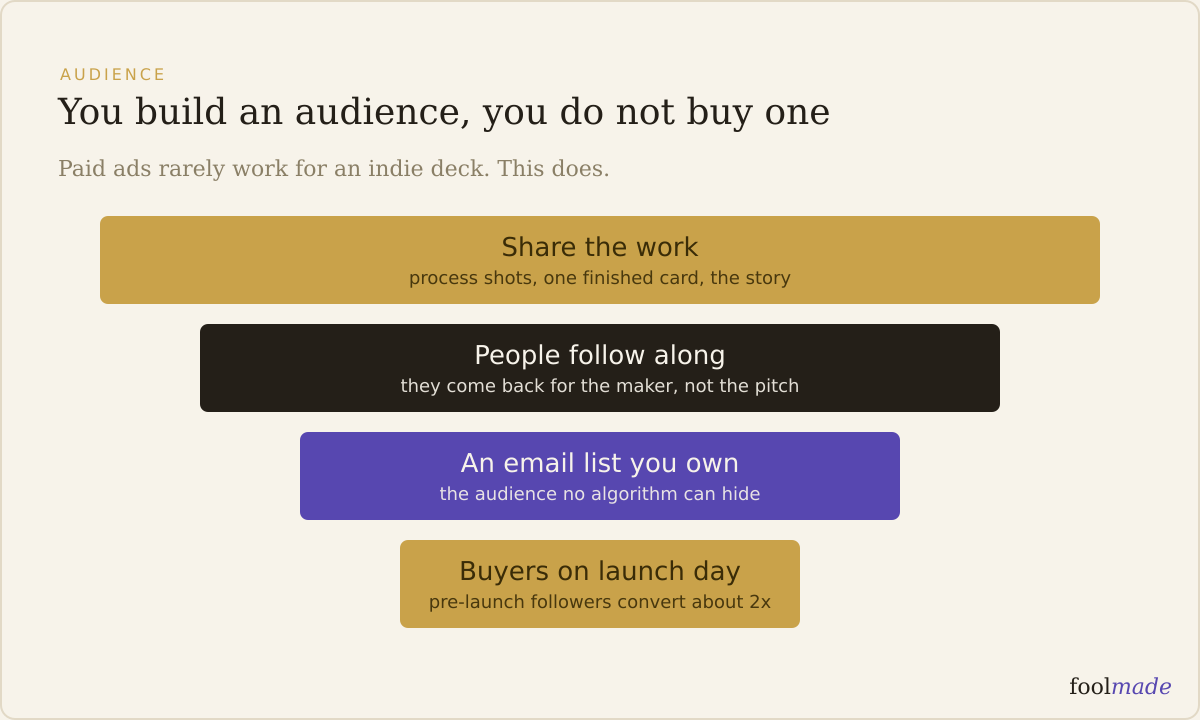
That last part is the whole game. Most of the audience you build on Instagram or Reddit is rented, and you find out how little you own it the week you finally have something to sell.
Why does an email list beat followers for a tarot deck launch?
Because followers are a number, and a list is a direct line. Those are not the same thing.
Instagram shows a single post to a small slice of your followers, and the ones who see it are chosen by a feed you don't control. You can have three thousand followers and reach four hundred of them on launch day. A Reddit post lives for a few hours, then scrolls into the dark. None of that reach is yours to keep.
Kickstarter is the sharpest version of the trap. You can run a fully funded campaign, ship to hundreds of backers, and never get to email those people again. Kickstarter keeps the backer addresses. You can post campaign updates, but for your second deck you are starting your outreach close to zero. Many creators only notice this when the second edition is ready and there's no one to tell.
An email list sidesteps all of it. Someone typed their address and said "tell me when it's out." That's it. That's a person who wants the thing you're making.
Who actually owns the audience?
Ownership is the only question that matters when you're deciding where to put your effort. Here's how the common channels stack up.
| Channel | Do you own the audience? | Reach on launch day |
|---|---|---|
| Email list | Yes, the addresses are yours | Nearly everyone, straight to the inbox |
| Instagram followers | No, the platform owns the feed | A small fraction of followers per post |
| Reddit / community post | No, it's the sub's space | One post, live for hours, then gone |
| Kickstarter backers | No, Kickstarter keeps the emails | Only via campaign updates, no export |
| Your own deck page signups | Yes, they're your contacts | Direct, whenever you send |
Social and community reach are still worth building. They're how strangers find you in the first place. But treat them as the top of the funnel that feeds the list, not the list itself. The goal of a good weekly card reveal or a WIP post is partly to turn a scroller into a subscriber, because the subscriber is the one you can reach again.
What should you send your email list before a deck launch?
Not much, and not often. The fear that a list means writing a newsletter is what stops most creators from starting one. It doesn't. A deck list can send a handful of emails across a whole project and do its entire job.
Send these, roughly in this order:
- A welcome, once. One short note when someone signs up: what the deck is, when you expect it, and that you'll only email when there's real news. Set the low-volume expectation and people stay subscribed.
- The occasional reveal. When you finish a card you're proud of, send it. This is the same content as your public weekly reveal, just delivered to people who asked. A picture and two sentences is plenty.
- A heads-up before launch. A week out: "the deck opens next Tuesday, here's the price, here's how many I'm printing." This primes the people who will buy in the first hour.
- The launch notice. The one email that pays for the whole list. "It's live, here's the link." Short, clear, one button.
- A last-call, maybe. If it's a limited run, one "almost gone" note near the end converts the fence-sitters.
That's five emails, not a publishing schedule. Everything else lives in your public feed. The list is for the moments that matter, so when an email does land, people open it. For the full picture of how these pieces fit a launch week, see the launch day plan.
Do you need Mailchimp for this?
You need a way to collect addresses and a way to send one email to all of them. That's the whole requirement. What you don't need is a marketing platform bolted onto your deck with duct tape.
The pattern to avoid is the one that plays out in deck communities constantly: a creator sets up a Mailchimp account, generates a signup form, and pastes the raw form link into a Reddit comment or an Instagram caption. It looks like homework. It reads like marketing. It sits at odds with a feed that's otherwise all handmade art, and it asks a stranger to click through to a branded form before they've even decided they care.
Signing up should be one tap from the place people already are, and it should feel like part of your work, not a mailing-service detour. The cleaner setup is a single deck page that shows the art and quietly collects the people who want to know when it's ready, so the "follow along" and the "tell me at launch" are the same small action. Keep the tool invisible. The reader should feel like they followed an artist, not that they entered a funnel.
How much better do pre-launch signups convert?
A lot. People who signed up before launch tend to convert at roughly twice the rate of a cold audience you reach for the first time on the day. They already know the deck, they already decided they want it, and your email arrives as the thing they were waiting for instead of an interruption.
The mechanism is simple. A stranger seeing your deck for the first time needs to be convinced from scratch, and most won't be, not in one pass. A pre-launch subscriber watched you paint it. The decision is already made; the email just tells them where to click. That's why a list of a few hundred genuinely interested people will out-sell a social following many times its size.
This is also why the list compounds. Everyone who buys the first deck, and everyone who wanted to but missed it, becomes the warm audience for the second. You never start from zero again. That's the asset a Kickstarter-only launch quietly fails to build. For where the list sits in the wider picture of finding buyers, the guide to marketing an indie deck is the pillar to start from.
Frequently asked questions
How many subscribers do I need to launch a tarot deck?
Fewer than you'd think. A few hundred genuinely interested subscribers can sell out a small print run, because a pre-launch list converts far better than a large cold following. Aim for real interest, not a big number.
When should I start collecting emails for my deck?
The day you show your first card publicly. Every reveal and WIP post is a chance to turn a viewer into a subscriber, and starting early means the list is warm and sizable by the time you launch, instead of thrown together in the final week.
Do I still need social media if I have an email list?
Yes, but for a different job. Social and community posts are how new people discover you; the email list is how you keep and reach them. Use your link in bio to move followers onto the list so a discovery becomes a contact you own.
Is it worth building a list if I'm launching on Kickstarter?
Especially then. Kickstarter never gives you the backer emails, so without your own list you can't reach those buyers for your next deck. Collect signups on your own page before and during the campaign, so the audience is yours to keep.
The bottom line
Followers are borrowed and a list is yours. If you're going to spend years on a deck, spend a little of that time building the one audience a platform can't take away, so on launch day you're sending to people who already said yes.
Foolmade gives you a deck page that shows your work and collects the people who want it, so following along and signing up are the same tap and the contacts stay yours to keep. It never prints or generates art. The deck is yours, and so is the list.