Market an indie tarot deck without paid ads
You market an indie tarot deck by sharing the work as you make it, not by buying ads. Post the cards as you paint them, gather the people who follow along, and sell to them first. Paid ads almost never pay off for a single handmade deck. The audience you build along the way is the marketing.
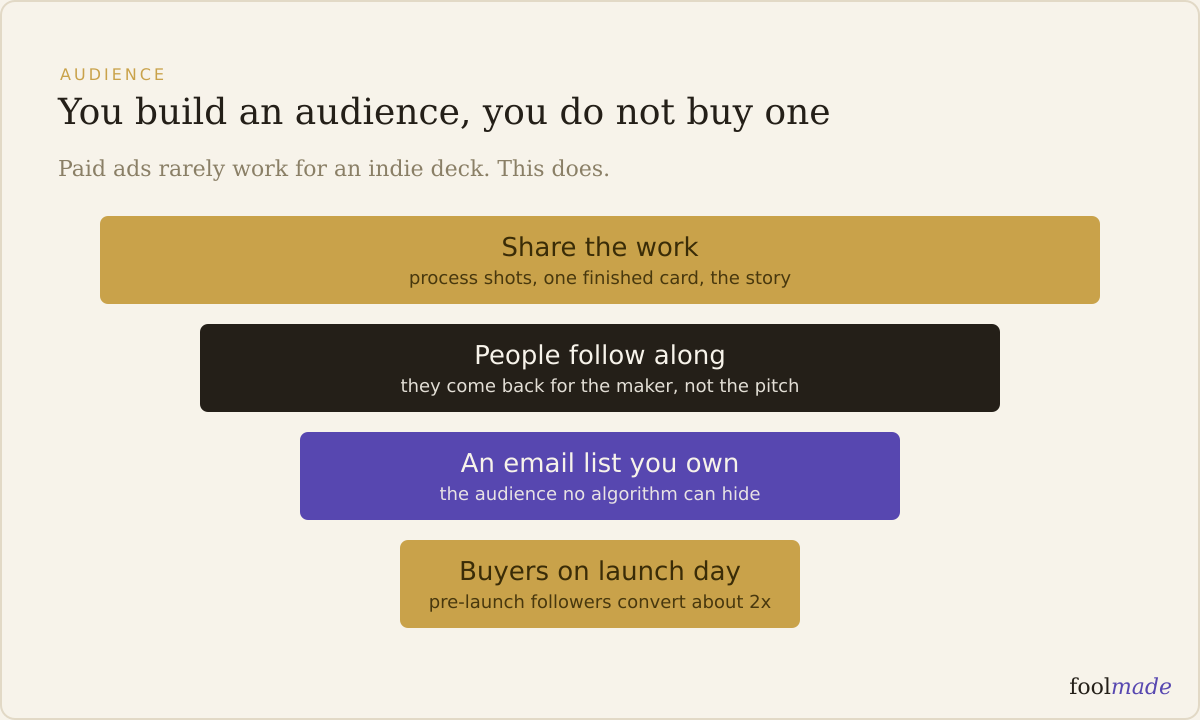
That's the whole strategy. It runs against every instinct that says marketing means budgets and funnels. For one deck made by one person, it doesn't. It means letting people watch.
Why don't paid ads work to market an indie tarot deck?
The math doesn't hold. A boxed indie deck sells for somewhere around 30 to 50 dollars, and a slice of that goes to printing, shipping, and fees. You keep maybe 10 to 20 dollars a deck. To break even on ads you'd need to turn strangers into buyers cheaply and reliably, and tarot ad clicks are neither cheap nor reliable.
Worse, ads chase cold traffic. Someone who's never seen your art has no reason to trust a 40 dollar unknown deck over the hundreds already on the shelf. What makes an indie deck worth buying is the story of the hands that made it, and you can't fit that in a banner.
The creators who fund and sell out do it the slow way. They post work for a year, and by launch there's a group of people already waiting. The spend that would have gone to ads goes nowhere, because the audience built itself for free.
What actually sells a handmade deck?
Three things, in order.
First, a pre-launch following. People who watched the deck get painted convert at roughly twice the rate of cold visitors, because they're not deciding whether to trust you at checkout. They decided months ago. Every card you post before launch is a small deposit in that account.
Second, the process itself. The tarot audience loves following a deck being painted. Card by card, sketch to finish, the messy media, the desk covered in gouache. It's a real signal in a market fed up with mass-produced and AI-generated art. A visibly handmade, human process isn't something to downplay. It's the strongest thing you've got.
Third, and this is the hard part, you have to be willing to be seen. One artist on r/TarotDecks said it straight: they're gun-shy about self-promotion, and being a professional artist, that has worked out about as well as you'd expect. The shy-artist reality is the real bottleneck, not reach or budget. The fix isn't to become a salesperson. It's to reframe posting as documenting your work, which asks nothing of anyone.
Which marketing tactics are worth your time?
Not all of them earn their effort. Here's how the common moves stack up for a single indie deck, as of 2026. Your mileage varies with your art and your patience.
| Tactic | Effort | Works for indie decks? |
|---|---|---|
| Posting work-in-progress art | Low, ongoing | Yes. The core engine. It's content the audience already wants. |
| A weekly card reveal | Low, steady | Yes. Rhythm keeps followers warm without feeling like ads. |
| A mailing list | Medium to set up | Yes. Your only channel you own, unaffected by algorithms. |
| A single deck page plus link in bio | Low, one-time | Yes. Gives the buy a home so your feed stays about the art. |
| Kickstarter or pre-orders | High | Yes, if you've built a following first. Not a shortcut around one. |
| Paid social ads | Money, plus tuning | Rarely. Cold traffic, thin margins, low trust. Skip early on. |
| Buying followers or engagement | Money | No. Fake reach doesn't buy decks and the community spots it. |
| Spamming shop links in reading threads | Low | No. Against most community rules and it gets you resented. |
The pattern is clear. The cheap, slow, honest tactics work. The fast, paid, pushy ones don't, and some actively hurt you. Spend your limited energy on the top of the table.
How do you market an indie tarot deck if you're shy about it?
You separate the work from the ask. Most of the cringe in self-promotion comes from mixing them, so every post carries a little "please buy this" hanging off it. Pull them apart and the discomfort mostly goes.
Post only the work: a finished card, a sketch, a time-lapse, the reason the Tower has a particular symbol. None of that is a pitch. It's just what you made this week, and it's exactly what deck communities show up for. There's a full playbook in sharing your deck in progress without feeling spammy.
Then give the buy exactly one home. A single deck page, one link in your bio, and that's the only place selling happens. Your feed and your community posts get to stay purely about the art. When someone falls for a card and wonders if it's real, the answer is one tap away, on a page that's allowed to be about buying. Setting that up well is its own small craft, covered in link in bio for deck creators.
What does a year of low-key marketing look like?
A steady drip beats a launch-day scramble. The creators who sell out treat the whole painting process as the campaign, not the two weeks around release.
- Every week or two: post one piece of real work. A card, a WIP beside its final, a materials shot. No call to action. A predictable weekly card reveal gives followers a reason to keep coming back.
- Early and always: move interested people onto a list you own. Algorithms bury feeds; email doesn't. Start building a mailing list for your deck the day you have your second follower, not the week you launch.
- Read every community's rules before posting. Most deck subs, r/TarotDecks included, ban spamming shops and reading offers, but explicitly welcome deck-in-progress posts. Use the WIP flair. Contribute before you promote.
- When the deck is done: run the release on purpose. A tight tarot deck launch day plan turns a year of quiet audience-building into actual sales instead of a link dropped into silence.
Notice what's missing: no ad budget, no growth hacks, no follower-buying. Just the work, shown consistently, to people who chose to watch.
Frequently asked questions
How much should I spend to market an indie tarot deck?
Close to nothing, especially before launch. Your budget is time spent posting the work, not money spent on ads. Save any spend for a good proof and clean packaging, which sell the deck better than a banner ever will.
When should I start marketing my deck?
The day you have finished cards worth showing, often a year or more before you can sell. The pre-launch window is where the audience that doubles your conversion rate gets built. Waiting until the deck is printed wastes the best part of the runway.
Do I need a big following to sell out a small run?
No. A small run of a few hundred decks needs only a few hundred committed buyers, and a slow-built following of even 500 real people who watched you paint can carry that. Depth of interest beats raw follower count.
Is Kickstarter a marketing strategy?
It's a funding and pre-order tool, not an audience machine. Kickstarter rewards creators who arrive with a following already, and it under-delivers for those who show up cold hoping the platform will find buyers for them.
Does posting my work count as spamming?
Not if you post the work and not the ask. Sharing a finished card with no buy-link is content the community wants. Dropping shop links in other people's threads is the spam, and it's the fast way to get quietly resented.
The honest bottom line: you can't out-spend the shelf, but you can out-care it. The deck sells because people watched a real person make it slowly, by hand, and wanted the thing at the end. When you're ready to give that buy a respectful home, Foolmade gives your deck a page and a link in bio built for handmade decks by actual people. It never prints or generates art. The work stays yours, start to finish.
- The Game of Hopehow a game became an oracle
- The Sibylle des Salonsa deck sold on its pictures
- The Grand Jeu de Mlle Lenormandborrowed authority as marketing
- The Livre du Destindeck plus booklet as a product