How to Spot an AI Tarot Deck (Every Tell)
To spot an AI tarot deck, look at the hands first: extra fingers, fused knuckles, and melted thumbs are the most common giveaway. Then check for nonsense text, garbled symmetry, and a suspiciously smooth airbrushed finish. Real tells cluster. One oddity can be a style choice; three or four together is a machine.
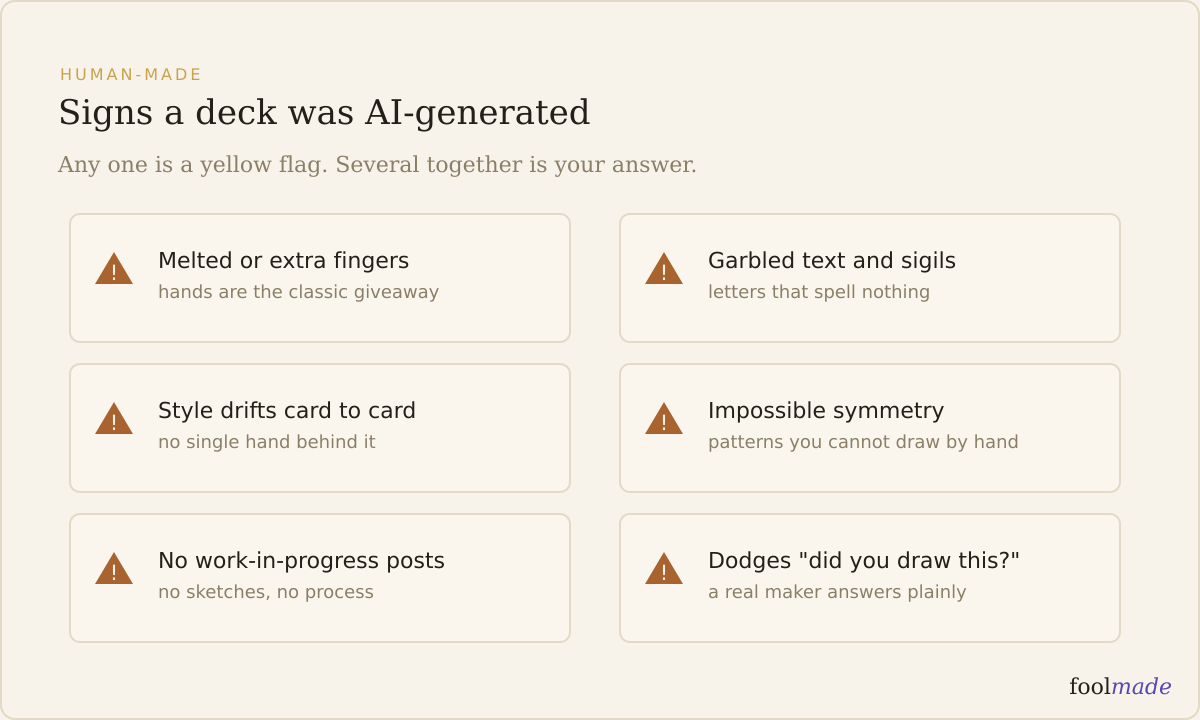
Buyers in r/TarotDecks have turned this into a sport. The sub keeps a running "spot fake decks" thread, and the same word shows up over and over from people who bought first and looked closely later: "appalled." This guide is how to look closely before you pay, and how honest makers can prove they have nothing to hide.
What does an AI-generated tarot deck look like?
AI image tools are trained on scraped art, so they fake the surface of a painting well and fall apart on structure. The failures are consistent once you know where they live.
Hands and fingers are the classic break. Count them. AI routinely gives figures six fingers, two thumbs, or a hand that melts into a sleeve. The Magician and the Hierophant, cards full of gesturing hands, are where this shows up worst.
Text and sigils are the next tell. AI cannot spell. Card titles come out as warped near-letters, and any "ancient" script, rune, or astrological glyph reads as decorative gibberish that means nothing. Zoom in on the banner under The Sun or the book on The High Priestess.
Symmetry goes subtly wrong. A pillar on the left does not match the one on the right. A patterned border drifts and repeats badly. Eyes sit at different heights. The image looks balanced from a thumbnail and wrong at full size.
Then there is the finish: an oddly smooth, airbrushed, plastic sheen where every surface has the same soft glow and no real brushwork, pencil grain, or paper texture underneath.
Can you spot an AI tarot deck across the whole set?
Yes, and the full deck often gives it away faster than any single card. A hand-made deck of 78 cards carries one artist's consistent choices. AI cannot hold a character or a world steady across that many images.
Look for inconsistent style card to card. The Empress is painted in lush oils; three cards later the Emperor looks like a different render entirely. Recurring characters change face, age, and costume between appearances. The Fool's dog is a spaniel on one card and something else on the next.
Watch for watermark ghosts. Because the training data was scraped from stock sites and other artists, faint leftover watermark shapes, signature smears, or logo fragments sometimes bleed into a corner. A real ghost of someone else's mark is a dead giveaway.
Backgrounds also melt on inspection. Architecture that does not connect, staircases to nowhere, and foliage that dissolves into abstract mush are all structural failures a human painter would not leave in a finished, printed card.
What are the non-visual signs of an AI deck?
Sometimes you are looking at a listing, not the art up close. The behavior around a deck is as telling as the pixels, and this is where the r/TarotDecks crowd does its detective work.
No process, ever. Real deck-making is measured in years. Creators post work in progress obsessively: half-inked cards, desk photos with actual paint, weekly reveals, "7 years start to finish." A deck that appears fully finished with zero visible history is a flag.
The maker dodges the question. Ask "did you draw this?" and an honest artist answers instantly and specifically, naming a medium. An AI seller deflects, changes the subject, talks about "curating" or "channeling" the images, or goes quiet. The dodge is the answer.
Impossible pace and scale. A full 78-card deck plus a majors-only variant plus an oracle, all launched in a few weeks by someone with no back catalog, is not how hand-painting works. Volume that outruns any human timeline is a machine tell.
Style with no fingerprint. Established artists have a recognizable hand across their work. A brand-new shop selling generically "gorgeous" decks with no artist name, no studio, and no earlier pieces is worth a second look.
The spot-an-AI-tarot-deck checklist
Run a deck through these before you buy. Any one item can be innocent. Several together is your answer.
| Tell | What to look for |
|---|---|
| Hands and fingers | Extra or fused fingers, two thumbs, hands melting into sleeves |
| Text and titles | Warped letters, misspelled card names, unreadable "script" |
| Sigils and glyphs | Runes, zodiac, or alchemical marks that mean nothing |
| Symmetry | Mismatched pillars, drifting borders, uneven eyes |
| Style consistency | Different rendering or characters across the 78 cards |
| Finish | Airbrushed plastic sheen, no brushwork or paper texture |
| Watermark ghosts | Faint stock-site marks or signature smears in corners |
| Backgrounds | Architecture and stairs that do not connect, mush foliage |
| Process posts | No work in progress, no history, deck appears fully formed |
| The direct question | Maker won't plainly say "yes, I drew this" |
| Pace and volume | A huge deck or several decks made impossibly fast |
Why does spotting AI decks help honest makers too?
Because the same tells that catch a fake are the ones that prove a real deck is real. Every artifact on the list is something a machine leaves and a human does not. That makes the checklist a two-way tool.
For buyers, it protects the money and the trust. Paying independent-artist prices for a prompt output is the exact betrayal this community reacts to, and undoing it after the fact is hard. Checking first is easier than feeling appalled later.
For makers, the suspicion in the market is actually your opening. When buyers arrive already scanning for AI, a clear human-made signal separates you from the flood of vague listings instantly. The threads that punish hidden AI reward visible craft with equal energy.
That is why the smart move is not to resent the scrutiny but to feed it. Show the process the machine cannot fake, and the checklist starts working in your favor.
The reasoning behind that, and why coming clean beats being caught, is covered in the pillar on whether you should disclose how your deck was made. If you want the market case, why hand-made tarot decks sell breaks down what collectors actually pay for. And the human-made pledge for deck creators shows how to state your commitment where buyers look.
Frequently asked questions
How can I tell if a tarot deck is AI-generated before buying online?
Zoom into the product photos on hands, card titles, and any script or glyphs, then check the full deck for consistent style. Also look at the maker: real creators post work in progress and name their medium without being pushed.
Are AI tarot decks illegal to sell?
Not inherently, but they are widely disliked in the tarot community, and selling AI art as hand-drawn is a trust problem, not a legal one in most places. The backlash is reputational and swift once a deck is exposed.
What is the fastest single tell of an AI deck?
Hands and text. Count the fingers and try to read the card title. Extra digits or unreadable "letters" are the two failures AI still cannot reliably hide.
Can a deck use some AI and still be honest?
Only if the maker says so plainly and where you can see it before paying. Buyers here object to hidden AI far more than to disclosed use, so a quiet "just the backgrounds" reads as concealment.
Why do tarot buyers care so much about AI?
The value of an indie deck is a human authoring 78 images by hand, often over years. AI art is assembled from scraped work, so passing it off erases the one thing collectors came to pay for.
The honest bottom line: AI fakes the surface of a painting and breaks on the structure, so trust your eyes on hands, text, and consistency, and trust the maker's willingness to answer plainly. If you make real decks and want that plainly visible, Foolmade puts a signed human-made pledge on your deck page, where the people running this checklist will actually find it. It never prints or generates art. The work stays yours, start to finish.