AI tarot deck disclosure: should you tell buyers?
Yes, disclose how your deck was made. AI tarot deck disclosure builds trust and costs nothing if your work is human-made, and hidden AI is a trust bomb buyers will find. Name the medium, say you made it, and list any tools honestly. Openness reads as confidence, not weakness.
The instinct to stay quiet is understandable. You spent years on this and you do not want a label to shrink it. But silence does not protect you. It just moves the reveal to the worst possible moment: after someone has paid.
Why does AI tarot deck disclosure matter so much?
Because this audience is already burned. On r/TarotDecks, buyers describe opening a deck they saved up for, realizing the art was AI-generated only while holding the cards, and feeling "appalled." One collector called a maker who leaned on AI "not an artist worthy of the name." The sub keeps a "spot fake decks" guide going.
That anger is not about AI in the abstract. It is about being deceived. The same buyer who trashed a hidden-AI deck wrote that they had "no issue paying" at that price "if the art is original and made by the human hand."
So the demand is clear. Buyers want to know what they are holding before they pay. Disclosure is how you meet that demand instead of ambushing it.
If your deck is painted by hand, this is pure upside. You are telling the exact thing your buyer most wants to hear.
What happens when a creator hides how a deck was made?
The reveal still happens. It just happens without you in the room. A buyer notices the six-fingered hand, the melted card back, the smudged text, and the story writes itself: this maker had something to hide.
Once that trust breaks, it does not come back with an apology in the comments. The buyer refunds, posts photos, and warns their circle. Word travels fast in a small community that already polices this on sight. A deck that could have found the right audience gets branded a fake instead.
Compare that with the cost of just saying it up front, which is nothing when the work is genuinely yours. Hiding the process only makes sense if the process would not survive daylight. That is worth sitting with before you decide.
Why does "I only used AI for the images" land so badly?
Because on a tarot deck, the images are the deck. A real guidebook that tried this line got picked apart: if the cards openly take inspiration from existing art, buyers asked, what was left for a generator to "create," other than the part that was supposed to be the artist's whole job?
The phrase reads as a dodge. "Only" is doing damage control, and buyers hear it as an admission that the maker could not do the central task themselves. Minimizing the AI does not shrink the problem. It signals you already know it is a problem.
Honesty scales the other way. "I painted every card in gouache and used Photoshop to clean up scans" is specific, checkable, and calm. The difference is not how much software you touched. It is whether you sound like you are confessing or just describing your process.
How do you write an AI tarot deck disclosure that builds trust?
Keep it plain and put it where buyers look first: the product page, not buried in the guidebook after the sale. Three moves cover it.
1. Name the medium. Say what the art actually is. "Hand-painted in watercolour on 300gsm hot-pressed paper." "Digitally illustrated in Procreate, drawn by hand." Concrete beats vague every time.
2. Say you made it. Put your name on the work and take authorship out loud. This is the core of the human-made pledge for deck creators: standing behind the deck as yours.
3. List your tools honestly. Scanners, Photoshop, a tablet, Lightroom for color, a print shop. None of these are AI, and naming them shows you have nothing to hide. If you did use a generative tool anywhere, say exactly where and for what.
Do not perform it. You do not need a manifesto. A short, specific line in your own voice does more than a paragraph of defensiveness.
If you want a fixed place for it, Foolmade lets you attach a signed human-made pledge to your deck page so the statement travels with the deck instead of living in a caption that gets lost.
Can disclosure actually help you sell your deck?
Yes, and this is the part creators underrate. In a market that is now flooded with AI-generated decks, "made by a human hand" is a selling point, not a disclaimer. Buyers are actively hunting for it and paying a premium for it. That is the whole reason hand-made tarot decks sell at the prices they do.
Openness also does your marketing for you. Work-in-progress posts, the foraged pigments, the seven years start to finish, the finished Fool: this is the story buyers connect to. Disclosure is just the front door to that story.
The flip side is that buyers are getting good at spotting an AI-generated tarot deck on their own. When they can already tell, the only variable you control is whether you were honest first. Being the maker who said it plainly is a durable advantage.
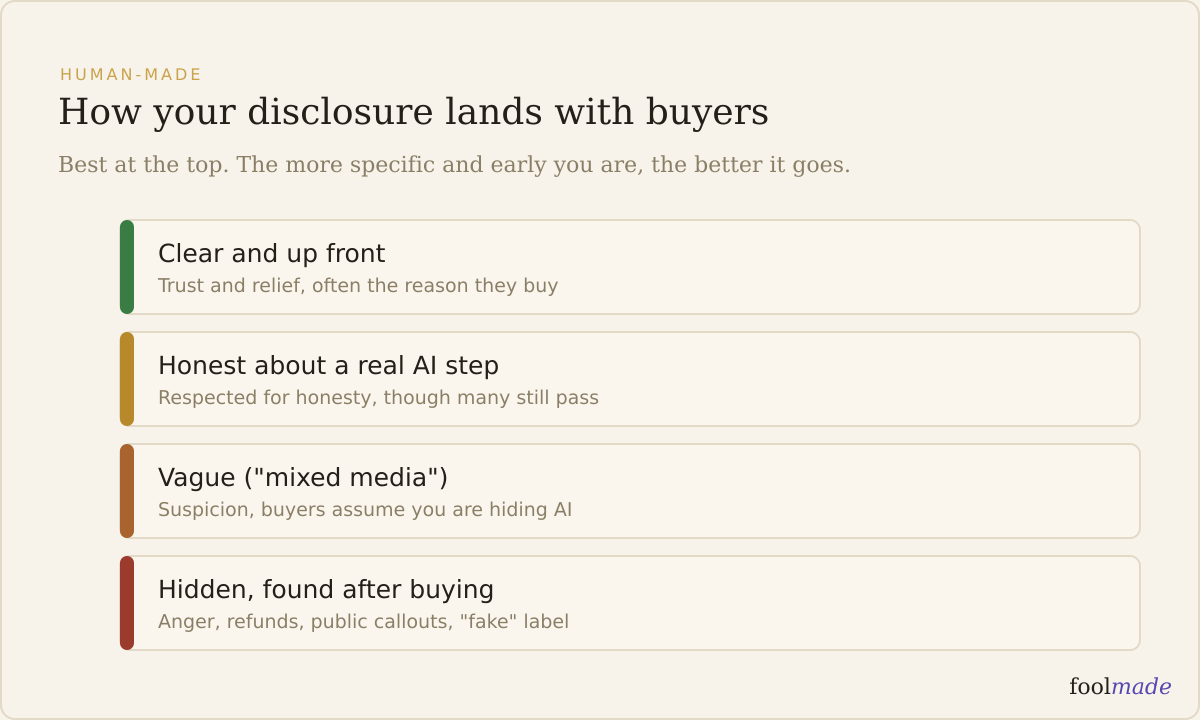
Disclosure approach vs buyer reaction
How you frame it changes everything. Here is how each approach tends to land in this community, based on what creators and buyers actually report.
| Disclosure approach | How buyers tend to react |
|---|---|
| Clear, up-front: "Hand-painted, drawn by me, printed at [shop]" | Trust and relief; often the reason they buy |
| Honest about a real AI step: "AI used only for X, disclosed here" | Mixed; respected for honesty, but many still pass |
| Vague: "mixed media," "digitally created," no specifics | Suspicion; buyers assume you are hiding AI |
| Minimizing: "I only used AI for the images" | Read as a dodge; signals the art is not really yours |
| Hidden, found after purchase | Anger, refunds, public callouts, "fake" label |
The pattern is simple. The more specific and early you are, the better it goes. Every step toward vagueness or silence costs you trust you cannot easily earn back.
The honest bottom line
If your deck is human-made, disclosure is the easiest win you will get all launch. You are handing your buyer the exact reassurance they are searching for, and you look confident doing it. Say what the art is, say you made it, name your tools, and put it where people see it before they pay.
If part of your deck leaned on AI, the same rule holds, it just asks more of you: say exactly where, up front, and let buyers decide with full information. Either way, the deception version is the only one that reliably blows up.
Frequently asked questions
Do I have to disclose AI use when selling a tarot deck?
Ethically and practically, yes. This community treats undisclosed AI as deception, and buyers routinely refund and call out decks once they find it. Some marketplaces are also adding AI-labeling rules, so disclosure protects you on both fronts.
Where should the disclosure go on my deck listing?
On the product page itself, high up, before checkout. Buyers should never learn how the art was made only after opening the box. A line in your shop listing and a note on the box or first guidebook page both help.
Will admitting I used any AI kill my sales?
Not automatically, but it narrows your audience. Buyers respect honesty far more than a cover-up, and many will still pass on generative art. If the AI step was small and real, name it precisely; vagueness does more damage than the fact itself.
What if my deck is fully hand-made? Do I still say anything?
Yes, loudly. "Made by a human hand" is exactly what this market is paying for. Stating it plainly turns your process into a selling point and separates you from the flood of AI decks.
Is using Photoshop or a scanner the same as using AI?
No. Editing, scanning, and color-correcting your own art are standard tools, not generation. Naming them is fine and even reassuring. The line buyers care about is whether the actual imagery was invented by you or by a generator.
- The Sola Busca Taroton borrowing and crediting
- The Jacques Viéville Taroton signing your own work
- The Besançon Tarotediting a deck for its market
- The Sibylle des Salonsattributed art and who gets named