Trademark vs copyright for your tarot deck name
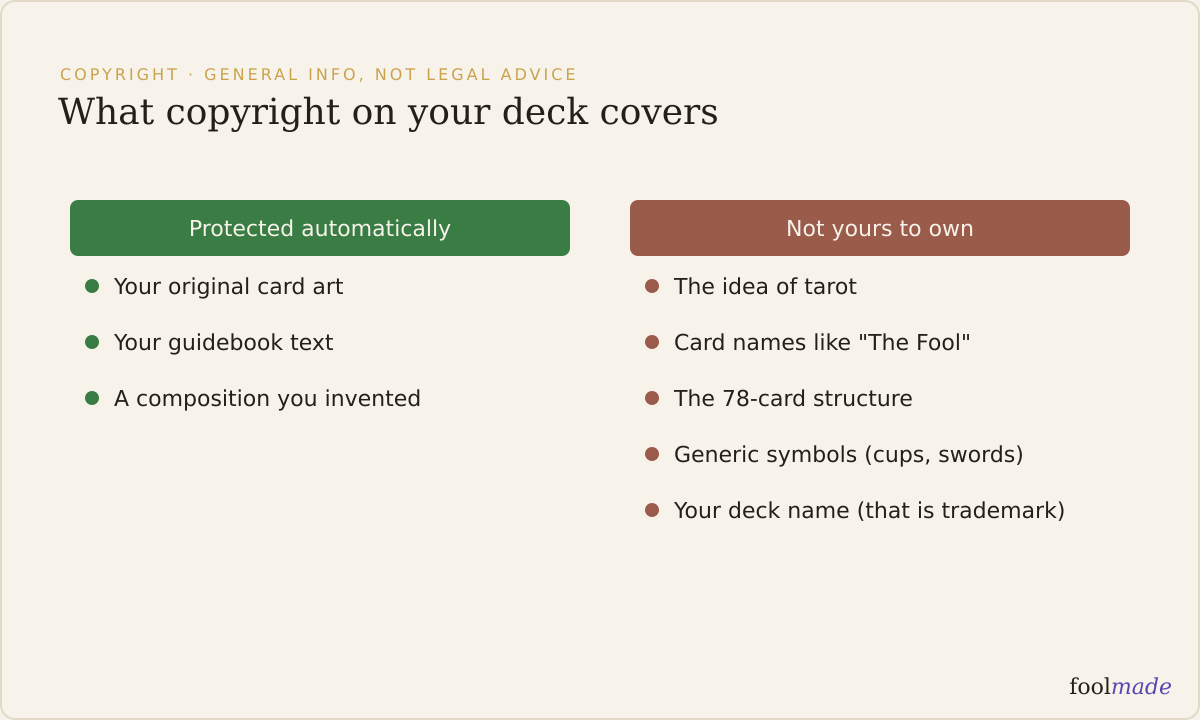
Copyright protects your art and guidebook text; a trademark protects your deck name and brand. Copyright is automatic and free the moment you make the work. A trademark tarot deck name is something you have to claim, search first, and pay to register if you want it enforced widely. Two tools, two jobs.
Creators mix these up constantly, usually right before they print a thousand boxes with a name someone else already owns. Here is the plain version.
What is the difference between trademark and copyright?
They protect different parts of your deck. Copyright covers creative expression: your paintings, your card compositions, the words in your guidebook. Trademark covers identifiers: the name, logo, or brand that tells a buyer which deck is yours in a crowded shop.
Think of it this way. Copyright stops someone from copying your Moon card. Trademark stops someone from selling their own deck under your deck's name and riding on your reputation.
Copyright also happens on its own. In the US, an original work is protected the instant it is "fixed in a tangible form," meaning the moment you save the finished art file or type the card meanings. No form, no fee. Trademark rights build up as you actually use a name in commerce, but the strong, enforceable protection comes from registration, which you have to file and pay for.
For the full picture on the art side, see the deeper guide to what copyright covers for a tarot deck. This article is about the other half: the name.
Why is your tarot deck name a trademark question?
Because names are too short for copyright to touch. Copyright does not protect titles, short phrases, or single words, no matter how clever. "The Fool's Journey Tarot" is not a copyrightable work. So the law files names under trademark instead.
A trademark is about preventing customer confusion. If two decks share a name, or names close enough that a buyer could mix them up, the market gets muddy and whoever established the name first can object. That is the whole logic: protect the identifier so buyers know what they are getting.
This matters most when your deck name is also your shop name, your handle, and your brand going forward. If you plan to publish more than one deck under a single studio name, that studio name is your real long-term asset, and it lives in trademark territory. Your individual card art stays with copyright.
How do you do a basic clearance search?
Before you commit to a name, spend an afternoon checking whether it is taken. This is a clearance search, and it is the single cheapest insurance in the whole process. Do it in this order:
1. Plain web search. Search the exact name plus "tarot" and "oracle." Look for existing decks, retired decks, and Kickstarter campaigns. A name that was used five years ago can still cause a headache.
2. Etsy and marketplaces. Search Etsy, Amazon, and the big deck retailers directly. Etsy in particular is where indie decks live, so a conflict there is a conflict with your actual buyers.
3. Social handles. Check Instagram, TikTok, and whatever platform you will post on. If the handle is gone, the name is effectively half-taken even if nobody registered it.
4. The USPTO database. Search the federal trademark database (the USPTO's TESS system in the US, or your country's equivalent) for the name in related categories like games, printed matter, and publications. This tells you if someone has a registered claim, which is the strongest kind.
A conflict found now costs you a rename and a little ego. A conflict found after your print run costs you the boxes, the listings, the URL, and possibly a cease-and-desist. For the naming process end to end, including checking domains and handles, see naming your tarot deck.
Copyright vs trademark, side by side
Here is the whole thing on one screen.
| Copyright | Trademark | |
|---|---|---|
| Protects what | Your original art, card compositions, guidebook text | Your deck name, studio name, logo, brand |
| Automatic? | Yes, the moment the work is fixed | Some rights from use; strong protection needs registration |
| Cost | Free to exist; roughly $45 to $65 to register a work in the US | Free to use; often several hundred dollars per class to register |
| When it matters | Someone copies your art or writing | Someone sells under your name or a confusingly similar one |
| Where to file | US Copyright Office (copyright.gov) | USPTO (uspto.gov) or your national office |
Prices are planning estimates as of 2026 and both offices adjust fees, so confirm the current number before you file.
When should you register a trademark for your deck name?
Not always, and not on day one. Registration is worth the cost and effort when the name is a central, lasting part of your business and there are real stakes if someone copies it. Signs it is time:
- Your studio or deck name is becoming a brand you will publish under for years.
- You are selling at real volume, or a Kickstarter did well and copycats are plausible.
- You are licensing, wholesaling, or expanding into a line of products.
Signs you can wait: a single small-batch deck, a hobby run, a name you are not fully attached to yet. In those cases a solid clearance search plus using the name openly is a reasonable start, and you can register later once the brand proves itself.
Two honest caveats. Trademark registration costs meaningfully more than copyright, commonly a few hundred dollars per class of goods plus the work of filing correctly. And it is a completely separate process from copyright, with its own forms, its own office, and its own timeline that can run many months. Registering your art with the Copyright Office does nothing for your name, and vice versa. If the brand is central to your income, this is the point to talk to a trademark attorney.
Frequently asked questions
Can I copyright my deck name instead of trademarking it?
No. Copyright does not protect names, titles, or short phrases. Your deck name is a trademark matter, while copyright covers the art and guidebook text.
Do I have to register a trademark to protect my deck name?
Not to have any rights, since using a name in commerce builds some common-law protection. But registration is what gives you strong, enforceable, nationwide rights, and it is usually worth it once the name is a real brand.
How much does a trademark cost compared to copyright?
In the US, registering a copyright for a work runs roughly $45 to $65, while a trademark commonly costs several hundred dollars per class of goods, plus any attorney help. Confirm current fees on copyright.gov and uspto.gov.
What if two indie decks have the same name by accident?
Trademark turns on likelihood of customer confusion and who used the name first in commerce. Two similar names can coexist if the products and markets are clearly different, but it is a real risk, which is why a clearance search comes before you print.
Is a trademark search really necessary for a small deck?
Yes, at least a basic one. Searching the web, Etsy, social handles, and the USPTO database is free and fast, and it saves you from renaming after you have printed and listed.
The honest bottom line
Copyright and trademark are not competitors, they are two halves of protecting a deck. Your art and guidebook are covered by copyright automatically, and registering them is cheap. Your name is a trademark question, so search it thoroughly before you commit, and register the mark only when the brand is central enough and the stakes are real enough to justify the higher cost and separate process.
This is a plain overview, not legal advice. Trademark and copyright rules vary by country and depend on your specific situation. For anything with real money on the line, talk to an attorney who handles intellectual property.
One practical piece of protecting a name is using it out in the open, tied to you. A link in bio built for deck creators is one way to do that. You can claim your creator handle on Foolmade so your deck name and your work sit together on a named, human-made page, publicly attached to the person who made it.