Copyright a tarot deck: what's protected and what isn't
Yes, you can copyright a tarot deck, but only the parts that are truly yours. Your original card art and guidebook text are copyrighted automatically the moment you make them, no filing required. What you cannot own is tarot itself: the structure, the traditional card names, and generic symbolism are free for everyone.
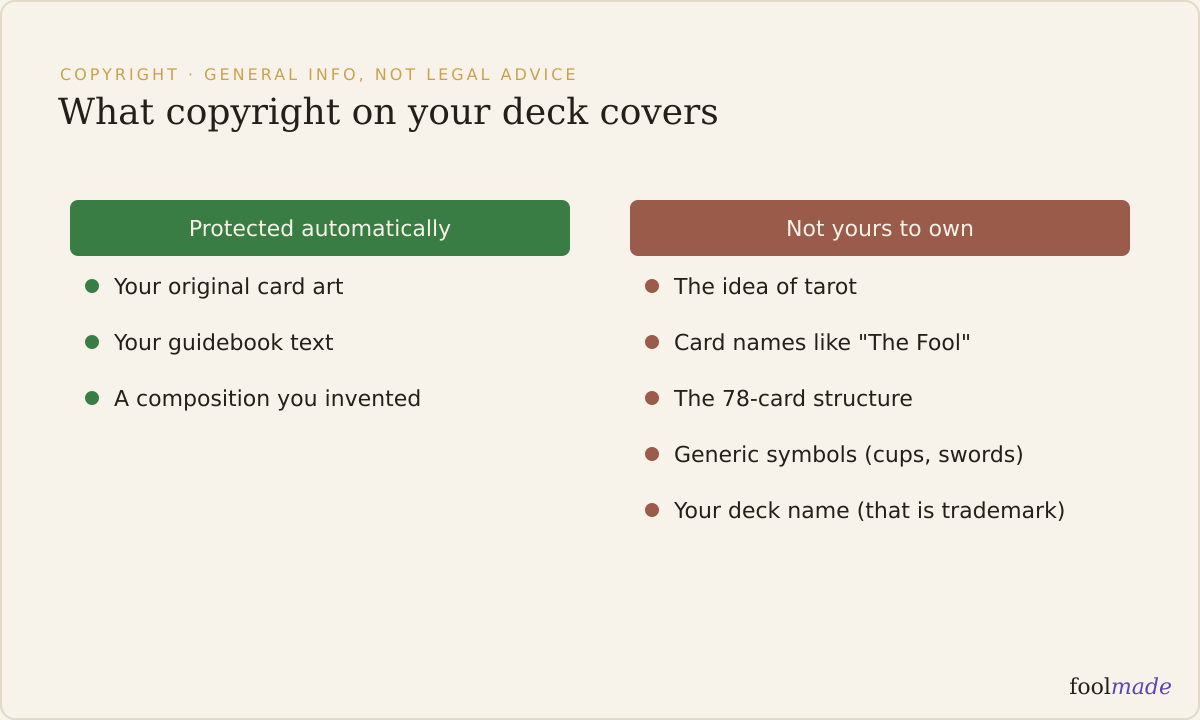
That split confuses most indie creators. Here is the plain-language map of what copyright actually covers on a deck, what it never will, and where trademark takes over.
What does copyright on a tarot deck actually protect?
In the United States, an original creative work is protected the moment it is "fixed in a tangible form." For a deck, that means the instant you save the finished painting file or type your card meanings into a document, copyright attaches. No form, no fee, no waiting.
Two big things are covered:
- Your card art. Every original illustration you paint for the deck is yours, including the specific pose, composition, palette, and detail you invented.
- Your guidebook text. Your card interpretations, intros, spreads, and rituals count as original writing and are protected as text.
So if someone lifts your paintings or copies your guidebook word for word, they are infringing your copyright whether or not you ever filed a single piece of paper. The protection exists on creation. Registration, covered below, only changes what you can do about infringement.
What does copyright not cover?
This is the half people miss. Copyright protects a specific creative expression, not the underlying idea, system, or name. Several parts of a tarot deck fall outside it:
- The idea of tarot itself. The concept of a 78-card divination deck is not something anyone can own.
- The traditional structure and card names. Major Arcana, Minor Arcana, four suits, "The Fool," "Three of Cups." These are generic to the form. You cannot stop other creators from using the same names and structure.
- Short names and titles. Your deck's name, and short phrases in general, are too short to carry copyright. They live in trademark territory instead.
- Generic symbolism. A cup meaning emotion, a sword meaning conflict, the sun as a bright disc. Common symbols are shared vocabulary, not your property.
What you can protect is how you specifically render those things. Two artists can each paint The Lovers, and each painting is separately protected, but neither owns "The Lovers" as a concept.
What's protected, and what's fair game?
Here is the whole thing in one place.
| Element | Protected by copyright? | Notes |
|---|---|---|
| Your original card illustrations | Yes, automatically | Applies the moment they are fixed |
| Your guidebook and card-meaning text | Yes, automatically | Original writing counts |
| A specific pose or composition you invented | Often yes | The expression, not the symbol |
| Your deck's name or brand | No, trademark instead | Do a clearance search first |
| Card names like "The Fool" or "Three of Cups" | No | Traditional and generic |
| The idea and structure of tarot | No | Systems are not copyrightable |
| Generic symbolism (cups, swords, suns) | No | Shared vocabulary |
Do you need to register your copyright?
Since protection is automatic, why register at all? Because registration with the U.S. Copyright Office gives your rights teeth. Two reasons matter most:
1. You generally cannot sue for infringement until the work is registered. If you ever need to enforce your rights in court, registration is the entry ticket.
2. Timely registration gives you stronger remedies. Registering before an infringement, or shortly after publication, can make you eligible for statutory damages and attorney's fees. That is often the difference between a case being worth pursuing and not.
The cost is modest. As of 2026, electronic filing runs about $45 for a single author registering one work, and about $65 for the standard application. The Copyright Office proposed raising those fees in early 2026, so confirm the current number on copyright.gov before you file. There is also a group option for registering multiple two-dimensional artworks together, which can spread the cost across a whole deck.
Compared to the months or years you put into painting the thing, registration is cheap insurance.
Is a deck name copyright or trademark?
If you want to protect what you call your deck, copyright is the wrong tool. Names, logos, and brands are the domain of trademark, which protects the identifier customers use to recognize your product.
Before you commit to a name, do a basic clearance search. Look for other decks, shops, or products using the same or a confusingly similar name, and search the federal trademark database (the USPTO's system in the US) to see if it is already claimed in a related category.
Finding a conflict early is annoying. Finding it after you have printed a thousand boxes is expensive. Formal trademark registration is a separate process with its own forms and higher fees. The full breakdown lives in trademark vs copyright for your deck name.
Can you copyright a tarot deck based on Rider-Waite-Smith?
Yes, and a lot of modern decks do, because the original 1909 Rider-Waite-Smith (RWS) imagery, illustrated by Pamela Colman Smith, is in the public domain in the United States. You can reference and reinterpret those classic compositions freely, and your new paintings are your own protected work.
Here is the line that matters. The 1909 images are free. A living artist's 2020s take on those same cards is not. You can go back to the century-old source and build your own version, but you cannot copy a contemporary creator's palette, poses, and compositions and call it inspiration.
If you are tracing how close you can get to a recent deck, you are looking at the wrong reference. The details of that distinction are in is the Rider-Waite-Smith deck public domain, and the practical how-to is in using public-domain art in a new tarot deck.
The honest bottom line
Your original art and your guidebook text are protected automatically. Registration is optional but worth it before you sell widely, because it is required to sue and it is inexpensive. Your card names and structure are not yours to own, and neither are anyone else's. Your deck's name is a trademark matter, so search before you commit. And you can stand on the public-domain RWS system without stepping on a living artist's specific work.
This is general information, not legal advice. Copyright and trademark rules vary by country and turn on the specifics of your situation. For anything with real stakes, consult an attorney who handles intellectual property.
Frequently asked questions
Is my tarot deck copyrighted if I never registered it?
Yes. In the US, your original card art and guidebook text are protected the moment they are fixed in a file or document. Registration is optional and only needed to sue and to claim statutory damages.
Can I make a deck with the same card names as other decks?
Yes. Card names like "The Fool," "The Tower," and "Three of Cups" are traditional and generic, so no one owns them. Only the specific artwork and written meanings you create are protected.
How much does it cost to register a tarot deck copyright?
As of 2026, electronic filing is about $45 for a single author, one work, and about $65 for the standard application. Fees were proposed to rise in 2026, so check copyright.gov for the current amount.
Can I copyright the name of my tarot deck?
No. Names are protected by trademark, not copyright. Run a clearance search and check the USPTO database before you commit, especially before printing.
Is it legal to base a deck on Rider-Waite-Smith?
Yes. The original 1909 RWS art is public domain in the US, so you can reinterpret it. You cannot copy a modern artist's version of those cards.
One last thing on standing behind your work. Part of protecting an original deck is being able to point to it as yours, out in the open. Foolmade is built around a human-made pledge and a named creator page, so your deck is publicly tied to you, the person who actually painted it. It never generates art. It is just a clear place to say this is mine, I made it, here is my name on it.
- The Charles VI Taroton decks credited to the wrong maker
- The Conver Tarot de Marseilleon blocks, copies and who owns a pattern
- The Tarocco Soprafinofacsimiles and rights
- The Grand Jeu de Mlle Lenormanda deck sold under a dead woman’s name