Tarot deck printing cost: real 2026 per-deck numbers
Tarot deck printing cost runs about $14 to $17 per deck at a single copy and can drop under $6 each at 500 copies. That is the whole reason budgeting feels confusing: you are not buying a fixed product, you are buying a spot on a price curve. Where you land depends on how many decks you can afford to sit on.
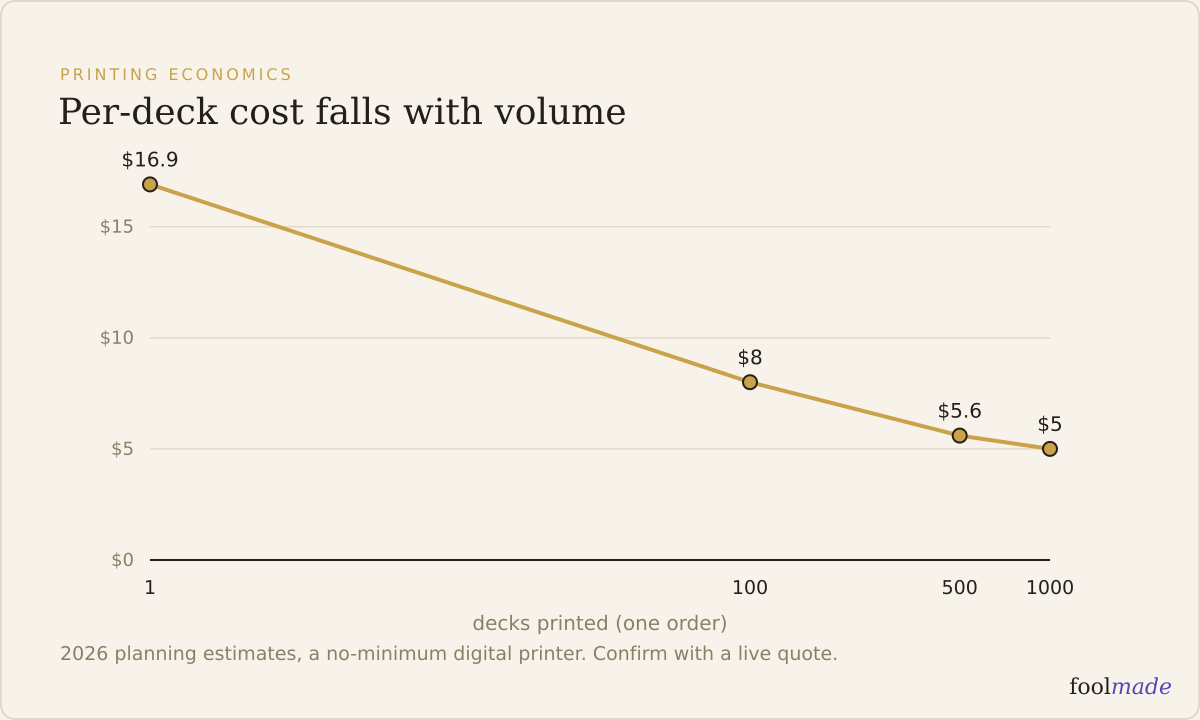
Here is what that curve looks like across the printers indie creators actually use, and what the sticker price quietly leaves out.
Why does tarot deck printing cost drop with volume?
A print run has two kinds of cost. Setup costs happen once no matter how many decks you order: making the press files, calibrating color, cutting a die for the cards and the box. Unit costs happen per deck: the card stock, the ink, the tuck box, the shrink wrap.
At one copy, that entire setup bill sits on a single deck, so the price is brutal. Spread it across 500 decks and the setup cost per deck rounds to pennies. What is left is mostly materials, and materials get cheaper in bulk too.
Two families of printer sit at opposite ends. Digital, no-minimum shops (MakePlayingCards, DriveThruCards, The Game Crafter) print one deck happily at a flat digital rate. Offset printers (Shuffled Ink, PrintNinja) refuse small runs because the setup would swamp them, but their per-deck price at volume is far lower than digital can reach. If you are still choosing a shop, where to print your indie tarot deck walks through the full field.
What is the per-deck tarot deck printing cost by run size?
These are 2026 planning estimates for a standard 78-card deck, 2.75 by 4.75 inches, with a basic tuck box and no fancy add-ons. Treat every figure as a starting point and pull a live quote before you commit. Prices move with stock choice, box type, and, increasingly, shipping.
| Printer | Minimum | ~1 deck | ~100 | ~500 | ~1000 | Notes |
|---|---|---|---|---|---|---|
| MakePlayingCards (MPC) | none | $16.90 | ~$8 | $5.60 | ~$5 | Digital, huge stock and finish menu |
| DriveThruCards | none | $14 | ~$11 | $10.50 | ~$10 | Also a print-on-demand marketplace |
| The Game Crafter | none | $13.50 | $13.50 | $13.50 | $13.50 | Flat rate, zero-inventory storefront |
| Shuffled Ink | ~100 | n/a | $12 | ~$7 | $5.25 | US offset, lower at higher counts |
| PrintNinja | ~500 | n/a | n/a | $4.90 | $2.75 | Cheapest at scale, long lead plus freight |
A few things jump out. The Game Crafter and DriveThruCards barely move with volume because they are built for print-on-demand: you pay for never holding inventory, not for a run. MPC drops fast and bottoms out around $5. PrintNinja makes the cheapest deck you can get, but only if you order 500 to 2000 and can wait weeks for a boat. The MakePlayingCards vs Game Crafter vs DriveThruCards breakdown covers how those three feel in the hand.
What hidden costs raise your tarot deck printing cost?
The per-deck figure above is the cards and a basic box. A finished, sellable product usually costs more. Budget for these before you fall for the low number.
- Guidebook. Even a small stapled booklet adds cost per unit, and a perfect-bound guidebook adds more. Figure $1 to $4 per deck depending on page count and run size.
- Custom or rigid box. The default tuck box is thin. A rigid two-piece box, the kind that feels like a gift, can add $2 to $5 per deck and sometimes needs its own die.
- Gilded edges. Foil or silver edging is one of the most requested premium touches and one of the priciest. Expect a real per-deck surcharge and confirm the printer offers it at your run size. Gold and silver edges on tarot cards has the numbers.
- Proofs. Order one before the run, always. A single proof deck plus rush shipping might cost $30 to $60, and it is the cheapest insurance you will buy. Colors shift, stock feels different than you pictured, and you want to hold it first. Do you need a proof before your print run makes the case.
- Shipping to you. Offshore offset means freight. A pallet from an overseas printer can add hundreds of dollars and weeks of transit.
- 2026 tariffs. This is the live worry right now. Duties on goods printed offshore can add a real percentage to your landed cost, and the rules keep shifting. Ask the printer directly what applies and who pays. Tariffs and international shipping for deck creators digs into it.
- Fulfillment. If you are not shipping decks from your kitchen table, someone has to pick, pack, and post each order. Print-on-demand shops fold this in. Holding your own stock means your time or a pick-pack fee per order.
What does a 100-deck run actually cost?
Say you want 100 decks with a small guidebook and a decent box, printed at a US offset shop to dodge tariff uncertainty.
- Cards plus basic box at ~$12 per deck: $1,200
- Guidebook add-on at ~$2 per deck: $200
- Upgraded rigid box at ~$3 per deck: $300
- Proof deck plus shipping: ~$50
- Freight to you: ~$150
Total: roughly $1,900, or about $19 per deck landed. Sell at $35 to $45 and you clear a real margin, but you have $1,900 tied up and 100 boxes in your closet until they move.
What does a 500-deck run actually cost?
Now the same deck at 500 copies through an offset printer.
- Cards plus box at ~$6 per deck: $3,000
- Guidebook at ~$1.50 per deck: $750
- Proof plus shipping: ~$60
- Freight (larger, possibly offshore): ~$400
- Tariff cushion (offshore, budget 10 to 20%): ~$400
Total: roughly $4,600, or about $9.20 per deck landed. Your cost per deck just halved versus the 100 run. But you spent $4,600 and now own 500 decks you have to actually sell. That is the trade.
What is the cheapest way to print a tarot deck?
For a first deck, do not chase the lowest per-unit price. Chase the lowest risk.
Print one to five proofs first, from whichever no-minimum shop matches the stock and finish you want. Live with the deck. Then run 50 to 150 through a print-on-demand or short-run offset printer. Your per-deck cost is high, but you learn what sells, you avoid a garage full of unsold inventory, and you find out whether people pay before you sink four thousand dollars into a pallet. Deciding between the two paths is exactly what print on demand vs a bulk print run is for.
Scale to 500 or 1000 only once you have sold through a small batch and know your real demand. At that point the volume price is a reward you earned, not a bet you are making. When you get there, set your sticker with how to price your tarot deck so the margin survives contact with reality.
Frequently asked questions
What is the cheapest way to print a tarot deck?
For one to a few copies, a no-minimum digital printer like MakePlayingCards gives you the lowest cost to hold a real deck. For hundreds, an offset run at 500 or more drops the per-deck price under $6, but you pay it all up front and hold the stock.
How much does it cost to print 100 tarot decks?
Plan on roughly $1,500 to $2,000 for 100 decks with a small guidebook, a decent box, a proof, and freight. That is about $15 to $20 per deck landed. A live quote from your chosen printer will firm up the range.
Do 2026 tariffs really change my printing cost?
Yes, if you print offshore. Duties can add a real percentage to your landed cost and the rules keep moving. Ask the printer what applies and who pays, or print domestically and skip the guessing.
Is a proof worth the extra cost?
Almost always. A proof deck runs $30 to $60 with rush shipping and catches color shifts, tight borders, and stock that feels wrong before you commit to a full run. It is the cheapest mistake you can make.
Why is per-deck cost so much lower at 500 than at 100?
Fixed setup costs get spread over five times as many decks, and materials get cheaper in bulk. The savings are arithmetic, not a discount, which is why volume pricing looks dramatic.
If you want to see how these numbers land for your specific deck, Foolmade's margin planner lets you plug in your card count, box choice, and target price, then shows your cost per deck and break-even point across run sizes before you spend a dollar. Foolmade never prints your deck or generates your art. It just helps you see the math clearly.
- The Minchiate Fiorentinethe price of more cards