Print on Demand vs a Bulk Run for Your Deck
A print on demand tarot deck costs you almost nothing upfront and prints one copy only when someone buys, so you carry zero inventory but pay $12 to $20 per deck. A bulk run flips that: you pay $2,000 to $6,000 upfront for 500 to 1,000 decks at $4 to $8 each, keep the higher margin, and hold the stock and the risk yourself.
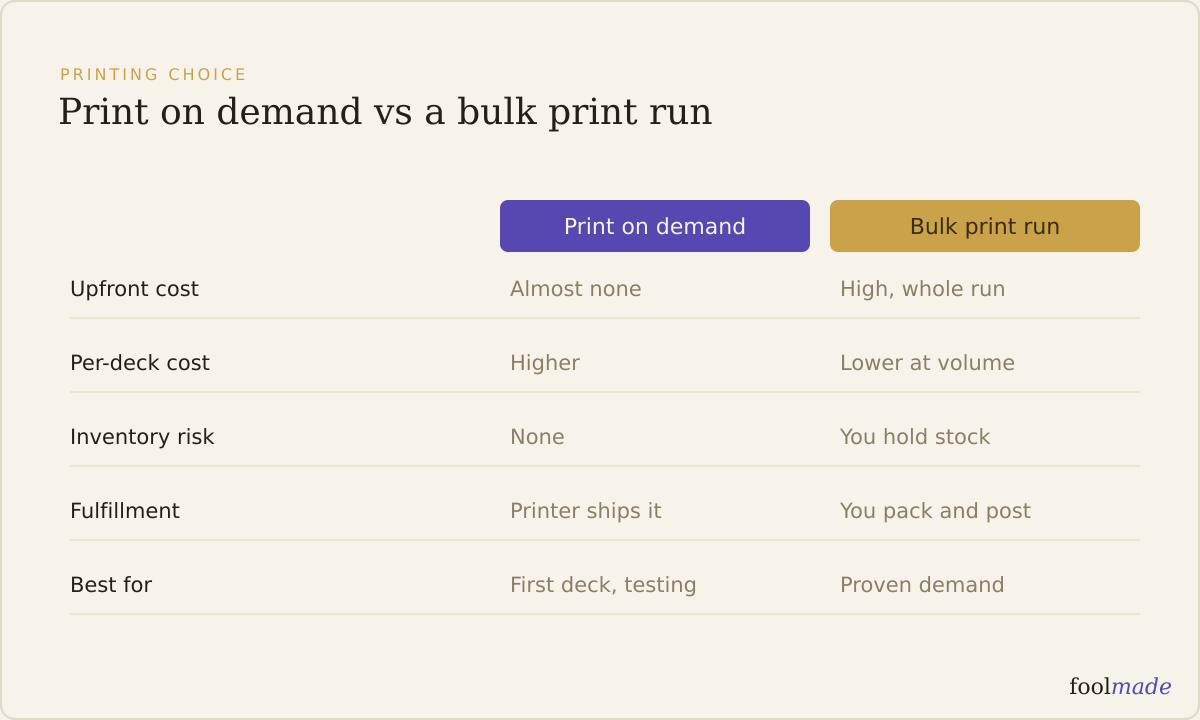
Which one is right depends on how much cash you have, how confident you are that the deck will sell, and how much margin you need per copy. Below is the honest math on both.
What is a print on demand tarot deck?
A print on demand tarot deck is a deck printed one unit at a time, on order, by a printer that also stores your files and ships to the buyer for you. You upload your cards once, set a retail price, and the printer prints, packs, and mails each deck as it sells.
The two names that come up in r/TarotDecks are The Game Crafter and DriveThruCards. Both run a storefront, both handle fulfillment, and both let you list a deck for sale with no minimum order and no money down.
The trade is per-unit cost. Because nobody is running a thousand cards through a press at once, each deck costs far more to make. You never front cash, but you also never get the volume discount.
What is a bulk print run?
A bulk print run is a single large order, usually 250, 500, or 1,000 decks, printed together and shipped to you in boxes. You pay the full invoice before printing starts, store the decks yourself, and handle every sale and shipment (or pay a fulfillment house to).
MakePlayingCards (MPC) and dedicated offset printers are the common routes here. The more decks you order, the lower the price per deck falls, because setup and plate costs spread across the run.
The catch is obvious: you spend thousands before you have sold a single copy, and unsold decks sit in a closet as tied-up cash.
Print on demand vs bulk: the numbers side by side
Figures below are planning estimates for a standard 78-card deck with a tuck box, as of 2026. Always confirm with a live quote, because tariffs, card size, and finish move these numbers.
| Factor | Print on demand (Game Crafter, DriveThruCards) | Bulk run (MPC, offset) |
|---|---|---|
| Upfront cost | ~$0 to $30 (proof only) | ~$2,000 to $6,000 for 500 to 1,000 |
| Per-deck cost | ~$12 to $20 | ~$4 to $8 (drops with volume) |
| Minimum order | 1 | 100 to 250 typical |
| Inventory risk | None (nothing unsold) | You own every unsold deck |
| Margin at $35 retail | ~$15 to $23 per deck | ~$27 to $31 per deck |
| Fulfillment | Printer ships for you | You ship, or hire a fulfiller |
| Cash tied up | None | Full run, before any sale |
| Best for | Testing, tiny audience, no capital | Proven demand, Kickstarter, volume |
The pattern: POD protects your wallet and your risk, bulk protects your margin. At 500 decks sold, the per-unit gap (roughly $10 a deck) is $5,000 in your pocket, which is why funded creators bulk print. At 20 decks sold, that gap is $200 and the bulk run's upfront cost would have buried you.
When should you use print on demand?
Use a print on demand tarot deck when you cannot or will not risk cash on inventory. It is the right call for a first deck, an untested audience, or a creator who wants the deck simply available without a launch.
- You have no upfront budget and no Kickstarter.
- You are not sure the deck will sell more than 50 copies.
- You want it listed and shipping without managing stock or a post office run.
- You are selling to a slow trickle of buyers over months or years.
The honest downside is margin and control. You take home less per deck, you cannot inspect and hand-finish each copy, and the card stock and finish options are limited to what the POD printer offers. For many creators that is a fair price for zero risk.
When should you commit to a bulk run?
Commit to a bulk print run once demand is proven or pre-paid. If a Kickstarter funded, or you have a waitlist, or you have already sold through a small batch, the volume price makes bulk the clear winner.
- Your campaign funded, so the decks are effectively pre-sold.
- You need premium options POD does not offer, like linen finish, black-core stock, or gilded edges.
- You are confident of selling 250-plus copies within a year.
- You want the fattest margin per deck and control over quality.
Run the break-even before you order. If a 500-deck run costs $3,000 and each deck nets you $28, you are whole at 108 sales and everything after is profit. If you doubt you will hit 108, the run is a gamble, not a plan. A tarot deck margin planner makes that math take two minutes instead of a spreadsheet afternoon.
Can you do both?
Yes, and many creators do. A common path is to start with print on demand to test the deck and gather real buyers, then move to a bulk run once sales prove the demand is there. Some keep POD as a permanent long-tail channel while bulk-printing for launches and conventions.
Another hybrid is the small-batch route: order 50 to 100 decks at a middling per-unit price, sell them as a real first edition, and use that cash and proof of demand to justify a bigger second run. It sits between the two extremes and lowers the leap.
Frequently asked questions
Is print on demand cheaper than bulk printing a tarot deck?
Per deck, no. POD runs about $12 to $20 a copy versus $4 to $8 in bulk. POD is only cheaper in total when you sell few enough decks that the bulk run's upfront cost never pays off, roughly under 100 to 150 copies.
Can you sell a tarot deck with zero inventory?
Yes. Print on demand printers like The Game Crafter and DriveThruCards print and ship each deck only after it sells, so you never hold or fund stock. You trade that safety for a higher per-deck cost and thinner margin.
How many decks should you sell before doing a bulk run?
Run the break-even, not a rule of thumb. Divide your total bulk cost by your profit per deck to find the number of sales that makes you whole. If a run costs $3,000 and each deck nets $28, you break even at about 108 decks.
Does print on demand hurt your deck's quality?
It limits your options more than it lowers quality. POD stock and finishes are fixed to what the printer offers, so premium touches like linen texture, black-core stock, or gilt edges usually require a bulk run with a printer that supports them.
What does a bulk tarot deck run cost in 2026?
Plan for roughly $2,000 to $6,000 for 500 to 1,000 standard 78-card decks with tuck boxes, before shipping and any 2026 tariffs. Price per deck falls as quantity rises. Get a live quote, since finish, size, and import duties shift the total a lot.
The bottom line
If you have no cash and unproven demand, list a print on demand tarot deck and let it sell at its own pace. If demand is proven or pre-paid and you want real margin, bulk print. Most creators do the first, then graduate to the second.
Before you commit either way, price it out. See how much it costs to print a tarot deck at each quantity, compare the printers in MPC vs Game Crafter vs DriveThruCards, and check the pillar on where to print your indie tarot deck. When the numbers get real, the Foolmade margin planner shows your true profit per deck for POD and bulk side by side, so you pick with your eyes open. Foolmade never prints your deck or touches your art. It just helps you plan the business around it.