Small-Batch Tarot Deck Printing: 50 to 100 Decks
Small batch tarot deck printing means ordering 50 to 100 copies at once, paying for them upfront, and selling them direct until they run out. You carry the inventory and the cash risk, but you control quality, and your per-deck cost drops with volume. It fits creators who already know a handful of buyers.
Think of it as the middle path. It is not a thousand-deck offset run that needs a Kickstarter, and it is not print on demand where you never touch a copy. It is a real first edition you can hold, sign, and hand over.
What is small batch tarot deck printing?
Small batch tarot deck printing is a single order of roughly 50 to 100 finished decks, printed together and shipped to you in boxes. You pay the whole invoice before printing starts, store the decks at home, and fulfill every sale yourself.
The name people use in r/TarotDecks is the "tiny little duck tarot deck" model: print a small run, sell it out of your own hands, reprint if it moves. One creator described running a tiny deck this way and treating each batch as its own edition.
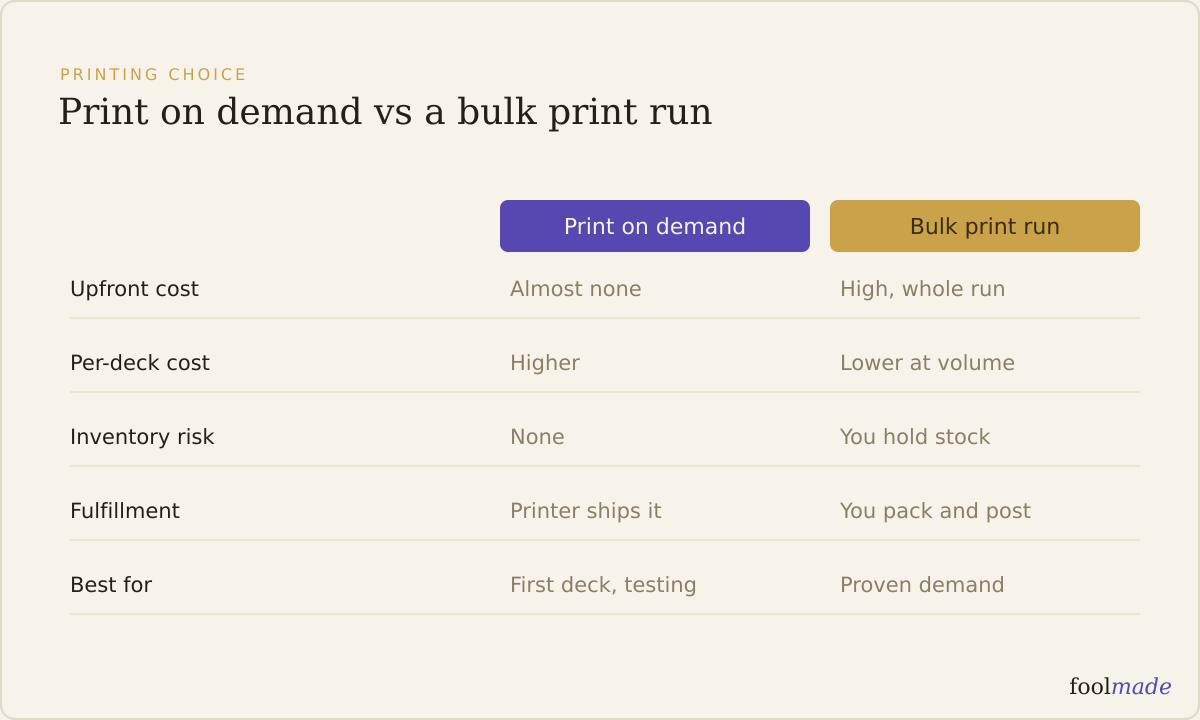
It sits between two extremes. Print on demand means zero inventory and a high per-copy price. A bulk run means thousands of dollars and hundreds of decks in a closet. Small batch is the compromise that lets you self-fund a real edition without betting the mortgage.
How much does a small batch actually cost?
Plan for roughly $6 to $12 per deck at 50 to 100 copies, so a run lands somewhere around $400 to $1,000 before shipping. The exact figure moves with card count, box type, finish, and printer.
Figures below are planning estimates for a standard 78-card deck with a tuck box, as of 2026. Get a live quote before you order, because card size, finish, and 2026 tariffs shift these numbers.
| Run size | Rough per-deck cost | Rough total | Upfront cash needed |
|---|---|---|---|
| Print on demand (1 at a time) | $12 to $20 | n/a | ~$0 |
| Small batch (50) | $8 to $12 | ~$400 to $600 | ~$500 |
| Small batch (100) | $6 to $10 | ~$600 to $1,000 | ~$800 |
| Bulk run (500 to 1,000) | $4 to $8 | ~$2,000 to $6,000 | thousands |
The pattern is simple: the more you print, the less each deck costs, but the more cash you front. At 50 to 100 decks you get a real volume discount over print on demand while keeping the upfront number under four figures. That is the whole appeal.
Who is a small batch right for?
A small batch works best when you already have a handful of buyers waiting. If you know 30 people who will buy the deck (a mailing list, a WIP audience, friends who kept asking), a run of 50 is close to pre-sold and the risk shrinks fast.
- You want a real, physical first edition, not a print-on-demand listing.
- You have a small but real audience: a mailing list, followers who watched the deck get painted, past customers.
- You can float $400 to $1,000 without stress.
- You want control over quality: inspecting each deck, hand-signing, adding a note or a wrap.
It is the wrong call if you have no buyers lined up and cannot afford the upfront cash. In that case a zero-inventory print-on-demand deck protects your wallet while you build an audience.
Small batch vs print on demand vs a bulk run
Each path trades cash, risk, and margin differently. Small batch is the one that keeps upfront cost low-ish while still handing you a real edition and a decent per-deck margin.
| Factor | Print on demand | Small batch (50 to 100) | Bulk run (500+) |
|---|---|---|---|
| Upfront cost | ~$0 | ~$400 to $1,000 | ~$2,000 to $6,000 |
| Per-deck cost | high | middling | lowest |
| Inventory risk | none | small, bounded | large |
| Quality control | printer decides | you inspect each deck | you inspect, at volume |
| Margin per deck | thin | solid | fattest |
| Best when | no buyers yet | a few buyers, some cash | proven or pre-paid demand |
For the full breakdown of the two ends of that spectrum, see print on demand vs a bulk run. Small batch borrows the best of each: bounded risk, real margin, real cards.
Can your proof run double as your first product?
Yes, and this is the quiet advantage of a small batch. Before any run you should order a proof to check color, cut, and card feel. With a tiny edition, that proof and the run are almost the same act: you are already printing a small quantity, so the first few decks you inspect are stock you can sell or gift.
Treat the proof as a real checkpoint, not a formality. Colors shift in print, black borders show every speck of dust, and a bad cut ruins the deck feel. If the proof is wrong, you fix the file and reprint before committing the whole batch. Skipping this is the most expensive mistake in a small run. See whether you need a proof before your print run for what to check.
How do you sell 50 to 100 decks yourself?
You sell them direct, one at a time, until they run out. The realistic channels are your own shop or Etsy, in person at a market or convention, and straight to the people who followed the deck getting made.
1. List the edition as numbered and limited (buyers value "1 of 50").
2. Tell your mailing list and WIP audience first; they are your warmest buyers.
3. Fulfill each order yourself: a rigid mailer, tracking, a signed note if you want.
4. Watch the count. When you are down to the last handful, decide whether to reprint.
5. If it sold through cleanly, use the proven demand to justify a larger second run.
Selling out a small edition is the cleanest proof of demand there is. It funds the next batch and tells you honestly whether the deck has legs.
Frequently asked questions
What is the minimum number of decks I can print?
Print on demand prints one at a time. For a batch you order yourself, many printers set a minimum around 50 to 100 decks, though some allow smaller. Below that, per-deck cost climbs toward print-on-demand pricing, so a run of 50 is usually the smallest that still earns a volume discount.
Is small batch printing cheaper than print on demand?
Per deck, yes. A small batch runs roughly $6 to $12 a copy versus $12 to $20 for print on demand, because printing 50 at once spreads setup cost. The catch is you pay the whole run upfront and carry any decks that do not sell.
How much money do I need to print a small batch tarot deck?
Budget roughly $400 to $1,000 for 50 to 100 standard 78-card decks with tuck boxes, plus shipping to you and any 2026 tariffs. Add the cost of a proof first. Confirm with a live quote, since finish, card size, and import duties move the total.
Should I do a small batch or a Kickstarter?
A small batch fits when you can self-fund a run of 50 to 100 and already know a few buyers. Kickstarter fits when you need thousands of dollars covered before you print. Many creators start with a small self-funded batch, then run a campaign for the larger second edition.
What if I do not sell all the decks?
Your risk is bounded to the run size, which is the point. Leftover decks become market stock, convention inventory, bundle add-ons, or gifts to reviewers. A batch of 50 is a small, recoverable bet compared with hundreds of unsold copies from a bulk run.
The bottom line
Small batch tarot deck printing is the self-funded middle path: order 50 to 100 decks, control quality, sell them direct until they run out, and reprint if they move. It fits the creator who has a small real audience and can float a few hundred dollars, and it turns your proof run into your first product.
Before you order, price it out at each quantity. Compare the costs in how much it costs to print a tarot deck, and if you are weighing the whole route, read the pillar on how to self-publish a tarot deck. When the numbers get real, the Foolmade margin planner shows your true profit per deck at 50, 100, and beyond, so you know exactly what a batch nets before you commit. Foolmade never prints your deck or touches your art. It just helps you plan the business around it.