Sell a tarot deck with no inventory (print on demand)
To sell a tarot deck with no inventory, use print on demand. A storefront on The Game Crafter or DriveThruCards prints and ships each deck only after a customer orders it. You never fund a print run, hold boxes, or pay upfront. The tradeoff is a higher per-unit cost and a thinner margin.
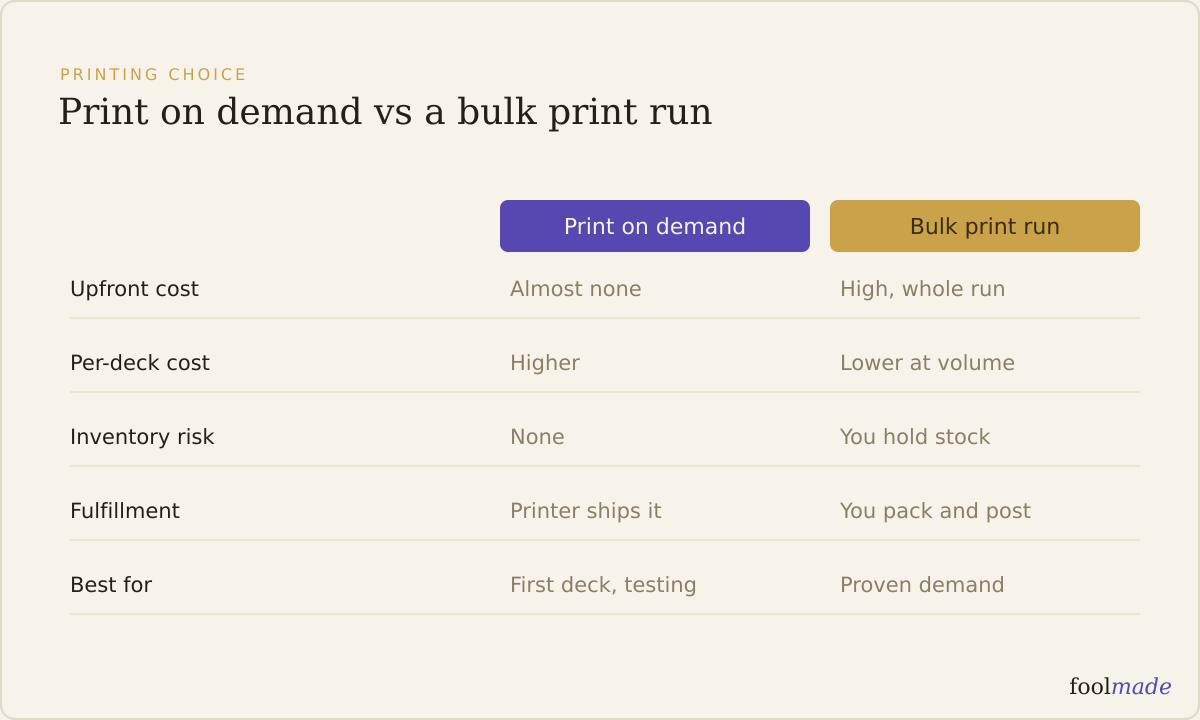
For a first deck, that tradeoff is usually worth it. You find out whether people will actually buy your art before you gamble a few thousand dollars on 500 boxes sitting in a closet.
How do you sell a tarot deck with no inventory?
You upload print-ready files to a print-on-demand platform, set up a public storefront, and set your price. The platform lists your deck. When someone buys, it prints that one deck and mails it to them directly. You get paid the difference between your list price and their per-unit cost.
Nothing is printed until it sells. There is no minimum order, no bulk invoice, no pallet of stock. Your money is never tied up in cardboard.
The two names that come up most for indie tarot are The Game Crafter and DriveThruCards. Both handle printing and fulfillment. Both let you keep a storefront that a buyer can order from without you touching a shipping label.
What does print on demand actually cost per deck?
More than a bulk run, and that is the whole catch. A bulk order of 500 to 1,000 decks drives your per-unit cost down because setup is spread across many copies. Print on demand pays that setup on every single deck, so each one costs more to make.
Here is the shape of it. Treat these as planning estimates and confirm live, because both platforms reprice and your card count and box choice move the number.
| Approach | Upfront cash | Per-deck cost (78 cards) | Your margin | Best for |
|---|---|---|---|---|
| Print on demand | $0 | roughly $12 to $22 | thinner | first deck, testing demand |
| Small bulk run (100-250) | ~$800-$2,500 | roughly $7 to $12 | medium | proven interest |
| Large bulk run (500-1,000) | ~$3,000-$8,000 | roughly $4 to $8 | fattest | a deck that already sells |
The pattern is simple. Print on demand trades margin for zero risk. Bulk trades cash and risk for margin. If you do not yet know that strangers will buy your deck, paying more per unit to avoid a closet full of unsold stock is a good deal.
For the full comparison, see print on demand vs a bulk run for your deck and how the numbers move in how to price your tarot deck.
Game Crafter vs DriveThruCards for zero inventory
Both are print-on-demand fulfillers. They differ in feel, box options, and how a buyer reaches your deck.
| Platform | Storefront | Box and stock options | Notes |
|---|---|---|---|
| The Game Crafter | Public shop page per game | Tuck boxes, larger card sizes, many components | Tabletop-first; strong for custom sizes |
| DriveThruCards | Marketplace listing | Tarot-sized cards, tuck boxes, print-on-demand focus | Big existing tarot and RPG audience |
The Game Crafter gives you a component-heavy catalog and more physical box choices, which matters if you want an unusual card size. DriveThruCards sits inside a marketplace that tarot and game buyers already browse, so a listing can get found on its own.
Neither will match a real print run for box variety. You get a limited menu: standard tarot dimensions, a couple of stocks, a tuck box. If you had your heart set on a rigid magnetic box with gold foil, print on demand is not where that lives yet. A full breakdown is in MakePlayingCards vs Game Crafter vs DriveThruCards.
What are the real limits of selling with no inventory?
Print on demand solves cash and risk. It does not solve everything, and pretending otherwise wastes your time.
- Thinner margin. You keep less per sale, so a deck priced for a marketplace can feel tight after fees.
- Fewer box and finish options. No gilded edges, limited stocks, standard boxes only. Premium touches wait for a bulk run.
- Less control over feel. You are locked to that platform's cardstock and finish. If a buyer wants 350gsm linen, you may not have it.
- Slower per-order shipping. Each deck prints when ordered, so a buyer waits days to weeks, not next-day.
- Platform-branded fulfillment. Packaging is the platform's, not a custom unboxing you designed.
None of these are dealbreakers for a first deck. They become reasons to graduate to a bulk run once you know the deck sells. Print on demand is the on-ramp, not the destination.
When should you switch from POD to a real print run?
Switch when demand is proven and the math flips. Once you are selling steadily and the per-deck savings of a bulk run would clearly beat the cash you tie up, order a batch. Many creators use print on demand to validate, then run a small batch of 100 to 250 as their first real inventory.
That path lets the sales fund the print run instead of your savings account. See small-batch self-publishing: 50 to 100 decks for the next step, and how to self-publish a tarot deck for where this fits in the whole journey.
A rough rule: stay on print on demand while you are guessing, move to bulk once you are counting. If you have sold 50 decks without trying hard, you have your answer.
Frequently asked questions
Can you sell a tarot deck with no upfront cost at all?
Yes. Print on demand platforms like The Game Crafter and DriveThruCards charge nothing to list. You only pay the per-deck print cost, and that comes out of a sale that already happened, so your out-of-pocket cost to start is zero.
Do Game Crafter and DriveThruCards ship the deck for me?
Yes. Both are fulfillers, not just printers. When a customer buys, the platform prints the deck and ships it directly to them. You never handle a card, a box, or a mailing label.
Is print on demand good for a first tarot deck?
It is often the best choice for a first deck. You test whether real buyers want your art without risking a few thousand dollars on stock that might not sell. The higher per-unit cost buys you certainty.
Why is print on demand more expensive per deck than a bulk run?
Bulk printing spreads fixed setup costs across hundreds of copies, so each deck is cheap. Print on demand pays that setup on every single deck, one at a time, so the per-unit price stays high no matter how many you sell.
Can I use print on demand and a bulk run for the same deck?
Yes, and many creators do. Start on print on demand to prove demand, then order a bulk batch once sales justify it. You can keep the print-on-demand listing running for overflow or international buyers.
The honest bottom line
If you have finished art and no budget for a print run, print on demand is how you start selling this month instead of next year. You trade margin for zero risk, which is exactly the right trade before you know your deck sells.
Once buyers are finding you, point them somewhere that shows every deck you make. A Foolmade creator profile gives you one link-in-bio page for your storefront, your work in progress, and your human-made pledge, so a first sale can turn into a following. Foolmade never prints or touches your art. That part stays entirely yours.