How to self-publish a tarot deck (the whole path)
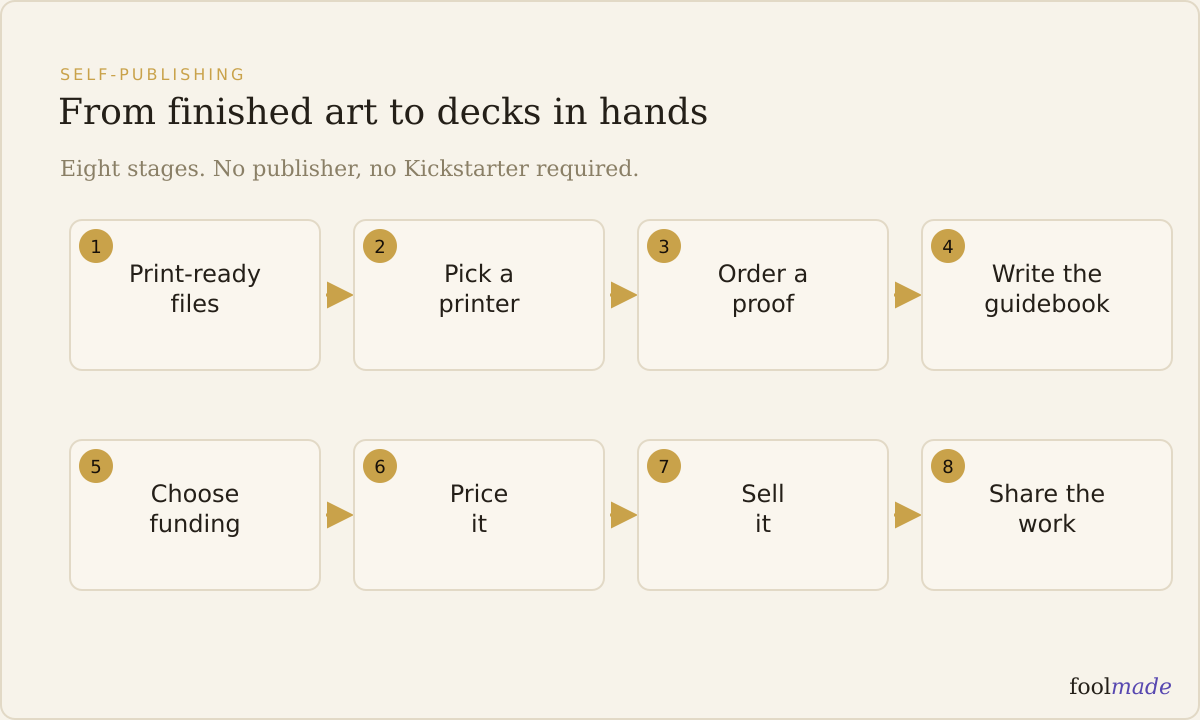
To self-publish a tarot deck, you take finished art through eight stages: prep print-ready files, pick a printer, order a proof, write the guidebook, decide how to fund it, price it from cost, sell it, and find buyers by sharing the work. You do not need Kickstarter, and you do not need a publisher.
The last card is done. It has been months, maybe years, and now there's a folder of finished paintings and a strange quiet where the drawing used to be. Nobody hands you a next step, and everything after the art is a fog. This is the map through it.
The stages to self-publish a tarot deck at a glance
Each stage has one decision that matters and one trap that catches most first-time makers. Read the stage you are stuck on.
| Stage | The key decision | The trap |
|---|---|---|
| Print-ready files | Match your printer's exact size, DPI, and bleed | Titles or borders too close to the trim get shaved off |
| Pick a printer | Small-run or bulk, based on quantity | Choosing before you know your numbers |
| Order a proof | Hold one physical deck before you print any quantity | Approving a full run off a screen preview |
| Write the guidebook | Your own voice, one entry per card | Treating it as an afterthought, not a project |
| Decide funding | Kickstarter, pre-orders, print-on-demand, or self-funded | Assuming crowdfunding is required |
| Price it | Price up from real cost plus fees | Undercharging and losing money per deck |
| Sell it | One venue you can manage, then add another | Launching to an audience of nobody |
| Find buyers | Share the work as you make it | Going quiet until launch day |
Get your files print-ready
A printer needs your art in a very specific form, and this is where most first decks stall. Standard tarot size is 2.75 by 4.75 inches, and your files need 300 DPI at that size or they print soft.
You also need bleed: a few extra millimeters of art past the trim line on every edge, because cutting machines drift and you don't want a white sliver on one card. And you need a card back, one design repeated across all 78.
Watch anything you placed near the edge (titles, borders, a signature) because the safe zone sits inside the trim. This stage is fiddly, and it is the biggest gap between "I painted a deck" and "I have a deck." Run a full check: here is what print-ready means.
Pick a printer that matches your run
There's no best printer, only the right one for how many decks you're making. For small runs, MakePlayingCards, DriveThruCards, and The Game Crafter let you order tens of decks, or even one, at a higher per-unit cost.
For hundreds or thousands, bulk printers bring the unit price down but ask for a bigger upfront order. They differ in small things too: stock weight, finish (linen versus smooth), custom tuck boxes, and template layout. Read each spec sheet before you build your files.
If you don't yet know your numbers, start with a small-run printer. You'll learn more from ten real decks in hand than from a spreadsheet. The full printer comparison for indie decks walks through who fits which run.
Order a proof before the full run
Before you print any quantity, order a single physical proof and hold it. Screens lie about color. Your deep midnight blue can come back flat gray, your gold can turn brown, the stock can feel like cereal box or like silk, and the cut can shave a hair off your borders.
Every one of these is invisible until the deck is in your hands. Approving a full run off a screen preview is how people end up with a closet of decks they're ashamed to sell.
A proof costs a little money and about a week of waiting. Skipping it can cost you the whole run, so here is why a proof matters and how to order one.
Write the guidebook
A deck without a guidebook feels unfinished, and this is a second creative project hiding behind the first. It doesn't need to be a scholarly tome. A short entry per card in your own voice, plus a page on how you read and what the deck is about, is plenty.
This is where your deck's personality lands. The same 78 archetypes feel different filtered through your words, and creators judge published decks harshly on guidebook quality.
Many makers underestimate how long it takes, so start while the art is still drying. A practical structure lives in how to write a tarot guidebook people keep.
Decide how to fund your self-published deck
Here's the belief worth correcting early: you do not need Kickstarter. Crowdfunding is common in this world and it works, but it is one option among several, not a rite of passage.
Kickstarter suits you if you want a bigger first run and cash before you print. Direct pre-orders on your own page do the same job with less spectacle. Print-on-demand lets you sell with zero inventory risk. A small self-funded batch (order twenty, sell twenty, reinvest) is the calmest start and owes nobody anything.
Pick the one that fits your nerve and your bank account, not the one that looks most impressive. Here is the case for publishing without Kickstarter.
Price it so it survives
Price from cost, not from vibes. Add up what one deck actually costs you: printing, the guidebook, the box, shipping to you, then the platform's cut and payment fees on the sale. That total is your floor.
Selling below it means you lose money on every deck. Most indie decks land in the thirties to fifties depending on run size and finish.
Undercharging is the more common mistake, and it punishes the makers who took the most care. Your time and years of painting are real costs too, even when they don't show up on the invoice. The math is in how to price your tarot deck.
Sell it where you can reach people
You have three broad venues and most makers use more than one. Etsy puts you in front of an existing tarot audience and handles checkout, at the cost of fees and a crowded search field.
Your own shop keeps the margin and the customer, but you bring your own traffic. In person (markets, fairs, metaphysical shops) is slower but converts well, because people who hold your deck tend to buy it.
Start with one venue you can manage and add another when the first is steady. The full breakdown of where to sell your tarot deck compares fees and reach.
Find buyers by sharing the work
This is the part that feels worst and matters most, especially if self-promotion makes you want to hide. You don't find an audience by launching to silence and buying ads. You find it by sharing the work as you make it: process shots, a single finished card, the messy in-progress ones, the story of why the deck exists.
The tarot community online loves watching a human deck come together, and they're wary of anything that smells machine-made. Your slow, visibly handmade process is the strongest thing you have.
By the time the deck is ready to sell, the people who followed the painting are the people who buy it. It takes months and it works. More on finding buyers for an indie deck.
Where Foolmade fits
The art is yours and stays yours. Foolmade never prints your cards and never generates a scrap of art. What it handles is the anxious stretch after the painting: checking files against real printer specs, showing your cards in clean mockups, planning cost and margin, and giving you one page that gathers followers while the deck comes together.
It's the difference between doing all of that across ten browser tabs and doing it in one place. Start a free Foolmade account when you're ready to move a finished deck through the stages above.
Frequently asked questions
How much does it cost to self-publish a tarot deck?
Plan for the proof, the print run, boxes, and shipping to you. Small-run per-deck costs are higher; bulk runs of 500 to 1000 cut the unit price sharply but need cash upfront. Get a live quote before you budget.
Do I need Kickstarter to self-publish a tarot deck?
No. Direct pre-orders, print-on-demand, and small self-funded batches all publish a deck without crowdfunding. Kickstarter is one path among several, useful mainly when you want a large first run funded before you print.
How long does it take to self-publish a deck after the art is done?
Budget a few months. Prepping files, ordering and reviewing a proof, and writing the guidebook each take real time, and the proof alone adds a week or two of shipping before you can approve a full run.
Can I self-publish a tarot deck without a publisher?
Yes. Self-publishing means you keep the rights, hire the printer directly, and sell it yourself. A publisher trades reach and upfront cost for royalties and control, but it is optional, not required.
What is the most common first-deck mistake?
Skipping the proof. Approving a full print run off a screen preview leads to color shifts and trim surprises you can't undo, and a closet of decks you don't want to sell.
- The Mitelli Tarocchinomaking a deck for one patron
- The Petit Etteillaprinting the meanings on the cards
- The Cartomancie of 1788the deck of one
- The Livre de Thot Etteillahe sold it by subscription in 1788