Do you need Kickstarter to publish a tarot deck? (no)
No, you do not need Kickstarter to publish a tarot deck. You can publish a tarot deck without Kickstarter through direct pre-orders on your own site, print-on-demand, a small self-funded batch, or BackerKit. Kickstarter is one option with a specific shape, and for most solo makers it is the wrong one.
Kickstarter has become the default answer for indie deck creators, to the point where a lot of first-timers assume it is the only road to 78 printed cards. It is not. You need a way to make the deck, a way to take money, and a way to reach the people who want it. Kickstarter bundles those three into one loud public event. You can keep them separate and quiet instead, which suits most artists better.
What does Kickstarter actually cost you?
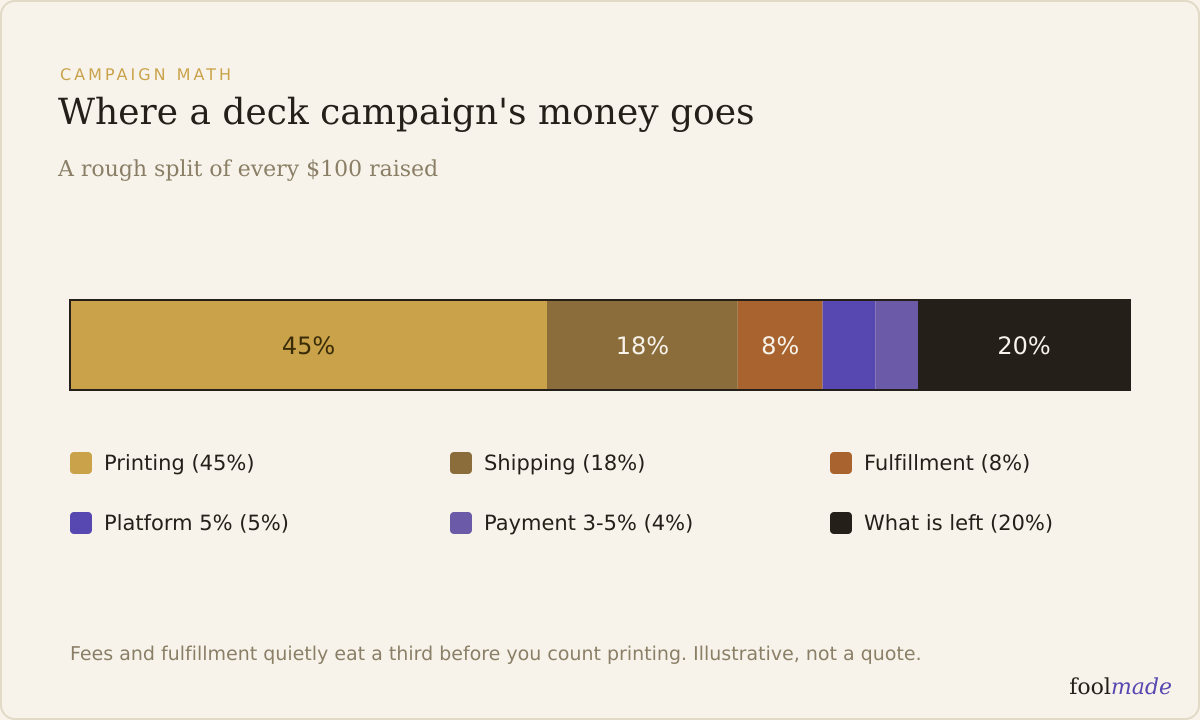
The fees are the easy part to name. Kickstarter takes about 5% of what you raise, and the payment processor takes roughly another 3% plus a per-pledge fee. Call it 8% off the top before you print a single card.
The costs that hurt more never show up on the pledge page. You owe fulfillment, which means packing and shipping every reward tier yourself, often months after the money arrived and after your print quote changed. You need an existing following to clear your goal, because a campaign is all-or-nothing: stall at 40% funded and every dollar goes back, leaving you with nothing.
And the pre-launch page, the one everyone tells you to build to collect interest, never hands you the backer emails. You cannot write to those people directly. You are renting the relationship from the platform.
There is also the temperament problem. A public funding bar counts up in front of an audience, and many deck artists are already gun-shy about self-promotion. If the thought of posting "we are 22% funded, please share" three times a week makes you want to abandon the project, that pressure is a real cost, not a flaw to push through.
How can you publish a tarot deck without Kickstarter?
None of these paths are theoretical. They are what creators on r/TarotDecks actually report using.
Direct pre-orders on your own site. You open a product page, take payment now, print once you have enough orders to cover the run, then ship. This is Kickstarter's core mechanic without the platform, the all-or-nothing cliff, or the 5% cut. You keep the customer list because it is your store. The catch: you supply the trust that Kickstarter's brand lends for free, so be clear about timelines and honest when they slip.
Print-on-demand through The Game Crafter or DriveThruCards. You upload files, set a price, and a copy is printed and shipped only when someone buys. Zero inventory, zero upfront print bill, no boxes stacked in a closet. Per-unit cost is higher and your margin per deck is thinner, and the stock and box options are whatever the printer offers rather than a custom spec. For a first deck, or one whose audience you are unsure of, this is the lowest-risk way to be genuinely for sale. See the guide to selling a deck with zero inventory.
A small self-funded batch. Order 50, 100, or 200 decks, pay for them, and sell directly until they run out. Someone printed a tiny duck tarot deck and just sold it themselves, no campaign. You carry the inventory risk and the upfront cash, but per-unit cost drops with volume and you control quality completely. Good when you already know a handful of people want it. See small-batch self-publishing for the numbers.
BackerKit. It runs crowdfunding campaigns like Kickstarter, and it is also strong as a pledge manager and pre-order store, during a campaign or on its own. Creators use it to keep selling after a Kickstarter ends and to collect add-ons and shipping details cleanly. It sits close to Kickstarter in spirit, so reach for it when you want campaign structure but more control over post-launch selling and your own data.
Which path fits which deck?
| Path | Upfront risk | Inventory | Best for |
|---|---|---|---|
| Direct pre-order | Low, you print after orders | Made to order | A following you can sell to directly |
| Print-on-demand (Game Crafter, DriveThru) | Almost none | Zero, printed per sale | First decks, testing demand |
| Small self-funded batch | High, you pay for the run | You hold it | Known demand, full quality control |
| BackerKit | Medium | Campaign or pre-order | Campaign structure, better post-launch data |
| Kickstarter | Medium, all-or-nothing | You fulfill after | Large run, real audience, capital need |
Fees and minimums shift, so confirm current terms and get a live print quote before you commit to any row. For the wider picture of getting art to print to sale, see how to self-publish a tarot deck.
When is Kickstarter actually the right call?
It earns its fees in a specific situation. You want a large first run, the kind where a custom foil box and gilded edges only pencil out at 1,000-plus units. You have an existing audience already warmed up, so hitting the goal is a formality rather than a gamble. And you genuinely need the capital upfront, because a run that size costs more than you can float yourself.
Hit all three and Kickstarter does exactly what it is good at: pooling committed buyers to fund a big print before you spend your own money. Miss one, especially the audience, and you take on the fees and the fulfillment burden without the thing that makes it work. If you are leaning this way, read the realistic guide to running a deck Kickstarter before you build the page.
How do you keep the followers you earn?
Every path shares one moment: the launch. People find your deck, get interested, then need a place to land where they can watch it come together and say "tell me when it is ready." A page that shows your progress and collects the people who want in is what turns quiet interest into orders on the day you open.
The part that matters most is keeping those followers as yours. An email list you own and can write to directly beats a pre-launch page that holds the relationship hostage. Own the audience, and you can publish on any path without a platform standing between you and your buyers.
Frequently asked questions
Is Kickstarter or a direct pre-order cheaper? A direct pre-order on your own site avoids Kickstarter's roughly 5% platform fee, though you still pay payment processing of about 3% either way. The real difference is trust and reach, which Kickstarter provides and your own store does not.
Can I sell a tarot deck with no money upfront? Yes. Print-on-demand through The Game Crafter or DriveThruCards prints and ships each copy only after a sale, so there is no upfront print bill and no inventory to carry.
Do I get backers' email addresses from Kickstarter? Not usable ones for direct marketing. Kickstarter and its pre-launch page do not hand you a mailing list you can email freely, which is why creators build their own list in parallel.
What is the least stressful way to publish a first deck? For most solo makers, print-on-demand or a small pre-order run. Both skip the public countdown and the all-or-nothing deadline that make crowdfunding hard on shy artists.
Is BackerKit a replacement for Kickstarter? It can run a campaign like Kickstarter, but many creators use it mainly as a pledge manager and pre-order store to keep selling after a campaign ends, with more control over their own data.
If you want a home for your deck that shows your progress and keeps your followers as yours on whichever path you choose, Foolmade gives every deck a page and a link in bio. It never prints or generates art. Your deck stays yours, and the launch just lands softer.