Running a Kickstarter for a tarot deck
A tarot deck Kickstarter guide has to start with the part nobody puts on the pledge page: funding is the easy half. A campaign covers printing, shipping, platform and payment fees, and margin, then leaves you owing every backer a boxed deck months later. Run one only when the audience already exists.
Creators who have done it describe it plainly. One line from r/TarotDecks sums up the whole thing: "I ran a successful Kickstarter earlier this year and was able to self-publish." Successful, and a long journey. Both are true at once.
Do you need an audience before you launch?
Yes, and it is the single biggest predictor of whether you fund. Kickstarter is not a discovery engine that finds strangers for you. It rewards creators who arrive with a warm crowd already waiting.
Most funded deck campaigns clear the bar in the first 48 hours, then coast. That early spike is your existing followers, your mailing list, and the people who watched your weekly card reveals for a year. Cold traffic from Kickstarter's own browse pages is a trickle on top.
Build the pre-launch page and collect "notify me" signups, but know the catch: Kickstarter keeps those emails. You cannot message that list directly off-platform. Grow a list you actually own in parallel, so you are not renting the relationship to your own backers. See building a mailing list for your deck launch for the mechanics.
How do you set a Kickstarter funding goal that covers everything?
Set the goal to your real all-in cost, not your printing invoice. If you only fund the print run, you fund yourself into a loss the day the money lands. The goal has to absorb print, shipping, fees, and a margin.
Work it as a stack. Take your printer quote for the run (say 500 decks). Add outbound shipping and mailers for every reward you promised. Add the platform and payment cut off the top. Add a buffer for the quote moving between campaign day and print day, because it will. Then add margin so you are paid for years of painting.
A rough model for 500 decks:
| Line item | Estimate (2026, confirm live) |
|---|---|
| Printing, 500 decks with box and guidebook | $6,000 to $9,000 |
| Kickstarter platform fee (~5%) | ~$750 on $15k raised |
| Payment processing (~3% + $0.20/pledge) | ~$650 on $15k raised |
| Shipping + mailers (500 units, mixed domestic/intl) | $3,500 to $6,500 |
| Failed-card and reprint buffer | $500 to $1,000 |
| Your margin (years of work) | whatever is left, plan for it |
Numbers are planning estimates. Get a live printer quote and a current shipping table before you set a single dollar figure. The full method is in how to set your Kickstarter funding goal.
What do Kickstarter and payment fees actually take?
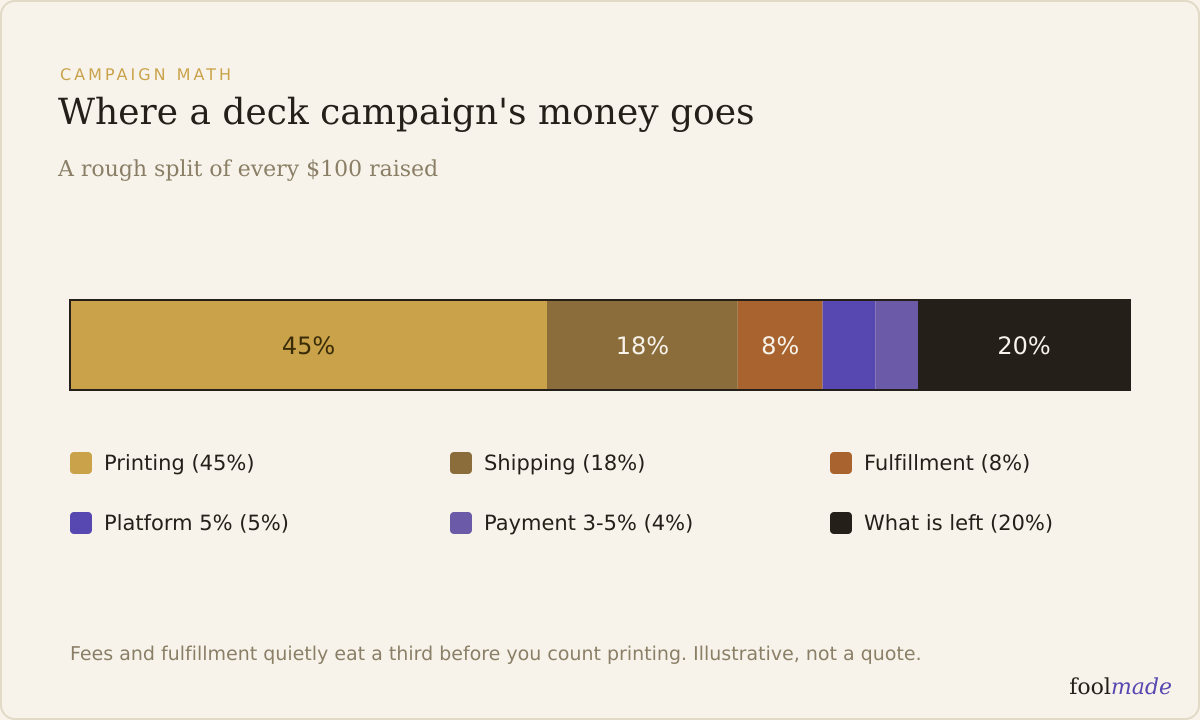
Plan on roughly 8% off the top before you buy any cardstock. Kickstarter's platform fee is about 5% of total funds raised, and payment processing runs another 3% to 5% plus a small per-pledge fee. On a $15,000 raise that is around $1,200 to $1,400 gone before printing.
That percentage is survivable when margins are healthy and brutal when they are thin. The mistake is treating "we hit our goal" as "we have that money." You do not. Read the goal number, subtract fees, subtract fulfillment, and the remainder is what actually prints and pays you.
The fee and cost stack, top to bottom:
| Layer | Typical bite | Notes |
|---|---|---|
| Kickstarter platform fee | ~5% of funds raised | Only charged if funded |
| Payment processing | ~3% to 5% + ~$0.20/pledge | Per-transaction, unavoidable |
| Printing | largest single cost | Scales down per unit at volume |
| Fulfillment (pick, pack, ship) | often rivals printing | The line first-timers forget |
| Pledge manager (optional) | small % if used | BackerKit and similar for add-ons |
For a fuller breakdown of the campaign spend, see what a tarot deck campaign actually costs to run.
How should you structure reward tiers?
Keep tiers few and clean. A single deck, a deck plus a small extra (print, pin, or signed guidebook), and one collector or wholesale tier is enough for most solo makers. Every extra tier is another thing you pack by hand.
Price the base deck at your real number, not a hopeful one. Indie tarot decks commonly land in the $35 to $60 range, and Kickstarter buyers expect the pledge to roughly match that plus shipping. Undercutting yourself to look generous just means you fulfill 500 orders at a loss.
Watch add-ons. A $5 enamel pin sounds easy until you are sourcing, storing, and separately packing 300 of them. Each add-on multiplies your fulfillment work. Offer only extras you can produce and ship without hating your own campaign by month three.
What happens after the campaign funds?
This is the long journey. Funding ends and the real work starts: final print files, a proof, the full run, then packing and shipping every single reward yourself. Money arrives up front; delivery is often three to six months later, sometimes more.
By fulfillment time your costs may have shifted. Printer prices move, and in 2026 tariffs and international shipping are a live worry for anyone using an overseas printer. Creators on r/TarotDecks say it directly: "I have NO idea how all the tariff nonsense is going to affect international costs." Build that uncertainty into your buffer, because backers already paid a fixed price and you eat the difference.
If self-fulfillment sounds like too much, a print-and-ship service can carry it. Game Crafter and similar fulfillers print on demand and ship for you, trading margin for your weekends back. Compare that path in fulfillment and shipping for a self-published deck.
When is timing and the all-or-nothing rule a problem?
Kickstarter is all-or-nothing. Miss your goal by a dollar and every pledge is refunded, you collect nothing, and your print quote and reveal momentum are spent. That is why an honest goal beats an ambitious one: a lower goal you clear pays out, a high goal you miss returns zero.
Timing compounds it. Set the goal too low to "just fund" and you cover printing but not shipping, which leaves you funding fulfillment out of pocket after the fact. Set it realistically and launch only when your audience is warm.
If the all-or-nothing math or the fulfillment load feels wrong for your deck, running a campaign is not required at all. Many creators publish through direct pre-orders or print-on-demand instead, covered in publishing a tarot deck without Kickstarter and the broader guide to self-publishing a tarot deck.
Frequently asked questions
How much does Kickstarter take from a tarot deck campaign?
About 5% platform fee plus 3% to 5% payment processing and a small per-pledge charge, so roughly 8% of funds raised before any printing cost.
What is a realistic funding goal for a tarot deck?
Whatever covers printing, shipping, fees, a reprint buffer, and your margin combined. For a 500-deck run that is often in the low-to-mid five figures. Base it on live quotes, never a guess.
How long does deck fulfillment take after a Kickstarter funds?
Commonly three to six months, sometimes longer once you factor final files, a proof, the print run, and hand-packing every reward. Tell backers a padded date up front.
Do I need an audience before launching a Kickstarter?
Yes. Most funded deck campaigns clear their goal in the first days on the strength of an existing following and mailing list. Cold Kickstarter traffic rarely funds a deck alone.
Is Kickstarter the only way to publish a tarot deck?
No. Direct pre-orders and print-on-demand let you publish without an all-or-nothing campaign, often with less risk for a first, small run.
A Kickstarter can genuinely fund a deck, but the campaign is the short, loud part and fulfillment is the long, quiet one. Before you set a goal, run the whole cost stack so your pledge price protects your margin. Foolmade's margin planner and creator link-in-bio help you sanity-check the numbers and point backers to every deck you make, without ever touching your art.