How to set your Kickstarter funding goal for a deck
Your Kickstarter funding goal for a tarot deck should cover the full cost of printing, shipping every reward, platform and payment fees, and a buffer, calculated at your realistic minimum backer count, not your dream one. Kickstarter is all-or-nothing, so the number you type is the smallest amount that still lets you deliver without paying out of pocket.
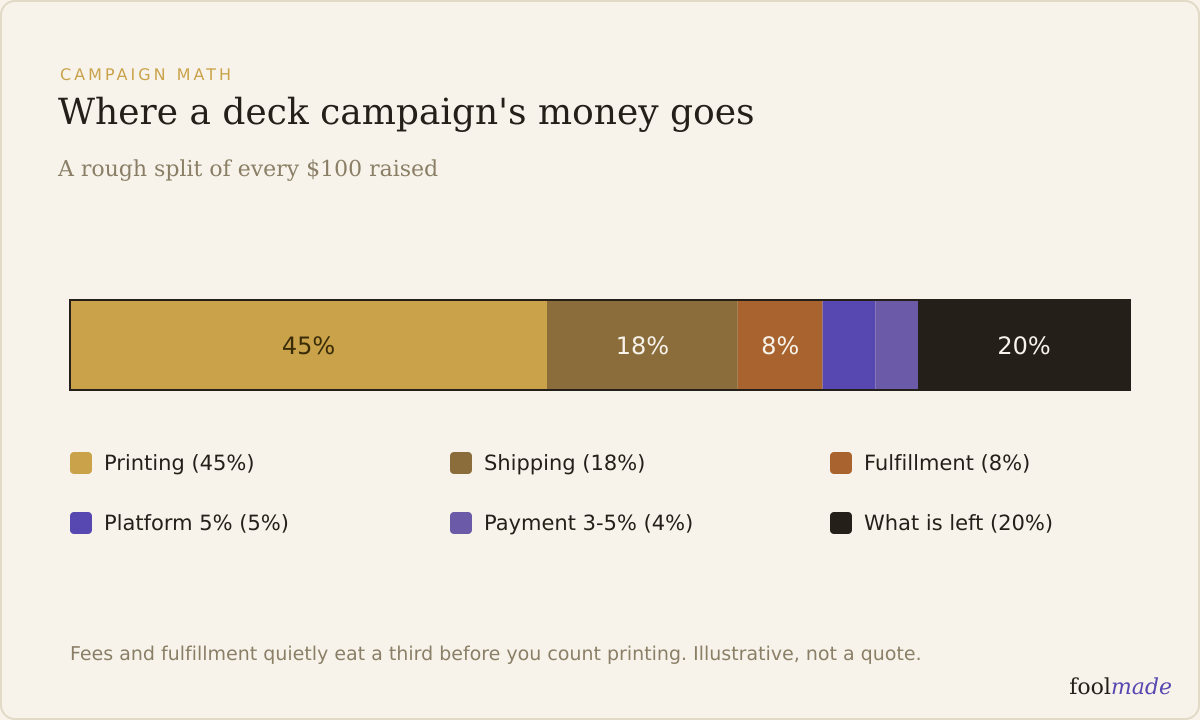
That last part trips up almost everyone. A funding goal is not your ambition. It is your break-even. Set it too high and a campaign that would have delivered fine fails at 90% funded and refunds everyone. Set it too low and you fund, then discover you owe more than you raised.
What should your Kickstarter funding goal cover?
Four things, every time, with nothing left implied.
- Printing. The full manufacturing cost of the decks you expect to make, including box, guidebook, and shrink wrap. Use your real printer quote, not a guess.
- Shipping and fulfillment. Packaging, postage, and any pick-pack fee for every reward you promised. This is the line people forget, and it is often larger than they think.
- Platform and payment fees. Kickstarter takes 5% of what you raise, and payment processing adds roughly 3% to 5% on top. So plan to lose about 8% to 10% of your total off the top.
- A buffer. Proof reprints, a stock shortfall, a shipping price hike, a bad exchange rate. Add 10% to 15% so one surprise does not eat your margin.
Cover all four at your minimum backer count and the goal is honest. Skip any one and the campaign can fund and still lose money.
Why does all-or-nothing change the math?
Kickstarter only charges backers if you hit your goal. Miss it by a dollar and you collect nothing, so the goal is a real floor, not a target you hope to clear.
That means you set it to your true break-even, not the amount you wish you would raise. If you need $6,000 to actually deliver, do not set $10,000 because it sounds better. You are far more likely to cross $6,000, and once you do, extra pledges are pure upside.
Everything above break-even that you dream about, deluxe boxes, gilded edges, a bigger print run, belongs in stretch goals, announced after you fund. Stretch goals are not part of the base number. The base goal is survival. Stretch goals are the reward for demand you did not have to bet on.
How do you calculate the goal? A worked example
Say you plan a first run of 300 decks and expect about 200 backers at the deck tier, keeping 100 as reserve and reward overage. Here is the build, using 2026 planning estimates. Pull live quotes before you launch, because printing and postage both move.
| Line | Calculation | Amount |
|---|---|---|
| Print 300 decks at $6 each | 300 x $6 | $1,800 |
| Guidebook and upgraded box | 300 x $2.50 | $750 |
| Proof deck plus rush shipping | one-time | $50 |
| Shipping rewards to 200 backers | 200 x $6 | $1,200 |
| Mailers and packing supplies | flat | $150 |
| Subtotal before fees | $3,950 | |
| Kickstarter 5% plus payment 5% | ~10% of raise | ~$440 |
| Buffer at ~12% | on subtotal | ~$475 |
| Funding goal | ~$4,900 |
Round to a clean $5,000 and you have a goal that survives printing, ships every reward, absorbs the platform's cut, and still has a cushion. Note the fee line is calculated on the amount you raise, not your costs, so if you expect to raise more, the fee grows with it. Build the fee off your goal figure, then confirm after the buffer.
For a fuller breakdown of where campaign money actually goes, what a tarot deck campaign actually costs walks every line item, including the ones that show up after you fund.
What is a realistic minimum backer count?
Base the goal on backers you can actually reach, not the whole world. Most indie tarot campaigns are small: a first-time creator with a modest following often lands somewhere between 50 and 300 backers, and the deck tier carries most of the funding.
Work backward. If your deck tier is $40 and you honestly believe you can bring 150 buyers, that is $6,000 in deck pledges before add-ons. Set your goal at or below the cost of serving that count, so you fund on the audience you have, not the audience you wish for. A campaign that funds at 150 backers and then climbs to 250 feels like a win. A campaign that needs 400 to survive usually does not get there.
Your tier price feeds directly off your unit cost. If you have not set it yet, how to price your tarot deck shows how to price so the pledge covers cost plus margin, and how much it costs to print a tarot deck gives the per-deck curve you plug into the printing line above.
What goes wrong when the goal is set badly?
Two failure modes, opposite directions, both common.
Goal too high. You set an aspirational number, the campaign builds real momentum, and it stalls at 85% funded on the last day. Everyone who pledged gets refunded and you deliver nothing, despite hundreds of people wanting the deck. The all-or-nothing floor punished ambition.
Goal too low. You set a number that only covers printing and forget shipping, or you leave out the 10% in fees. You fund, you celebrate, then the postage bill and Kickstarter's cut arrive and you are paying to fulfill your own successful campaign. This is the more painful one, because it hides until after you have promised delivery.
The fix for both is the same: build the goal from the four cost lines at your realistic backer count, then set it right at that break-even.
Frequently asked questions
Should my Kickstarter funding goal include Kickstarter's fees?
Yes. Kickstarter takes about 5% and payment processing another 3% to 5%, so roughly 8% to 10% of what you raise never reaches you. Build that percentage into the goal, or you fund on paper and come up short in the bank.
What is a realistic funding goal for a first tarot deck?
Many first indie decks set goals in the low four figures, often $3,000 to $8,000, matched to a first run of a few hundred decks and 50 to 300 backers. Your real number is whatever covers printing, shipping, fees, and a buffer at the backer count you can honestly reach.
Should stretch goals be part of my funding goal?
No. Your funding goal is your break-even to deliver the base deck. Stretch goals, like gilded edges or a deluxe box, are announced after you fund and are paid for by pledges above the goal, never baked into it.
What if I set my Kickstarter funding goal too low?
You can still fund and still lose money. If the goal only covers printing and skips shipping or fees, you will owe the difference out of pocket after the campaign closes. Always include every reward's shipping and the full fee cut.
Do I have to show my funding goal math to backers?
You do not have to, but a short, honest breakdown of where the money goes builds trust and tends to help conversion. Backers of handmade decks respond well to a creator who clearly is not padding the number.
Before you commit to a goal, Foolmade's margin planner lets you enter your print quote, shipping cost, and target backer count, then shows your break-even and the funding goal that covers it, fees and buffer included, so the number you type into Kickstarter is one you can actually deliver on. Foolmade never prints your deck or touches your art. It just makes the math visible before you go live. For the wider campaign picture, the realistic Kickstarter guide for a tarot deck covers fees, timing, and fulfillment end to end.