Cost to launch a tarot deck Kickstarter: real math
The real cost to launch a tarot deck Kickstarter is not the printing bill. Platform and payment fees take about 8 to 10 percent off the top, fulfillment and shipping can rival the print cost, and 2026 tariffs can blow a hole in a budget you already locked in. The sticker is the easy part.
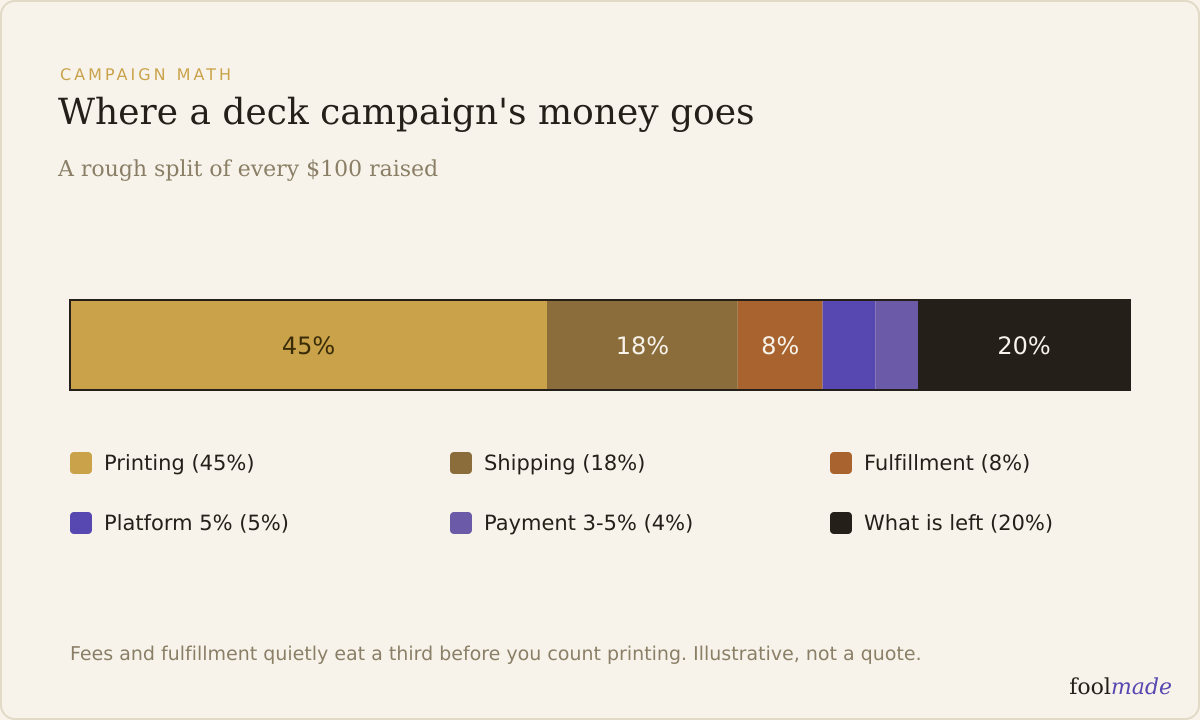
Most first-time creators price the cards, add a little cushion, and call it a budget. Then the fees, the mailers, and a customs bill they never saw coming eat the margin they thought they had. Here is where every dollar actually goes.
What does it cost to launch a tarot deck Kickstarter?
A campaign has four cost buckets, and creators reliably underweight three of them. The cards are bucket one, and it is the only one most people plan for.
The other three are platform and payment fees, fulfillment and shipping, and the pile of small stuff that adds up to real money. Kickstarter itself takes 5 percent of what you raise. The payment processor takes another 3 to 5 percent. So before a single deck is printed, roughly a tenth of your raised total is already spoken for.
Then there is the part that surprises people: getting a deck from the printer into a backer's hands often costs as much as printing it. Mailers, packing, the trip to the post office, and international postage stack up fast. Plan all four buckets or the campaign funds the art and quietly loses money on everything after it.
Where does the money actually go?
Here is a line-by-line breakdown for a 500-deck campaign, using 2026 planning estimates. Treat every figure as a starting point and confirm live quotes before you set a funding goal. The percentages are stable; the dollar amounts move with your deck.
| Cost line | Typical 2026 estimate | Notes |
|---|---|---|
| Kickstarter platform fee | ~5% of raised total | Flat, taken automatically |
| Payment processing | ~3 to 5% of raised total | Per-pledge, plus a small fixed fee each |
| Printing (cards) | $6 to $12 per deck at 500 | Offset run, standard 78 cards |
| Box and guidebook | $2 to $6 per deck | Rigid box and booklet add up |
| Sample and proof | $30 to $80 total | One-time, before the run |
| Fulfillment (pick, pack, post) | $3 to $8 per deck | Mailer, labor, drop-off |
| Shipping and 2026 tariffs | $4 to $15+ per deck | International and duties are the wild card |
| Packaging and mailers | $0.50 to $2 per deck | Rigid mailers cost more than they look |
| The 10 percent you forget | ~10% of everything | Reprints, refunds, lost parcels, fees on fees |
| Your time | Unpaid, but real | Months of admin, packing, and support |
The two lines that wreck budgets are shipping and the forgotten 10 percent. Everything above the fulfillment line is predictable. Everything below it depends on where your backers live and what the customs rules do between your budget and your ship date.
How much do Kickstarter and payment fees take?
Kickstarter charges a 5 percent platform fee on your total funds, plus payment processing of roughly 3 to 5 percent, with a small fixed fee on each pledge. Combined, budget about 8 to 10 percent of everything you raise going straight to fees before any product exists.
That matters for your funding goal. If you need $10,000 to actually deliver, raising exactly $10,000 leaves you about $1,000 short, because the fees came out first. You have to raise your goal to net your goal. The math for that lives in how to set your Kickstarter funding goal, and it is the single most common place first campaigns go wrong.
BackerKit and other pledge managers add their own cut if you use one. That is not free either. The Kickstarter guide for tarot decks walks through when a pledge manager earns its fee and when it just adds another slice off the top.
Why is shipping the line that blows up your margin?
Shipping is unpredictable in a way printing is not. A domestic deck in a rigid mailer might cost $5 to post. The same deck to Europe or Australia can cost $15 to $30, and backers hate paying it, so many creators quietly eat part of it.
Then there are duties. A creator on r/TarotDecks put the 2026 worry plainly: "I have NO idea how all the tariff nonsense is going to affect international costs." That is the honest position. If your cards are printed offshore, tariffs can add a real percentage to your landed cost, and the rules keep shifting between the day you budget and the day your pallet clears customs.
Two defenses help. Charge shipping separately as an add-on so it does not vanish into your pledge price, and build a tariff cushion of 10 to 20 percent if you print overseas. The full picture is in tariffs and international shipping for deck creators. Skipping this line is how a funded campaign still loses money.
What is the "10 percent you forget"?
It is the reprints, the refunds, the parcels that arrive crushed, and the fees charged on top of other fees. Every campaign has them, and almost no budget includes them.
A backer's deck goes missing in transit, so you ship a replacement at your cost. A dozen cards come back with a printing flaw, so you eat a partial reprint. A backer charges back a pledge. None of these are disasters on their own. Together they run about 10 percent of your total spend, so add a flat 10 percent contingency line and stop pretending your first campaign will be clean.
Your own time is the other uncounted cost. Answering backer messages, packing hundreds of boxes, and chasing a delayed printer is months of unpaid labor. It will not show on a spreadsheet, but it is the most expensive line of all.
Frequently asked questions
How much does it cost to launch a tarot deck Kickstarter?
Budget your printing plus roughly 8 to 10 percent in platform and payment fees, plus fulfillment and shipping that can match your print cost, plus a 10 percent contingency. For a 500-deck run, the fees and fulfillment alone often add $8 to $20 per deck on top of printing.
What percentage does Kickstarter take from a tarot deck campaign?
About 8 to 10 percent total. Kickstarter's platform fee is 5 percent of funds raised, and payment processing adds roughly 3 to 5 percent plus a small fixed fee per pledge. It comes out automatically before you see the money.
Do I have to pay tariffs on a Kickstarter deck printed overseas?
Often yes. Goods printed offshore can incur duties that add a real percentage to your landed cost, and 2026 rules keep changing. Ask your printer what applies and who pays, and add a 10 to 20 percent cushion if you print abroad.
Should backers pay shipping, or should I include it?
Charge shipping separately as an add-on in your pledge. Baking it into the price hides a cost that varies wildly by country, and international postage plus duties can quietly erase your margin if you absorb it.
How much should I add for costs I have not thought of?
Add a flat 10 percent contingency for reprints, refunds, lost parcels, and fees on fees. Every campaign hits some of these, and a budget without a cushion turns a funded project into a money-losing one.
Before you set a goal, run the whole thing through Foolmade's margin planner. Plug in your card count, box, fee percentages, shipping, and a tariff cushion, and see your true cost per deck and break-even before you launch. Foolmade never prints your deck or generates your art. It just makes sure the campaign that funds your work does not quietly lose money doing it.