How to price a tarot deck (what indie decks sell for)
How to price a tarot deck comes down to one rule: start from your all-in cost per deck, not the printing quote. Most indie decks sell for $35 to $65. Add up cards, guidebook, box, shipping, and selling fees, then mark up from there so the number actually pays you.
Mass-market decks sit lower, around $20 to $25, but those run on print orders of tens of thousands. You are making a few hundred by hand or through a small printer, so your price has to carry costs a factory spreads across a warehouse.
How much do indie tarot decks sell for?
The independent band is roughly $35 to $65 for a 78-card deck with a guidebook and a real box. Simple oracle decks with fewer cards can sit at $28 to $40. Premium decks with linen stock, gilded edges, and a rigid box push $60 to $80.
That band is not arbitrary. It is what buyers already pay artists on Etsy, at conventions, and through Kickstarter. Pricing far under it does not read as a bargain to this crowd. It reads as lower quality. Before you copy a competitor's number, learn what your own deck costs to make.
How to price a tarot deck from your all-in cost
Your floor is the total cost to produce and ship one deck, not the printing invoice alone. Printers quote a per-unit card cost, and new makers anchor on that single figure. It is the smallest part of the real stack.
Run every deck through this list before you price anything.
| Cost line | Typical range (per deck, 100-500 run) | Notes |
|---|---|---|
| Printed cards | $5 to $12 | Lower per unit as your run grows |
| Guidebook | $1.50 to $4 | Booklet or small perfect-bound book |
| Box / packaging | $1 to $3 | Rigid box costs more than a tuck box |
| Shipping to buyer | $4 to $8 domestic | Higher for international |
| Mailer / protective packing | $0.50 to $1.50 | Bubble mailer, filler, sticker |
| Platform + payment fees | ~10% of the sale, roughly $3 to $6 on a $45 deck | Applies to shipping too |
| Your time | Set a real hourly figure | Packing, listing, and support all count |
Add the material lines and you often land near $14 per deck before fees and before you pay yourself a cent. Printed at $9, plus a $2 guidebook, a $1.50 box, and shipping, the physical cost alone clears $14. That is the real floor, and it is roughly double the printing quote new makers fixate on. If you have not pinned your print number yet, how much does it cost to print a tarot deck has real per-deck figures by run size.
What fees eat into every sale?
Selling costs money on every channel, and the percentage bites harder than people expect because it applies to the full sale price, shipping included.
- Etsy: about 6.5% transaction fee, plus roughly 3% + $0.25 payment processing, plus a $0.20 listing fee. On a $45 sale that is close to $4.60. The full breakdown lives in selling tarot decks on Etsy.
- Kickstarter: 5% platform fee plus about 3% to 5% payment processing, so 8% to 10% of what you raise, before you have shipped a thing.
- Your own site: just payment processing, around 2.9% + $0.30. On a $45 sale that is about $1.60, which is why a direct storefront keeps the most per deck.
Budget 10% of the sale price for fees as a working number. It is close on Etsy and Kickstarter and leaves a small cushion on your own site. Shipping is part of that math whether you charge it separately or fold it into the price, so cost it out with how to ship a tarot deck before you set anything.
Cost-plus vs market pricing: a worked example
Two methods, and you want both pointing at the same answer.
Cost-plus works from the bottom. Take your all-in cost, decide a margin, and mark up. If a deck costs $14 all-in and you want to roughly triple it, you land around $42. Tripling sounds greedy until you remember that "cost" already ate your printing, box, guidebook, shipping, and fees, and the remainder still has to pay for your art, your months of work, the decks that arrive damaged, and the ones that never sell.
Market pricing works from the top. Look at what comparable indie decks actually charge. A 78-card deck with a real guidebook and a sturdy box sits in that $35 to $65 band, and buyers accept it. If your cost-plus number comes out at $28, the market is telling you there is room.
Use cost-plus to find your floor and market pricing to find your ceiling. Your price lives in the overlap.
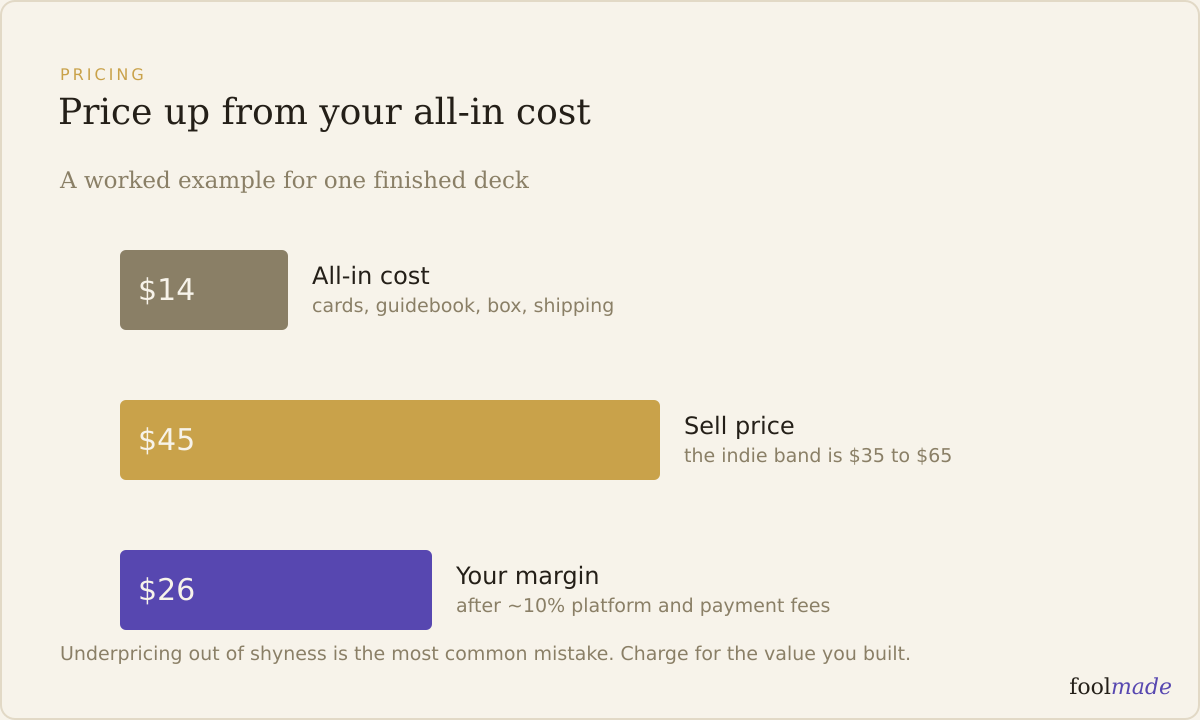
Worked example: a deck costs $14 all-in. Price it at $45. Fees take about 10%, roughly $4.50, so you clear about $40.50. Subtract the $14 cost and you keep about $26 per deck to pay for your art and your time. That $26 margin only exists because you started from the true cost, not the printing quote. Drop the price to $30 to feel safe and that same margin collapses to about $13.
Why does presentation let you charge more?
Card feel is not a detail buyers ignore. Linen-finish stock, gold or silver gilded edges, a rigid two-piece box, and a guidebook that reads like a real book each raise your cost by a few dollars and raise what people pay by far more. A deck that feels substantial in the hand justifies $55 where a flimsy one struggles at $30.
The audience for indie decks is also paying for a human. They want to know an artist drew every card, and they pay a premium for that story. The same crowd actively resents AI-generated decks and says so in reviews at any price. Made-by-hand is not a soft selling point here. It is the reason the premium exists, so put your process and your face in the listing.
Why pricing your tarot deck too low backfires
The most common mistake in this community is pricing out of shyness. Makers see their own deck, feel unproven, and set $25 to seem fair. That price often does not clear the all-in cost once fees land, so every sale loses money while creating packing work.
Underpricing also signals low quality to the exact buyers who happily pay $50 for a deck with a story and a good box. Price for the value you built, not for how new you feel. If your deck is beautiful, well made, and human, the $35 to $65 band is where it belongs, and where you sell it is part of the plan too. Weigh a marketplace against a direct shop in where to sell your tarot deck before you commit to a channel.
Frequently asked questions
How much should I sell my tarot deck for?
Most indie tarot decks sell for $35 to $65. Set your floor from your all-in cost per deck, including fees and shipping, then price into that band. If your cost-plus number lands under it, the market is giving you room to charge more.
How do I calculate my cost per deck?
Add printed cards, guidebook, box, mailer, shipping, and about 10% for platform and payment fees, then add a real value for your packing time. A deck that prints at $9 usually lands near $14 all-in before you pay yourself.
Should I include shipping in the price or charge it separately?
Either works, but the cost lives inside your math regardless. Buyers convert better on a single "free shipping" number, so many makers bake the shipping into a $45 sticker instead of quoting $39 plus $6 at checkout.
Is it bad to price my deck higher than competitors?
Not if the deck earns it. Linen stock, gilded edges, a rigid box, and a hand-drawn story justify the top of the band. Underpricing to feel safe loses money and undercuts every other indie maker doing the same work.
Foolmade's margin planner shows your true cost per deck and your break-even at any price, so you can see exactly what a $45 or $55 deck leaves you before you commit. We never print or generate art. We just do the math that keeps your work sustainable.
- The Petit Etteillathe cheapest possible package
- The Livre de Thot Etteillapricing a deck nobody has seen yet
- The Grand Etteillaa century in print
- The Practical Astrology Tarota dollar fifty, with the book