Sell a Tarot Deck on Etsy: Fees and Reality
To sell a tarot deck on Etsy you'll pay roughly 10% of each sale in fees: a 6.5% transaction fee, about 3% plus $0.25 for payment processing, and a $0.20 listing fee per item. The audience is already there, but a crowded tarot category means getting found is the real work.
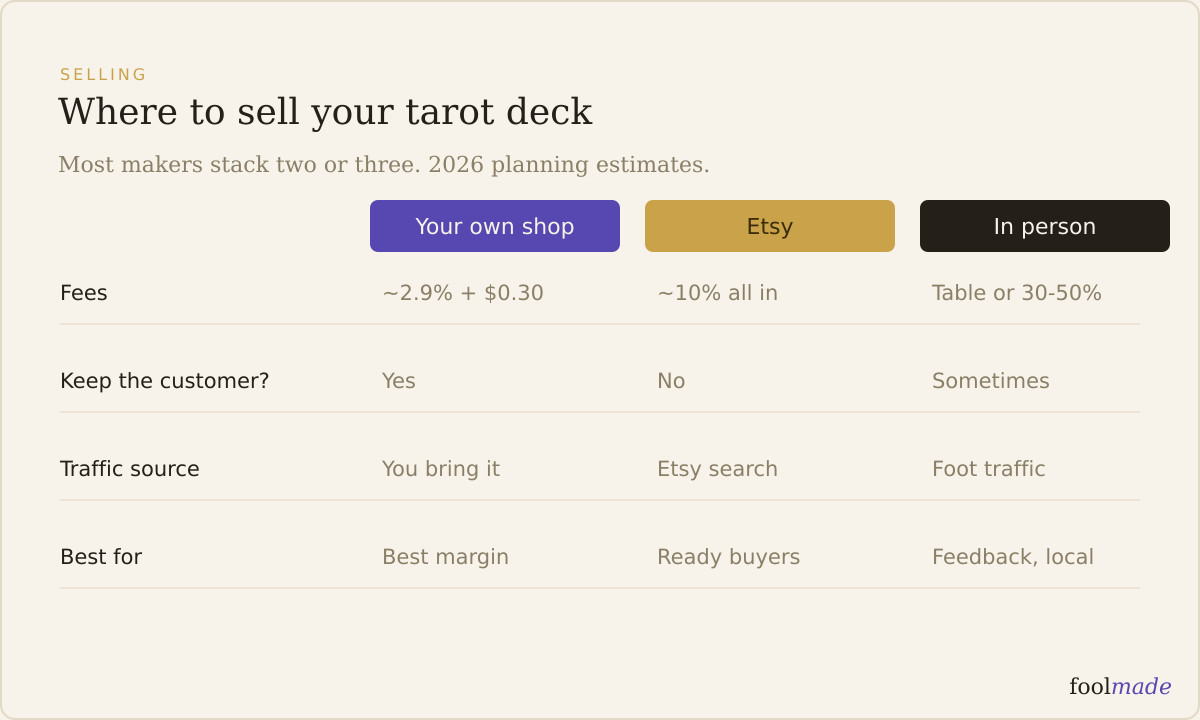
Etsy is where most indie deck makers list first, and for good reason. Buyers searching "indie tarot deck" already want what you made. You don't have to explain what a self-published deck is or why it costs $40. That warm audience is the whole value of the platform.
The catch is that everyone else knows this too. Tarot is one of the most saturated categories on Etsy, and a brand-new listing with zero sales history starts near the bottom. Below is what selling there actually costs and what it takes to get seen.
How much does Etsy take per sale?
Etsy takes about 10% of a typical sale once you stack the mandatory fees together. As of 2026 the three you can't avoid are the transaction fee, payment processing, and the per-listing fee. None of them are optional if you want to sell.
The transaction fee is 6.5% of the order total, and that total includes shipping and gift wrap, not just the deck price. Payment processing (Etsy Payments) adds about 3% plus $0.25 per order for US sellers. The listing fee is a flat $0.20 to publish each item, charged again every time it sells or after four months.
Confirm the current rates on Etsy's own fees page before you price anything, since Etsy adjusts them and payment rates vary by country.
Here's the stack on a $40 deck with $5 shipping, so a $45 order total:
| Fee | Rate (US, 2026) | On a $45 order |
|---|---|---|
| Listing fee | $0.20 flat | $0.20 |
| Transaction fee | 6.5% of order total | $2.93 |
| Payment processing | ~3% + $0.25 | $1.60 |
| Total Etsy fees | ~10% of the sale | ~$4.73 |
So on a $40 deck you keep roughly $35 before your printing cost, box, and the shipping label itself. If your deck cost $12 a unit to print, your actual profit is closer to $23. That math is why pricing has to come before you list, not after.
There are optional fees on top: Etsy Ads (you set a daily budget) and Offsite Ads, which charge 15% on a sale Etsy sourced through external advertising and become mandatory once you pass $10,000 in sales. Budget for those separately.
What listing photos sell a tarot deck?
Photos do more selling than your description ever will, and two shots matter most: the fan shot and the box shot. Buyers can't touch the cards, so the images have to carry the whole feel of the deck.
The fan shot is the hero. Spread the deck in an arc so a buyer can see the art style across ten or twelve cards at once, not just one. Shoot it flat, in daylight near a window, on a plain surface. This is the image that stops the scroll in search results.
The box shot proves it's a real, finished product. A deck photographed in its box and guidebook reads as professional and printed, not a stack of home prints. Include one card standing upright next to the box so the scale is obvious.
Fill the rest of your ten photo slots with the card backs, a few individual card close-ups, the guidebook interior, and one in-hand shot for size. Get the lighting and framing right once and it pays off across every listing. The guide to photographing your tarot deck for listings walks through the fan shot on a phone step by step.
Why is it so hard to get found on Etsy?
Etsy search rewards listings that already sell, which is a hard wall for a brand-new deck. Relevance and recent sales both feed the ranking, so a listing with no history sits far below established shops no matter how good the art is.
You climb it two ways. First, tags and titles: use all 13 tags and write a title that front-loads what people actually type, like "Indie Tarot Deck Hand Painted 78 Card." Skip vague words like "mystical" that everyone uses. Second, early momentum: your first handful of sales, from friends, your mailing list, or a small ad budget, teaches Etsy the listing converts.
You can pay to skip the line with Etsy Ads, but that eats into the thin margin the fee stack already left you. Many makers run a small ad budget only for a launch push, then taper off once organic sales start.
The honest read: Etsy gives you a crowd but not a spotlight. Ranking in the tarot category takes months, which is why most makers don't rely on Etsy search alone.
What about shipping a tarot deck?
A boxed tarot deck usually ships as a small parcel weighing under a pound, so US domestic postage runs roughly $4 to $6 with tracking. Decide early whether you fold that into the price or charge it separately, because the transaction fee applies to shipping either way.
Free shipping tends to convert better, and Etsy nudges you toward it in search, so many makers raise the deck price to absorb it. Pack in a rigid mailer or a small box so corners don't crush in transit. International shipping is where it gets expensive and slow, and 2026 tariff changes have made cross-border costs genuinely unpredictable, so quote those separately and consider limiting the countries you ship to at launch.
Does Etsy own the customer?
Yes, and this is the quiet cost that outlasts the fees. Etsy gives you an order, not an email address you're allowed to market to. You can't build a mailing list off Etsy buyers or pull them toward your own site later.
That matters most for your second deck. If your whole audience lives inside Etsy, every launch starts cold in the same crowded search. Makers who build a direct channel alongside Etsy get to email past buyers on launch day instead of hoping the algorithm notices them.
The common move is to use Etsy for discovery and slowly steer repeat buyers somewhere you own. A comparison of selling direct versus on a marketplace lays out that trade-off, and where to sell your tarot deck covers the full menu of channels.
Frequently asked questions
How much does it cost to sell a tarot deck on Etsy?
Plan on losing about 10% of each sale to Etsy's mandatory fees: 6.5% transaction, roughly 3% plus $0.25 payment processing, and a $0.20 listing fee. On a $40 deck that's around $4.70 before your printing cost and shipping.
Is Etsy or my own website better for selling decks?
Etsy is better for getting discovered, since the buyers are already there. Your own site keeps more margin and the customer relationship. Most makers do both: Etsy for reach, a direct shop for repeat buyers.
How many photos should an Etsy tarot listing have?
Use all ten slots. Lead with a fan shot showing the art range and a box shot proving it's finished, then add card backs, close-ups, the guidebook, and an in-hand size shot.
Do I need Etsy Ads to sell my deck?
No, but a new listing ranks poorly at first, so a small ad budget can help a launch. Don't rely on ads long term, because they cut into the margin the fee stack already thinned out.
How should I price a tarot deck for Etsy?
Work out your printing cost per unit, add the ~10% Etsy takes, then add your margin on top. Pricing before you list keeps the fees from eating your profit. See the tarot deck pricing guide for the full method.
Etsy is a good first storefront and a bad only-plan. Use it to reach buyers who are already searching, price with the fee stack in mind, and start steering repeat customers toward something you own. When you're ready to point them there, Foolmade gives your deck a link-in-bio page that respects the community and never touches your art.