Sell your tarot deck on your own website vs a marketplace
To sell your tarot deck on your own website, you set up a simple shop (Shopify, Payhip, or a one-page checkout), pay only the payment fee of about 2.9% plus $0.30 per sale, and keep the rest of the margin plus the buyer's email. A marketplace like Etsy hands you traffic but takes roughly 10% and owns the customer. That is the whole tradeoff.
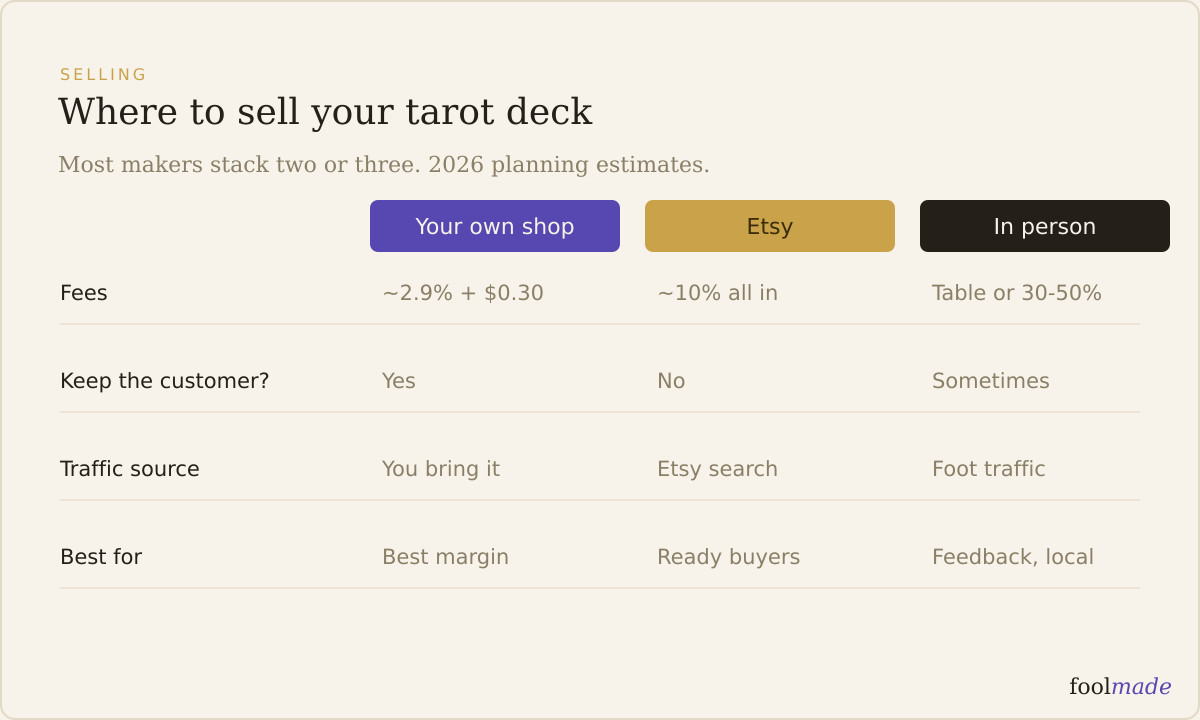
Should you sell on your own website or a marketplace?
Both can work, and plenty of makers run both at once. The split comes down to one question: do you need someone else to bring the buyers, or can you bring them yourself?
A marketplace is a mall. Etsy already has millions of shoppers typing "tarot deck" into its search bar, so a slice of that traffic can find you with almost no effort on your part. You pay for that reach with fees and, more importantly, with the customer relationship. The buyer is Etsy's, not yours.
Your own shop is a storefront on a quiet street. Nobody wanders past it. Every visitor arrives because you sent them, from an Instagram post, a Reddit reply, a mailing list, or a link in your bio. In exchange, you keep nearly all the money and every email address.
What does it cost to sell on your own website?
Selling direct is cheaper per sale than most makers expect, because you are only paying the payment processor, not a middleman.
On a $45 deck sold through your own site with Stripe or PayPal, the payment fee runs about 2.9% plus $0.30, which is roughly $1.60. You keep the remaining $43.40 before your production and shipping costs. There is no listing fee and no commission on top.
Platforms bundle the checkout for you at low or no monthly cost:
- Payhip or Gumroad: no monthly fee, they add a small cut on the free tier, and you can start in an afternoon.
- Shopify: about $39 a month as of 2026 for a full store, worth it once you sell steadily.
- A single Stripe or "buy" link: near zero overhead if you just need one product and a checkout.
Confirm current pricing and fees with each provider before you commit, since these change.
Own shop vs marketplace: the real comparison
Here is how the two paths stack up for a self-published deck. Figures are 2026 planning estimates; check live rates before you decide.
| Factor | Your own website | Marketplace (Etsy) |
|---|---|---|
| Fee per sale | ~2.9% + $0.30 payment only | ~6.5% + payment + $0.20 listing, near 10% all in |
| Who owns the customer | You (name and email) | The marketplace |
| Email list | Yours to keep and reuse | You rarely get the address |
| Built-in traffic | None, you drive it all | Real, buyers already search there |
| Effort to launch | Higher: build, drive traffic | Lower: list and go |
| Branding control | Full, your look and story | Limited to their template |
| Monthly cost | $0 to ~$39 | $0 base, fees per sale |
A marketplace wins on effort and cold traffic. Your own shop wins on margin, branding, and the one thing that compounds over years: the customer list.
Why does owning the customer list matter so much?
Because your second deck is where the real money is, and a list is the only asset that carries buyers from one launch to the next.
When you sell on Etsy, the buyer checks out and vanishes. Etsy has their email, not you. Two years later, when your next deck is ready, you have no way to reach the people who already loved the first one. You start your marketing from zero again and pay Etsy to reintroduce you to your own customers.
When you sell direct, that same buyer's email lands in your list. That list is a warm audience who already paid you once. A single email to a few hundred past buyers can fund a print run before you spend a cent on ads. This is why direct sales matter far more for a maker planning a body of work than for someone selling one deck and stopping.
If you take one thing from this: start collecting emails from day one, even while you sell on a marketplace. The list is yours no matter where the sale happens.
Can you run both a shop and a marketplace?
Yes, and it is often the smartest setup. Use each channel for what it does best instead of forcing a single choice.
A common pattern: list on Etsy to catch shoppers already hunting for decks, and run your own checkout for everyone you bring in yourself through social posts and your mailing list. The marketplace becomes a discovery channel, and your site becomes the place where you keep the full margin and the relationship.
The one rule that ties it together: point every link you control at your own shop. Your Instagram bio, your Reddit signature, your newsletter, all of it should send people to the checkout where you keep the customer, not to the marketplace where you rent them. For a fuller map of every channel, see where to sell your tarot deck, and for the marketplace side specifically, selling tarot decks on Etsy covers the fee math in detail.
How do the two paths change your pricing?
The channel eats a fixed slice of every sale, so your price has to cover the worst case, not the best one.
If you price a deck to net what you need after Etsy's roughly 10%, you automatically clear more on your own site, where you only lose the payment fee. Some makers price for the marketplace cut and treat the extra margin on direct sales as the reward for driving their own traffic. Whatever you choose, run the number against your all-in cost per deck first, which the tarot deck pricing guide walks through line by line.
Frequently asked questions
Is it worth selling a tarot deck on your own website?
It is worth it once you can drive your own traffic and plan to release more than one deck. You keep close to the full margin and, more importantly, the buyer's email for your next launch. If you have no audience yet and no way to reach buyers, a marketplace will make more early sales while you build one.
How much does Etsy take compared to my own site?
Etsy takes roughly 10% all in once you add the 6.5% transaction fee, payment processing, and the $0.20 listing fee. Your own site through Stripe or PayPal costs only the payment fee, about 2.9% plus $0.30. On a $45 deck that is close to $4.50 to Etsy versus about $1.60 direct.
What is the cheapest way to sell a deck from my own site?
A no-monthly-fee tool like Payhip or Gumroad, or a single Stripe payment link, lets you sell with zero fixed cost and only a small cut per sale. Move up to Shopify at about $39 a month once your volume makes the monthly fee worth the fuller store.
Do I really get customer emails when I sell direct?
Yes. When a buyer checks out on your own shop, you collect their email as part of the order and can add them to your list with their consent. That is the core advantage over a marketplace, where the platform keeps the customer relationship and you rarely see the address.
The honest bottom line
If you are selling one deck and want the fastest first sales, a marketplace is the lower-effort start. If you are building a practice, decks plural, over years, sell direct so you keep the margin and the list that funds the next one. Most makers land on both, with every link they control pointing home.
Foolmade gives you one link in bio that shows all your decks and sends buyers to wherever you sell, so the traffic you work for lands on a page you own. We never print or generate art. Your work stays yours, and so do your customers.