Where to sell your tarot deck: Etsy, shop, in person
The best places to sell your tarot deck are Etsy, your own online shop, in-person markets, and print-on-demand storefronts. Most makers use more than one: your own shop keeps the most margin, Etsy brings ready buyers, and markets convert because people can hold the cards.
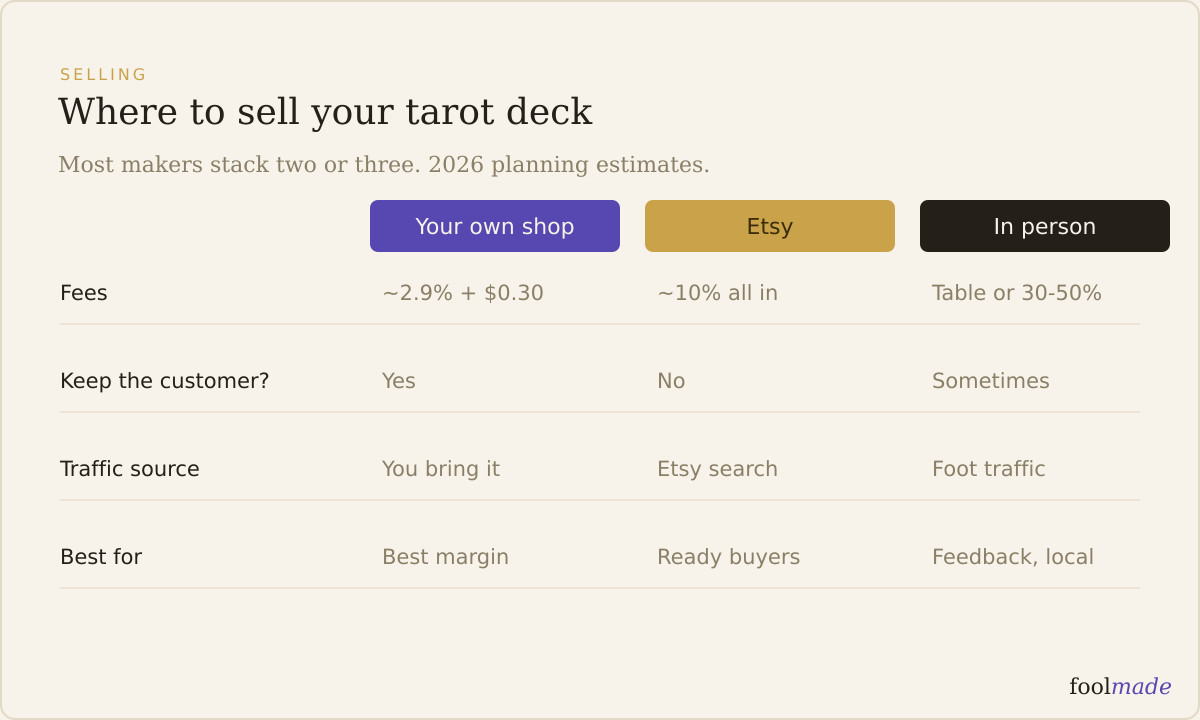
There's no single right channel. Each one trades something away, and the makers who do well stack a few. Here's what each costs you and who it fits.
Where should you sell your tarot deck first?
If you have no audience yet, start on Etsy or a print-on-demand storefront, because both come with buyers attached. If you already have a following, even a small one, open your own shop first and keep the margin.
The order matters less than the math. Before you pick a channel, be clear on how to price your tarot deck so you know what each fee tier actually leaves you. A channel that "brings buyers" is only worth it if the number you keep after fees still pays for the deck.
Most makers land on two or three channels within their first year. Pick one to start, add the next when the first is running.
Should you sell on Etsy or your own shop?
Etsy's whole pitch is the audience. People searching "indie tarot deck" on Etsy are ready to spend, and you don't have to teach them what an indie deck is. That's real value for a first release.
The cost is twofold. Fees run around 6.5% transaction plus payment processing plus a $0.20 listing fee, so figure roughly 10% of each sale gone before shipping. The bigger problem is search: tarot is crowded, and a new listing with no sales history sits far down the results. Etsy also owns the customer, so you get an order, not an email list. The full breakdown lives in selling tarot decks on Etsy.
Your own shop flips the trade. Payment processing is about 2.9% plus $0.30 per order and that's basically it. On a $40 deck that's keeping around $38.70 versus roughly $36 on Etsy. You also keep the customer list, so your second deck launches to a warm audience.
The catch is blunt: nobody finds your shop on its own. You bring every visitor. If you have any audience, your own shop makes the most per sale. If you have none, a beautiful shop with no traffic sells nothing. The trade-offs are laid out in selling direct versus a marketplace.
Is selling your tarot deck in person worth it?
Markets, craft fairs, metaphysical shops, and conventions convert better than anything online, for one reason: people hold the deck. They feel the card stock, riffle the edges, see the real color. That tactile moment closes sales a screen never will, and you get honest feedback in real time.
It's slow and it's work. You pay for a table, haul stock, and stand there for hours, and a rainy Saturday can flop. Consignment through a shop takes a cut, commonly 30 to 50%, and pays you after the sale, but it puts your deck in front of people who'd never find you online and lends the shop's trust to your work.
In person suits makers who like talking to buyers and want local word of mouth. It rarely scales, but the conversion and the relationships are hard to beat.
Does print on demand make sense?
The Game Crafter and DriveThruCards let you list a deck in their storefront and print each copy only when someone orders. No print run, no boxes in your closet, no upfront cash at risk. For a first deck or a niche oracle that might sell slowly, that removed risk is the whole appeal.
You pay for it in margin. Per-unit print cost is higher than a bulk run, so profit per deck is thinner, and you're limited to that platform's stock, box, and finish. Discovery on these marketplaces is modest too. It's a low-risk way to exist and to test whether demand is real before you commit cash to a full run.
How do the channels compare?
Figures are 2026 planning estimates. Confirm current fees on each platform before you price.
| Channel | Fees | Keep the customer? | Traffic source | Best for |
|---|---|---|---|---|
| Etsy | ~6.5% + payment + $0.20/listing (~10%) | No | Etsy search and shoppers | First release, want ready buyers |
| Your own shop | ~2.9% + $0.30 payment only | Yes | You bring it | Any audience, best margin |
| In person | Table fee, or 30 to 50% consignment | Sometimes | Foot traffic | Local sales, feedback, word of mouth |
| Print on demand | Built into higher unit cost | No | Marketplace and you | Zero-risk first deck, testing demand |
Read the table as a stack, not a menu. A common shape: your own shop as the home base where margin is best, an Etsy listing to catch searchers who'd never find your site, a table at a couple of markets a year for conversion, and a POD storefront so international buyers can order without you shipping worldwide. Each channel covers a gap the others leave open.
Whichever mix you run, the cost of getting the deck to the buyer stays in your math. Work out how to ship a tarot deck before you set prices, because postage quietly eats margin on every channel.
Can you sell your tarot deck in a community like r/TarotDecks?
Not with a link. Communities like r/TarotDecks ban shop links, social plugs, and reading offers. Drop your Etsy link in a reading thread and you'll get removed, and you'll read as a spammer to exactly the people most likely to buy.
The move those spaces reward is showing the work. Post progress. Share a finished card, the back design, a shot of the printed proof, the story behind a suit. People follow the maker, not the pitch, and when the deck is ready they already care. Selling here is a slow trust game, not a link drop.
That's the gap a link-in-bio profile fills. It gives people one respectful place to find and follow your work: a proper page for the deck and a single clean link you can point to that fits how these communities operate. You share the work, someone wants more, and one link leads them to it without breaking any room's rules. Foolmade never prints your cards or generates your art. It's the front door for the deck you already made.
Frequently asked questions
Where is the best place to sell an indie tarot deck?
Your own shop keeps the most money per sale, but it needs traffic you bring yourself. Etsy is the best starting point if you have no audience yet, because the buyers are already searching. Most makers use both.
How much does Etsy take from a tarot deck sale?
Roughly 10% all in: about 6.5% transaction fee, payment processing of around 3% plus $0.25, and a $0.20 listing fee. Fees apply to shipping too, so include postage when you price.
Can I sell my tarot deck without holding inventory?
Yes. Print-on-demand storefronts like The Game Crafter and DriveThruCards print and ship each deck only when it sells, so there's no print run or upfront cost. The trade is a thinner margin and fewer stock and finish options.
Do I need my own website to sell a tarot deck?
No. Plenty of makers sell only on Etsy or through markets. A website earns you the best margin and the customer list, so it pays off once you have an audience worth sending there, but it isn't required for a first deck.
Is it against the rules to sell in tarot subreddits?
Direct selling usually is. Most deck communities ban shop links and reading offers but welcome work-in-progress posts. Build interest by sharing your process, and keep a single link in your bio for anyone who asks where to buy.
Pick the channel that matches where you are right now, add the next one when you're ready, and let the work do the selling.