How to write a tarot guidebook people keep
To write a tarot guidebook readers keep, give every one of the 78 cards the same short template: name, keyword, upright meaning, a reversed meaning if you use them, and one line of your own intent. Aim for 80 to 160 words per card, and write in passes so the last 20 entries match the first.
The art gets people to buy. The guidebook decides whether they keep the deck on the desk or shelve it in a drawer.
Scroll any deck review thread on r/TarotDecks and you find the same pattern: gorgeous cards, then a booklet that reads thin or written for someone who already knows tarot cold. One reviewer called a beautiful deck's guidebook not as clear or inclusive as they wanted, and that single gap made the whole thing feel unfinished. The words let the paint down.
Why does the guidebook decide if buyers keep your deck?
A tarot deck ships as two halves. The images are the interface. The guidebook is the documentation and the voice of its maker.
When a new reader pulls the Five of Cups and feels nothing, the booklet is the only bridge between your intent and their table. If that bridge is a recycled Rider-Waite paraphrase, you have handed them a generic deck wearing your art.
Buyers grade the guidebook against the art, and a strong deck raises the bar the words have to clear. Beginners feel a thin booklet fastest. Experienced readers notice a different failure: a keyword-only entry never says why your Tower looks the way it does, so your choices read as decoration instead of meaning.
How do you write a tarot guidebook entry?
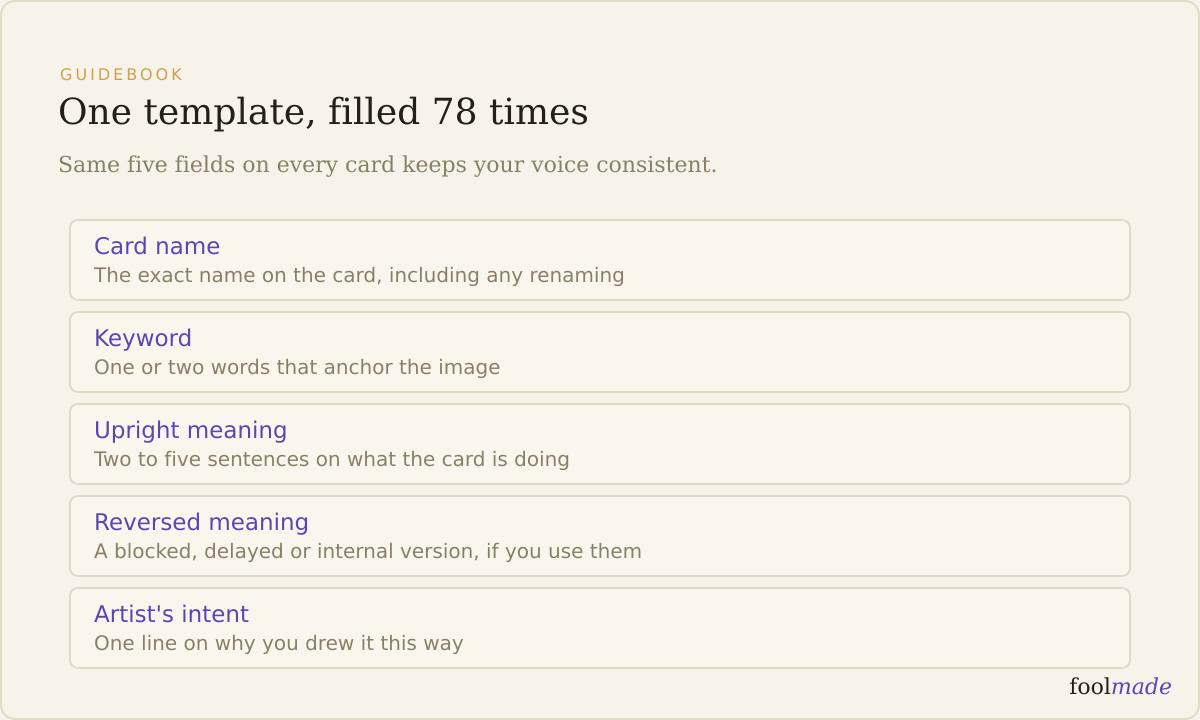
Writing 78 entries goes off the rails when each one is a blank page. Give yourself a fixed shape and fill it 78 times. Every card gets the same five fields in the same order:
| Field | What it is |
|---|---|
| Card name | The exact name on the card, including any renaming you did. If your Death card is The Threshold, say so. |
| Keyword or image cue | One or two words that anchor the picture and hook the reader back to the art. |
| Upright meaning | Two to five sentences on what the card is doing, not a thesaurus of adjectives. |
| Reversed meaning | A blocked, delayed, or internal version of the card, if your deck uses reversals. |
| Artist's intent line | One sentence on why you drew it this way and what you want the reader to take from it. |
That last field is the part most self-published decks skip, and the part buyers remember. It is the difference between a definition and a deck. When someone reads "I painted her turned away because acceptance usually starts with the part of us that wants to leave," they are holding your deck, not a meaning list.
Keep the fields in the same order on every card. It trains the reader where to look and stops you reinventing the entry each time.
How long should each guidebook entry be?
Long enough to say the real thing, short enough that you finish and the reader reads. In practice that lands around 80 to 160 words per card for the meanings, plus your one intent line.
Multiply that out and a full guidebook runs roughly 8,000 to 14,000 words. That is a book. Plan for one.
Resist two temptations. One is padding the Minor Arcana to match the Majors; no one needs four paragraphs on the Three of Pentacles. The other is going so terse that every card is three keywords, which is exactly the complaint that sinks a deck's beginner-friendliness. Give the Majors more room and keep the Minors tight and consistent. The 22 Majors and 56 Minors carry different weight, as the anatomy of a 78-card tarot deck lays out.
Should your deck have reversed meanings?
Decide this once, for the whole deck, before you write a word. Three honest options:
- Ship reversals and write them. If your art has a clear top and bottom and you expect free shuffling, reversed meanings are part of the contract. Write them as their own thought, not "the opposite of upright."
- Ship reversals but call them optional. Write the reversed line, then add a note that reading upright-only is valid. Plenty of decks do this well.
- Skip reversals on purpose. Some decks, especially oracle and symmetrical designs, read better one way. State it plainly in the intro. Silence reads as an oversight; a sentence reads as a choice.
How do you keep one voice across 78 cards?
Your guidebook has a narrator, and it should sound like the deck looks. A soft, botanical watercolor deck should not read like a clinical spec sheet. Pick the voice early, in the first few Majors, then hold it.
A few concrete ways to hold it: decide how you address the reader (you, or a neutral third person) and never switch. Choose your stance on prediction (does this deck tell futures or describe states) and stay with it. Keep a short list of words you use and words you refuse. If you would never say "manifest" out loud, do not let it creep into card 54.
The voice is also where authorship lives. A booklet that sounds like a real person is part of how you disclose how your deck was made and show a human wrote it.
Should you print the booklet or ship a PDF?
Both are legitimate, and the honest answer is often both.
A small printed booklet in the box is what most buyers expect and what makes the deck feel complete on arrival. Print locks the text forever, so keep it to the essentials: card meanings, intent lines, and a short how-to-read intro.
A PDF costs nothing to update and can run longer. The setup that works best is both: a concise booklet in the box plus a QR code to a fuller PDF. Readers who want more can get it, and you can fix a typo without a reprint.
| Format | Best for | Watch out for |
|---|---|---|
| Printed booklet | The expected in-box experience; feels finished | Costs money per copy; text is locked at print |
| Depth, updates, cheap fixes | Easy to ignore; some buyers never open it | |
| Both | Essentials in the box, depth in the link | A little more setup up front |
How do you write a tarot guidebook without phoning in the last 20?
Everyone writes the Fool and the Death card with love. The Six through Ten of Pentacles at 11pm on day nine is where guidebooks quietly die, and readers feel exactly which entries you were tired for.
The fix is to stop writing in card order. Write in passes, batching by field across all 78:
1. Write every artist's intent line first, while the art is fresh.
2. Then write all the uprights in one voice.
3. Then all the reverseds, if you use them.
4. Then a final read for tone, from card 78 backward so the tail gets fresh eyes.
Track which cards are done and which are still stubs so no entry ships half-written, and keep that list next to the art so a redraw never leaves stale text behind. When a card resists you, leave a one-line note and move on rather than forcing filler. You can hear forced filler, and so can the buyer. The guidebook is one leg of the whole build, alongside how to make your own tarot deck from idea to finished art.
Frequently asked questions
How long should a tarot guidebook be?
Plan for roughly 8,000 to 14,000 words total, or about 80 to 160 words per card plus one intent line. Give the Majors more room and keep the Minors tight so the booklet stays readable.
Do you have to write reversed meanings?
No. Reversals are optional, but the call should be deliberate and stated in your intro. What reads badly is silence that looks like you forgot a section.
What should each guidebook entry include?
Five fields in the same order every time: card name, a keyword or image cue, the upright meaning, a reversed meaning if you use them, and one line of your own intent. The intent line is what makes the booklet feel authored instead of generic.
Should the guidebook be printed or a PDF?
Most decks do both: the essentials in a small printed booklet buyers expect in the box, plus a linked PDF for expanded meanings and updates you can fix without a reprint.
How do you finish all 78 without the quality dropping off?
Write in passes instead of card by card. Do every intent line first, then all uprights, then all reverseds, and track stubs so nothing ships half-written.
Foolmade keeps your card list and writing progress in one place, so each of the 78 deck slots shows whether its art and its entry are both done as the deck evolves. It never generates the art or the words. Those are the deck, and they are yours.