Tarot deck structure: the anatomy of all 78 cards
The tarot deck structure is fixed: 22 Major Arcana and 56 Minor Arcana, 78 cards in total. That split is the first thing to internalize as a maker, because the two halves demand very different amounts of work, and the 56 is where most first decks stall.
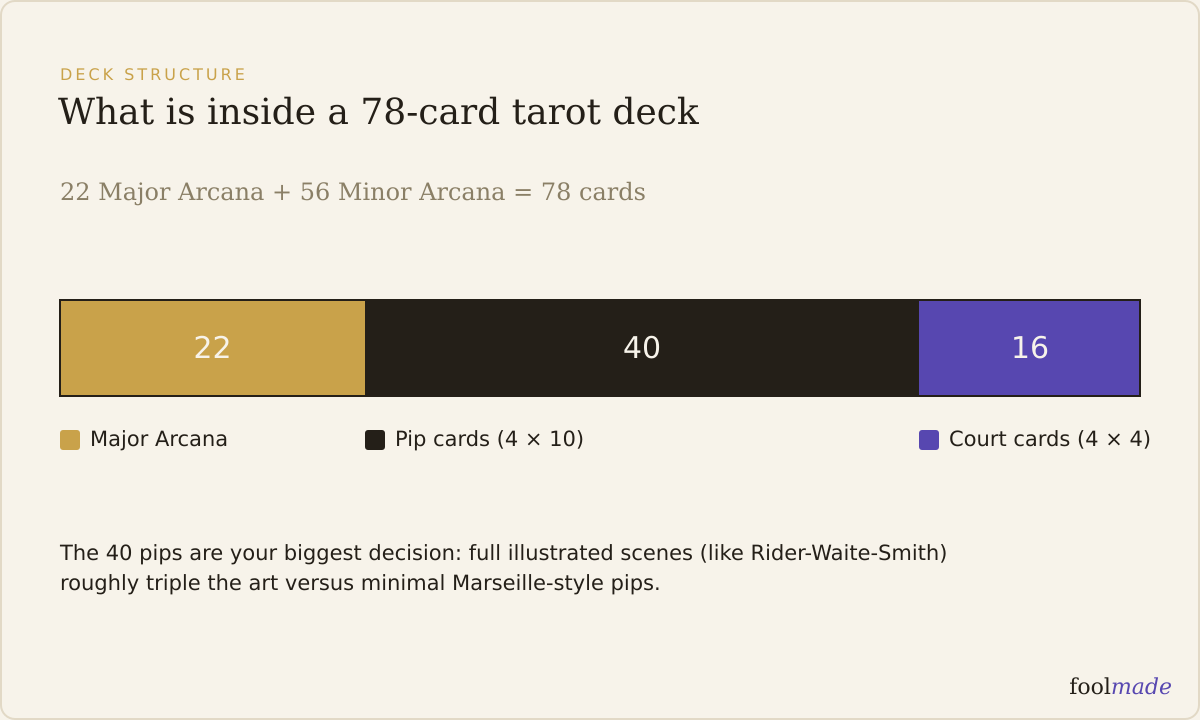
Everything below is a map of what you have signed up to paint before you make a single brush stroke.
What are the 22 Major Arcana?
The majors are a numbered sequence from 0 to 21. Card 0 is The Fool, card 21 is The World, and the twenty in between run through named archetypes like The Magician, The High Priestess, Death, The Tower, and The Star.
Each one is a standalone illustration with its own title and Roman numeral. There is no suit, no repeated layout. Twenty-two unique scenes, each carrying its own concept.
For you the maker, the majors feel like the fun part. They are the cards people screenshot, the ones that sell a deck's identity. Because every major is a fresh composition, you cannot copy a template from card to card. Budget them as 22 separate paintings, and plan a guidebook entry for each, since the majors carry the meaning readers lean on most.
What are the 56 Minor Arcana?
The minors are where the deck gets systematic. Fifty-six cards divide into four suits: Wands, Cups, Swords, and Pentacles (sometimes called Coins). Each suit holds 14 cards, and each suit is built the same way:
- Ten pip cards, numbered Ace (One) through Ten.
- Four court cards: Page, Knight, Queen, King.
So one suit is 10 pips plus 4 courts. Times four suits, that gives you 40 pip cards and 16 court cards. That 40-card block of pips is the single largest chunk of the whole deck, and it is the chunk that forces your biggest decision.
Should your pips be full scenes or minimal?
Here is the fork that shapes your entire workload, and the reason two decks with the same 78 slots can take wildly different amounts of time.
In the Rider-Waite-Smith tradition, every pip is a full illustrated scene. The Five of Cups shows a cloaked figure grieving over spilled cups. The Ten of Wands shows a person bent under a heavy bundle. Forty little narrative paintings, each composed from scratch. This is why RWS-style decks read so easily, and why they take so long to make.
In the older Marseille style, pips are not scenes at all. The Five of Cups is just five cups arranged on the card, the way a five of hearts in a poker deck is five hearts. You design one clean suit symbol and one layout system, then repeat it from one to ten. The court cards still get full figures, but the 40 pips collapse into a repeatable pattern.
The difference in scope is enormous. Fully illustrating pips roughly triples the illustration work of the whole deck. Neither choice is more correct. Plenty of respected modern decks keep pips minimal on purpose, both for the classic look and for a sane timeline.
Decide this before you paint anything, because it changes how many original compositions you owe:
- Full RWS-style: roughly 78 original illustrations.
- Marseille-style pips: roughly 38 (22 majors plus 16 courts), with the pips built from one repeatable system.
This choice sits inside a larger creative call about whether your deck follows convention at all. If you are weighing it, the trade-offs are laid out in should your deck follow RWS or go original.
What does the full tarot deck structure look like?
Here is the whole deck in one place, including the pieces that are not part of the 78.
| Component | Count |
|---|---|
| Major Arcana | 22 |
| Pip cards (4 suits x 10) | 40 |
| Court cards (4 suits x 4) | 16 |
| Minor Arcana subtotal | 56 |
| Playing total | 78 |
| Card back | 1 |
| Title or cover card | 1 (typical) |
| Box art | as needed |
The 78 is the number that goes in a player's hands. The card back, title card, and box are extra pieces of art you owe the finished product, and it is easy to forget them until the deck is otherwise done.
What lives outside the 78 cards?
The card back matters more than beginners expect. It appears on every single card, so it has to work at any orientation and never accidentally reveal which way a card is facing. A lot of readers use reversals, and a back with an obvious top and bottom ruins that. One design, but a high-stakes one.
You also need a consistent border and a titling scheme across all 78. Pick your border width, your corner style, your font, and where the number and name sit, then hold that constant.
A deck where the majors have one border and the minors have another looks unfinished even when every card is well painted. The title card and box art usually reuse the deck's strongest imagery and its final logotype.
Why does the tarot deck structure hold together?
The four suits and the numbered majors are not arbitrary decoration. They are the grid that makes a tarot deck legible to anyone who has handled one before.
A reader picks up your deck and already knows there is a Queen of Swords, a Three of Cups, and a card numbered XVI. If you keep the 78-slot skeleton, your art can be as strange as you like and the deck still functions. Break the skeleton and you are making something else, which is a valid choice, just a different one.
That legibility is also why the tarot deck structure is a good place to start your first deck. The frame tells you exactly what to draw next, and it carries into every later step, from writing the booklet covered in how to write a tarot guidebook to planning the art itself in how to make your own tarot deck.
How does an oracle deck break the rules?
Oracle decks answer to none of this. An oracle deck can be 30 cards, 44 cards, 100 cards, any count you want. No suits, no fixed courts, no numbered majors, no required structure. You define the theme and the number.
That freedom is real, but it moves all the burden onto you. With tarot, the 78-slot frame tells you what to draw next. With an oracle, you invent both the list and the logic. If you are leaning that way, how many cards an oracle deck should have walks through the common counts and how to pick one.
Many makers build a tarot deck first precisely because the structure removes a hundred small decisions and lets them focus on the art.
How to plan your 78 slots
Before the first sketch, write out all 78 as a checklist: 22 majors by name and number, then each suit Ace through King. Decide your pip approach, lock your border and titling, and add the card back and box to the bottom of the list so they do not ambush you at the end.
Then you can watch the deck fill in, one painting at a time, and always know what is left.
Frequently asked questions
How many cards are in a tarot deck?
A standard tarot deck has 78 cards: 22 Major Arcana and 56 Minor Arcana. The 56 minors split into four suits of 14, each holding 10 pip cards and 4 court cards.
How many Major Arcana cards are there?
There are 22 Major Arcana, numbered 0 (The Fool) through 21 (The World). Each is a standalone illustration with no suit and its own title.
How many Minor Arcana cards are there?
There are 56 Minor Arcana in four suits: Wands, Cups, Swords, and Pentacles. Each suit has 10 pips and 4 court cards, which works out to 40 pips and 16 courts.
Do all tarot decks have 78 cards?
Nearly all do. The 78-card structure is the shared skeleton readers expect. Oracle decks are the exception and can hold any number, often anywhere from 30 to over 100 cards.
Foolmade lays out all 78 slots for you, so you can see at a glance what is painted and what is still empty as you work, majors and courts and every pip in its place. We never generate art. The 78 paintings are yours; the map of where they go is handled.
- The Visconti-Sforza Tarotwhat the 78 settled into
- The Mantegna Tarocchithe count this deck ignores
- The Sola Busca Tarotthe minors this deck invented
- The Tarot de Paristhe structure it keeps and bends