How many cards in an oracle deck? (common counts)
There is no fixed rule for how many cards in an oracle deck. Oracle decks commonly run 30 to 50 or more cards, and you choose the number. Unlike tarot's locked 78, an oracle deck's count follows your theme, your budget, and how much guidebook you are willing to write.
That freedom is the whole appeal of oracle, and it is also the part that trips up first-time makers. A tarot deck hands you a spec. An oracle deck hands you a blank page and a printer invoice that grows with every card you add.
So how many cards in an oracle deck is normal?
Most published oracle decks land somewhere between 30 and 60 cards. Forty-four is the number you will see over and over, because a lot of the best-known modern oracle decks used it and buyers now read 44 as "a real, complete deck." Thirty-something feels intentional and tight. Above 60 starts to feel like a big project, and above 78 you are asking why it is not just a tarot.
None of these are rules. They are the ranges buyers are used to, which matters only because a deck of 12 cards can read as unfinished and a deck of 120 can read as bloated. Pick a number that serves your idea, then check it against what your printer and your writing hand can actually deliver.
What are the common oracle deck card counts?
Certain counts show up again and again, usually because they map cleanly onto a theme. Here is how the common ones tend to feel and where they fit.
| Card count | How it feels | Fits a deck about |
|---|---|---|
| 30 to 36 | Tight, focused, quick to learn | A single clear theme: moon phases, a set of animals, one system |
| 40 to 44 | The default "complete" oracle | General guidance, affirmations, mixed archetypes |
| 45 to 52 | Roomy, room for sub-themes | A calendar, a mythology, layered categories |
| 60 to 78 | Large, closer to tarot scope | A full symbolic system, or an oracle with suits |
| 78 plus | Rare, heavy | You may actually want a tarot structure instead |
The numbers are not magic. A 52-card deck maps onto a year of weeks or a playing-card feel. A 36-card deck splits neatly into twelve groups of three. If your theme has a natural count baked into it, use it. That built-in logic makes the deck easier to design and easier to explain.
How do you decide how many cards in an oracle deck to make?
Three things set your real number: the theme, the print cost per card, and the guidebook you will have to write. Work through all three before you commit.
Start with the theme. Count the ideas your concept genuinely contains. A deck of birds native to your region has whatever number of birds you want to paint. A deck of emotions has as many emotions as you can render distinctly. List them out first. If your list is 28, do not pad it to 44 with filler cards nobody will connect with. A tight deck of strong cards beats a padded one every time.
Then price it per card. Printing cost scales almost directly with card count, so every card you add is money on every copy you ever sell. At small runs through a service printer, each additional card adds real per-deck cost, and that multiplies across your whole print run. Going from 40 to 60 cards is a 50 percent jump in the part of the bill that scales with card count. Before you settle on a number, run it through the real math in how much it costs to print a deck so the count you love does not wreck your margin.
Then count your guidebook workload. This is the one most makers underestimate. Every card usually needs an entry: a name, a meaning, often an upright and a reversed reading or a prompt. Fifty cards is fifty entries, and a thin guidebook is the most common complaint buyers have about indie decks. If writing forty solid entries already feels like a mountain, sixty is not the deck to start with. The guide on writing a guidebook people keep breaks down the per-card work so you can size the deck to the writing you can finish.
Put those three together and your number usually picks itself. Theme gives you a floor, cost and guidebook give you a ceiling, and you settle in the honest middle.
How is an oracle deck different from tarot's 78?
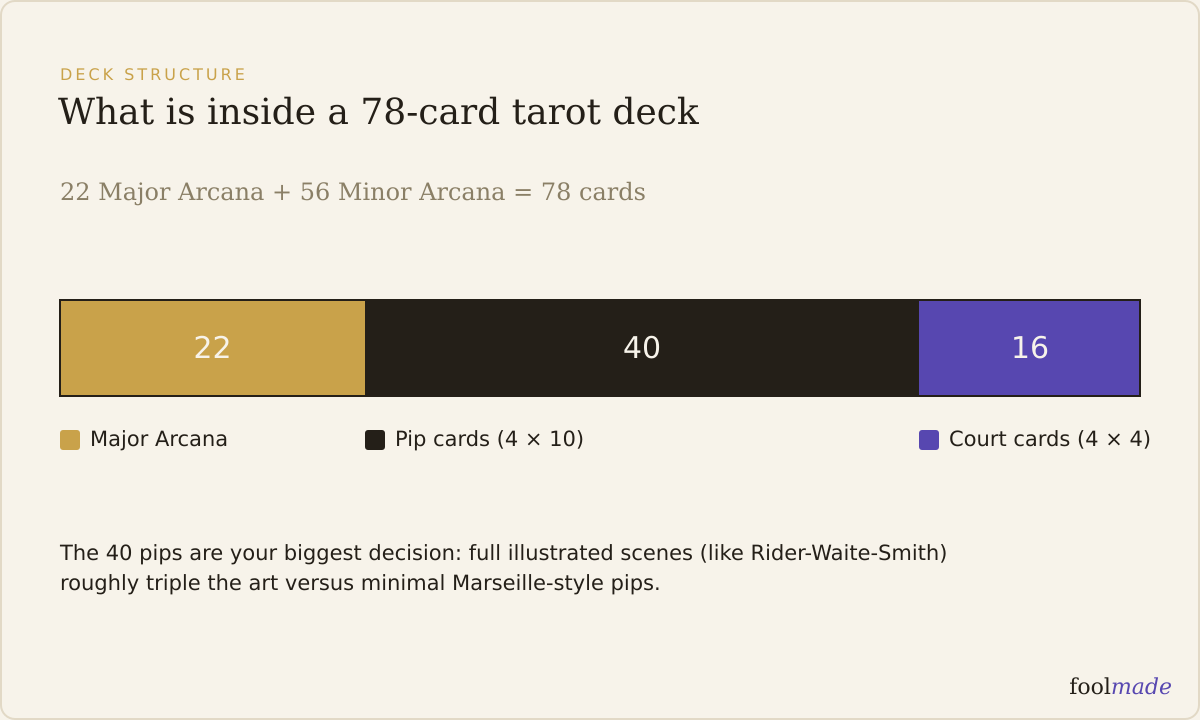
A tarot deck is fixed at 78 cards: 22 Major Arcana and 56 Minor Arcana across four suits. That structure is a standard buyers expect, and breaking it makes a deck read as "not really tarot." If you want the full breakdown, see the anatomy of a 78-card deck.
Oracle throws that spec out. There are no required suits, no set number, no fixed hierarchy of cards. You invent the framework. That is why oracle is the friendlier format for a first deck and also why it needs more discipline: nothing stops you from making a shapeless pile of pretty cards with no through-line.
The practical difference for you is scope. Tarot's 78 is a known, large commitment with a known payoff. An oracle deck lets you ship something complete at 40 cards and grow later. If you are weighing the two, the guide to making an oracle deck walks through building structure into a format that gives you none by default.
Does the card count need to be a round or special number?
No. Buyers do not count your cards against a rulebook. A 41-card deck is fine if 41 is the honest number of ideas you had. Round numbers and theme-driven counts (36, 44, 52) are common because they feel deliberate, not because odd numbers are wrong. Deliberate beats round.
Can an oracle deck have suits or sections?
Yes, and grouping cards is one of the best ways to give a larger deck structure. You might split 48 cards into four elements of twelve, or three phases of sixteen. Sections help readers work through the deck and help you write the guidebook in coherent chunks. Just make the grouping mean something rather than adding it for decoration.
Frequently asked questions
What is the most common oracle deck size?
Around 44 cards. Many well-known modern oracle decks used counts in the low 40s, so buyers now read that range as a full, finished deck. Anything from the mid-30s to the low 50s reads as normal.
Can an oracle deck have more than 78 cards?
It can, but it rarely should. Past 78 you are into heavy print costs and a guidebook the size of a book, and you are usually better served by a tarot structure. Most oracle decks stay under 60.
Is a smaller oracle deck less valuable?
No. A focused 36-card deck with strong art and a thorough guidebook is worth more to buyers than a padded 60-card deck with thin entries. Value comes from execution, not card count.
How does card count affect printing cost?
Directly. The per-card portion of your printing bill scales with the number of cards, so every extra card adds cost to every deck you print. Adding twenty cards can raise that scaling cost by roughly half.
The bottom line
An oracle deck is as long as your idea, your budget, and your writing stamina agree it should be. List your real ideas, price the count per card, count the guidebook entries, and pick the honest number where those three meet. Somewhere between 30 and 50 is where most makers land, and there is nothing wrong with sitting right in that range.
When you are ready to lock a count, Foolmade gives your deck a set of card slots so you can see the exact structure you are committing to before you send a single file to print. We keep the shape of the deck in front of you while the art is still yours to make, by hand, from start to finish.