How to make an oracle deck: structure without rules
To make an oracle deck, you invent both the card list and the logic that connects it, because there is no fixed structure the way tarot has one. You pick a theme, decide how many cards it needs, keep the art cohesive, and write a guidebook that tells readers what each card means. That freedom is the whole appeal and the whole trap.
What makes an oracle deck different from a tarot deck?
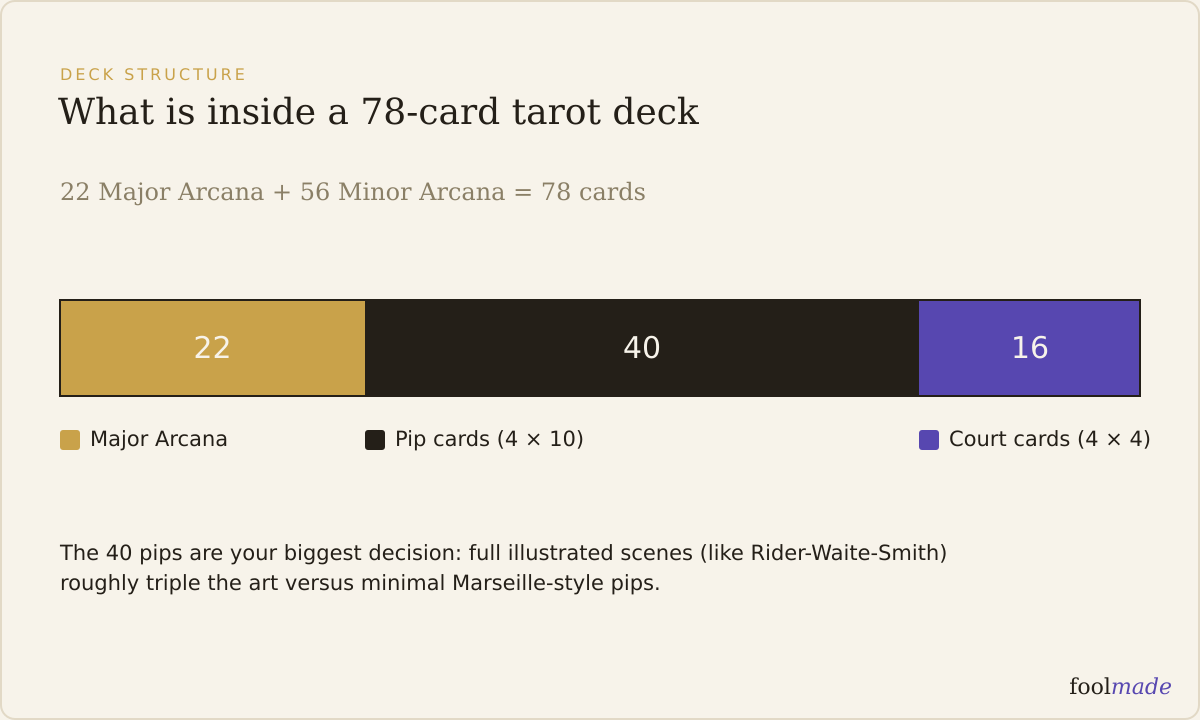
Tarot is a closed system. It has 22 majors, 40 pips, and 16 courts, always 78 cards, in an order most readers already know. You inherit that scaffold. Your job is to reinterpret slots that already exist.
An oracle deck hands you an empty room. There is no set count, no required cards, no suits, no numbering convention you have to honor. A deck can be 30 cards or 100. It can be moon phases, mushrooms, ancestors, feelings, or birds. Nobody will tell you a card is "missing," because you decide what belongs.
That sounds liberating until you sit down to it. Tarot's constraints do a lot of quiet work: they tell you when you are done, and they give the reader a familiar map. Take them away and you have to build both yourself.
How do you choose a theme and card count?
Start with the theme, because the theme decides the count, not the other way around. A deck about the 12 months writes its own length. A deck about "healing" could be any size, which is exactly why open themes are harder to finish.
Common oracle counts cluster in a few places. Many published decks land between 36 and 52 cards. Under about 30 can feel thin for repeat readings. Over 60 gets expensive to print and heavy to shuffle. There is more detail in the guide to how many cards an oracle deck should have, but the honest answer is: enough cards to cover the theme without padding, and not one more.
Pick a number early and treat it as a budget. If your theme is 44 cards, you have 44 paintings to plan, price, and finish. A count that keeps drifting upward is usually a theme that was never defined tightly enough.
How to make an oracle deck feel cohesive
This is where oracle decks quietly fail. With no suits or shared symbols to hold things together, a set of individually lovely cards can still look like a pile of unrelated illustrations.
Cohesion comes from rules you set for yourself and keep:
- One palette, or a deliberate palette shift you can explain.
- One medium and finish across every card. Do not mix watercolor and hard digital line unless that contrast is the point.
- A consistent format: same border or no border, titles in the same place, the same treatment on every card back.
- A recurring visual motif, a color line, a frame element, a small repeated symbol, that signals "these belong to one deck."
Tarot gets this for free from its structure. You have to install it. Decide your visual rules before you finish the second card, because retrofitting cohesion onto 40 finished paintings is the reprint you do not want.
Where tarot has a rule and an oracle makes you decide
The clearest way to see the work in front of you is to line the two up. Every place tarot hands you an answer, an oracle deck hands you a decision.
| Decision | Tarot has a rule | Oracle: you decide |
|---|---|---|
| Card count | Always 78 | Any number you choose |
| Card list | Fixed, named cards | You invent every card |
| Order and numbering | 0 to 21, Ace to King | Optional, your call |
| Suits and structure | Four suits, majors and minors | None required |
| Reader expectations | Readers know the system | You teach it from scratch |
| What each card means | Centuries of tradition | Only what your guidebook says |
| When the deck is "done" | At 78 | When you decide it is |
Read that right column top to bottom. That list is your project. None of it is handed to you, and all of it has to be answered before the deck can go to print.
Why does the guidebook carry more weight in an oracle deck?
With tarot, a reader can pull a card you painted and still read it, because they already know the Three of Swords. Your art reinterprets a meaning that exists outside your deck.
An oracle card means nothing until you say so. If your guidebook is thin, the deck is unusable, because there is no external tradition for the reader to fall back on. The guidebook is not an add-on here. It is half the product.
Write a real entry for every card: the image, what it represents, and how to read it in a spread. Give it a clear voice that matches the art. The walkthrough on writing a guidebook people keep applies directly, and it matters more for oracle than for tarot. Budget the writing time the way you budget the painting time, because a beautiful deck with a vague guidebook gets returned and reviewed harshly.
Do print specs still apply when you make an oracle deck?
Yes, completely. The freedom is in the content, not the production. Every physical rule that governs a tarot deck governs an oracle deck the same way.
Your cards still need full bleed, a safe zone, and 300 DPI at final print size. They still need consistent dimensions so the deck stacks and shuffles cleanly. You still choose a cardstock, still order a proof, still design a card back. If you have made cards before, the process is identical to making a tarot deck from the file side down. The only difference is that you defined the deck's structure yourself instead of inheriting it.
One extra note on count: oracle decks with odd numbers are common, but check your printer's pricing tiers. Some price in fixed brackets, so 55 cards may cost the same to print as 60. Confirm with a live quote before you lock the final number.
Frequently asked questions
How many cards should an oracle deck have?
Most published oracle decks fall between 36 and 52 cards. Let the theme set the number: enough to cover it fully, not so many that the deck feels padded or gets expensive to print. Fewer than 30 can feel thin.
Do oracle decks need suits or a set structure?
No. Suits, numbering, and majors and minors are tarot conventions. An oracle deck has no required structure, which is why you have to build your own internal logic and teach it in the guidebook.
Is it easier to make an oracle deck than a tarot deck?
Often fewer cards, so less painting, but more design thinking. You invent the card list, the meanings, and the cohesion that tarot's structure provides for free. The guidebook also carries far more weight.
Can an oracle deck be used for readings like tarot?
Yes. Readers pull cards and interpret them in spreads the same way. The difference is they rely entirely on your guidebook for meaning, since there is no shared tradition behind the cards.
The bottom line
Making an oracle deck is a design problem before it is a painting problem. Define the theme tightly, set a card count and treat it as a budget, lock your visual rules early, and write the guidebook as a real deliverable. Do that and the freedom works for you instead of leaving you with a stack of pretty, unrelated cards.
When you are ready to plan the deck itself, Foolmade's deck slots let you lay out every card in your count, track what is sketched, painted, and final, and see the whole structure you invented in one place. We never touch the art. That part stays yours.