Where to print your indie tarot deck (2026)
Where to print your indie tarot deck comes down to five printers and one question: how many decks, and who ships them. For proofs and small runs, MakePlayingCards is cheapest. For zero-inventory selling, The Game Crafter prints and ships each order. For big runs, Shuffled Ink or PrintNinja win on price but add lead time.
There is no single best printer. There is a best printer for the run you're actually doing. A person printing three copies to check color has a different answer than a person shipping 2,000 backer rewards. Below is how to match the machine to your moment, with 2026 planning prices you should confirm with a live quote.
Which tarot printers should you compare?
Five names cover almost every indie deck. Two are print-on-demand (they make a deck when someone orders it), two are bulk offset houses (cheap per deck, but you buy a pile up front), and one, MakePlayingCards, straddles both because it has no minimum yet a price that keeps falling with volume.
- MakePlayingCards (MPC): no minimum, best for proofs and mid-size runs, linen stock creators love.
- The Game Crafter (TGC): true print-on-demand, prints and ships each order for you.
- DriveThruCards: print-on-demand plus a marketplace that keeps selling your deck after launch.
- Shuffled Ink: US-based offset, minimum around 100, good middle ground on price and control.
- PrintNinja: offset for serious volume, minimum around 500, lowest per-deck cost with the longest wait.
For a deep head-to-head on the three POD names, see MPC vs Game Crafter vs DriveThruCards. This page is the map; that one is the tour.
How much does it cost to print a tarot deck?
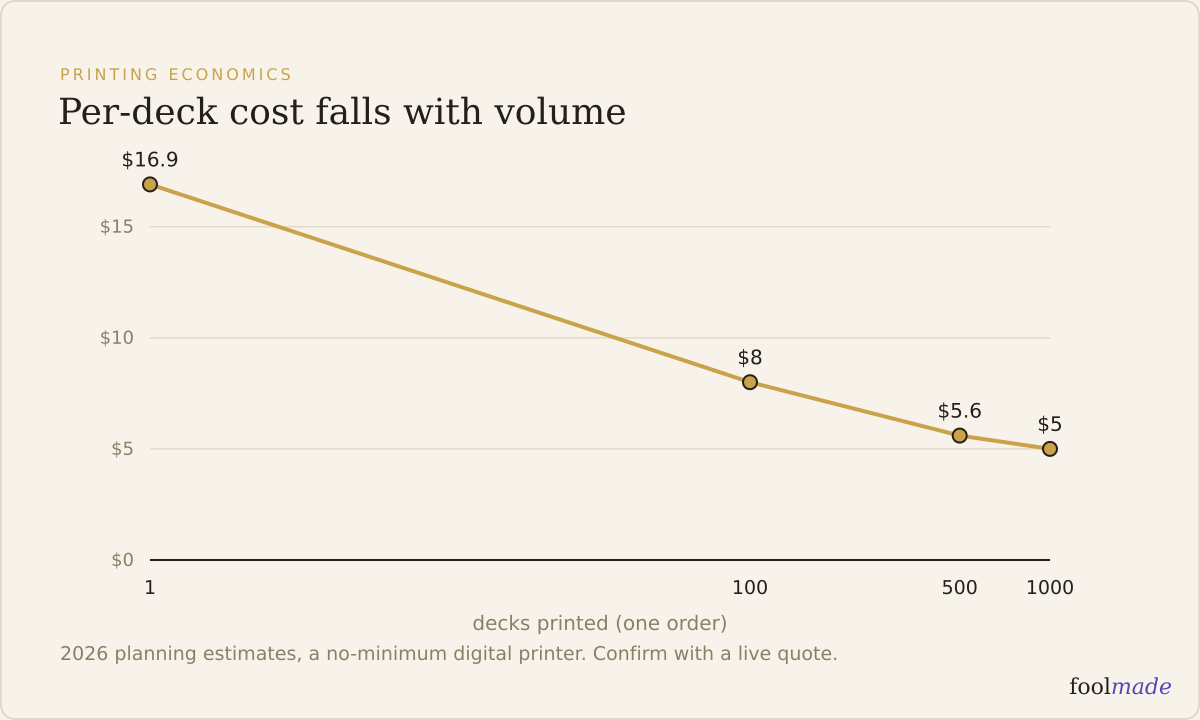
Per-deck price is set almost entirely by quantity. At one copy the printers cluster around $13 to $17. At 500 the spread blows open: PrintNinja can be under $5 a deck while a POD house is still charging double that, because POD never batches and never gives you the volume discount.
Here are 2026 planning estimates for a standard 78-card tarot deck (2.75 by 4.75 inches) with a box. Treat every number as a starting point for a real quote, not a promise.
| Printer | Minimum | ~Cost at 1 | ~Cost at 100 | ~Cost at 500 | ~Cost at 1000+ | Ships for you? |
|---|---|---|---|---|---|---|
| MakePlayingCards | None | ~$16.90 | dropping | ~$5.60 | lower | No |
| DriveThruCards | None (POD) | ~$14 | ~$12 | ~$10.50 | ~$10.50 | Yes (marketplace) |
| The Game Crafter | None (POD) | ~$13.50 | ~$13.50 | ~$13.50 | ~$13.50 | Yes |
| Shuffled Ink | ~100 | n/a | ~$12 | mid | ~$5.25 (1000) | No |
| PrintNinja | ~500 | n/a | n/a | ~$4.90 | ~$2.75 (2000) | No |
Read the curve, not the single-deck column. If you plan to sell 500 decks and print them POD at TGC, you pay roughly $6,750 more than an MPC run of the same size. That gap is your margin, handed to the printer. But the POD price buys something real: no inventory in your closet and no mailing labels, which is covered in full under fulfillment below. For the whole money picture, read how much it costs to print a tarot deck.
Which tarot printer has no minimum?
Three of the five have no minimum: MakePlayingCards, The Game Crafter, and DriveThruCards. That matters most at the very start, when you want one real deck in hand before you commit thousands of dollars.
MPC is the usual pick for a first proof because it gives you the cheapest single real deck, around $16.90, on stock you can actually evaluate. TGC and DriveThruCards will also print one copy, and since they fulfill orders, a single print doubles as a live storefront test.
Shuffled Ink and PrintNinja are offset houses. They exist for volume, so their minimums (roughly 100 and 500) rule them out for a one-off. You go to them once you know the deck is right.
Which is the cheapest tarot printer?
At real volume, PrintNinja. Its offset pricing bottoms out near $2.75 a deck at 2,000 copies, which nothing on the POD side approaches. Shuffled Ink is the next tier, around $5.25 a deck at 1,000, and keeps production in the US, which shortens shipping and simplifies the tariff question.
The catch with the cheapest printers is everything that isn't the sticker price:
1. Freight. A pallet of 2,000 decks ships by sea or air and can add real cost and 2026 tariff exposure.
2. Lead time. Offset runs plus freight often stretch four to eight weeks, sometimes longer near holidays.
3. Up-front cash. You pay for the whole run before you sell a single deck.
Cheapest per deck is not cheapest overall until you can sell what you print. If you're not sure you'll move 500 copies, a mid-size MPC run or POD is the safer money.
Who ships the decks for you?
This is the line item that decides more than price for a solo creator. Bulk printers (MPC, Shuffled Ink, PrintNinja) hand you the boxes and walk away. You become the warehouse and the post office: storing decks, printing labels, handling returns, and eating customs paperwork on the inbound freight.
Print-on-demand flips that. With The Game Crafter, a customer buys through your storefront and TGC prints, packs, and ships that one deck. You never touch a mailer. DriveThruCards works the same way through its marketplace, which is why it's the natural home for a deck you want to keep selling after a Kickstarter closes.
| Approach | Printers | You handle shipping? | Best moment |
|---|---|---|---|
| Print-on-demand | TGC, DriveThruCards | No | Zero-inventory selling, post-campaign |
| Bulk offset | MPC, Shuffled Ink, PrintNinja | Yes | Funded runs where margin matters |
How do you pick, step by step?
1. Order a sample pack from any printer you're serious about. Card feel closes or kills the sale, and a screen can't show it.
2. Print one proof of your actual deck before any real run. It catches the border that's 2mm too tight and the muddy black. Make sure your files are ready first with the print-ready checklist.
3. Decide who ships. If becoming a shipping operation sounds miserable, choose POD and accept the lower margin.
4. Match the printer to your volume. One to five copies: MPC. Zero inventory: TGC or DriveThruCards. Funded run of 500+: Shuffled Ink or PrintNinja.
5. Pull a live quote from your top two before committing. Prices, promotions, and shipping to your country all move the math.
Printing is one stop on a longer road. If you're mapping the whole thing, how to self-publish a tarot deck walks art to print to sale.
Frequently asked questions
What is the cheapest way to print a small batch of tarot decks?
For 1 to 50 decks, MakePlayingCards usually wins because it has no minimum and a per-deck price that beats print-on-demand once you pass a few copies. Below about five copies, POD at The Game Crafter is competitive and ships for you.
Is MPC or DriveThruCards better for a tarot deck?
MPC is better for proofs and runs you'll sell yourself, thanks to lower cost at volume and linen stock. DriveThruCards is better if you want a marketplace that fulfills and keeps selling the deck after launch. Many creators use both.
What size are tarot cards for printing?
Standard tarot is 2.75 by 4.75 inches, and most printers list it as a stock size. Confirm the exact trim and bleed on your printer's template before exporting. See tarot card size and dimensions for the numbers in inches, mm, and pixels.
How many decks should I print for my first run?
If you have not sold a deck before, print a proof, then a small batch you're confident you can sell (often 50 to 200) rather than a 1,000-deck offset run. You can reprint once demand is proven. Locking cash into unsold inventory is the most common first-run mistake.
Do these printers ship internationally?
Yes, all five ship worldwide, but 2026 tariffs and freight change the landed cost a lot depending on where the printer and your buyers are. US-based Shuffled Ink can simplify duties for US sellers. Always get a shipping quote to your actual country before you commit.
Once you have quotes, the real question is whether the deck pays for itself. Foolmade's margin planner lets you drop in a printer's per-deck price and your sale price to see your profit at 100, 500, or 1,000 decks before you spend a cent. It will never print your deck or generate your art, that stays entirely yours, but it will show you which printer leaves money in your pocket instead of the printer's.
- The Cary Sheetsheet printing, five centuries on
- The Tarocco Soprafinofine line and what it costs