Tarot card size and dimensions (inches, mm, px)
The standard tarot card size in inches is 2.75 x 4.75, which works out to 70 x 121 mm, 7.0 x 12.1 cm, or 825 x 1425 pixels at 300 DPI. That trim size is the number your whole print file is built around, so lock it in before you export a single card.
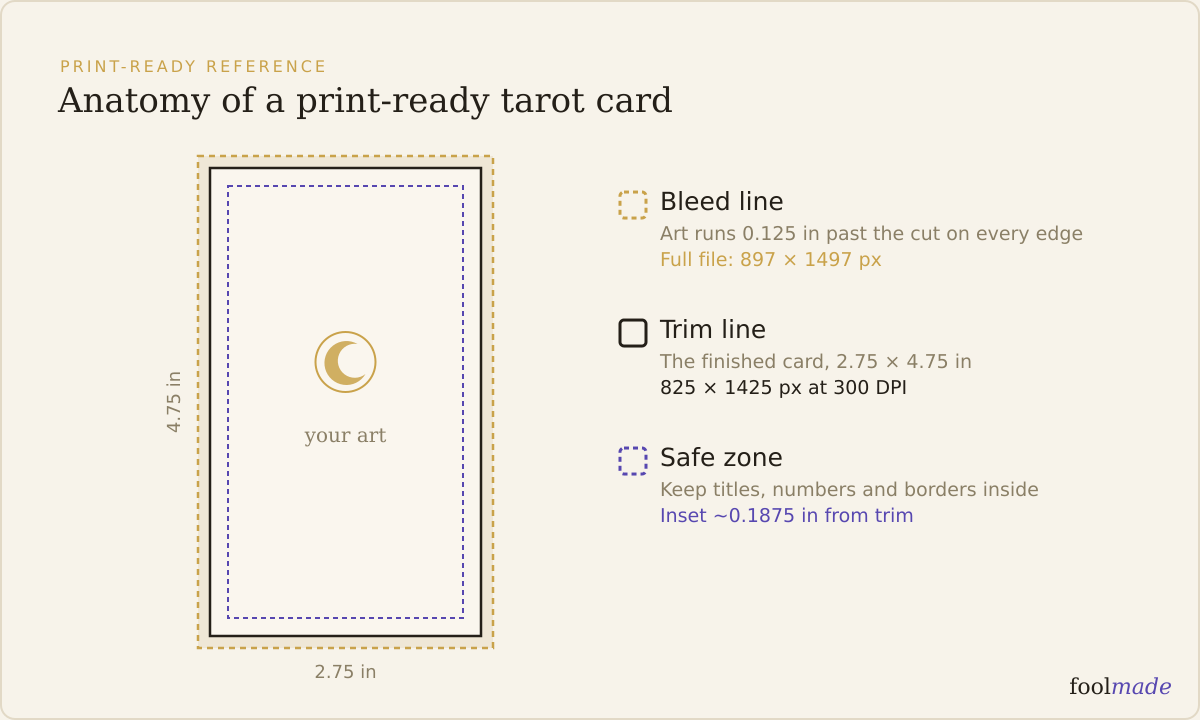
The trim size is only the visible card. The file you upload is bigger, because of bleed, and the part you design inside is smaller, because of the safe zone. Get those three layers right and the cards come back clean. Get them wrong and you pay for a reprint or ship a deck with a white sliver on one edge.
What size are tarot cards in inches, mm, and pixels?
Here is the standard card in every unit you will need, at 300 DPI, the resolution nearly every card printer expects.
| Measure | Value |
|---|---|
| Trim size (inches) | 2.75 x 4.75 in |
| Trim size (mm) | 70 x 121 mm |
| Trim size (cm) | 7.0 x 12.1 cm |
| Art at 300 DPI (no bleed) | 825 x 1425 px |
| With bleed (~0.125 in/side) | ~897 x 1497 px |
| Aspect ratio (width / height) | ~0.579 |
| Safe zone inset from trim | 0.125 to 0.25 in |
| Resolution | 300 DPI minimum |
The pixel math is just inches times DPI. 2.75 x 300 = 825 pixels wide. 4.75 x 300 = 1425 pixels tall. That is your finished card face, edge to edge, with nothing extra.
These are the widely used standards. Your printer publishes its own template with its own exact numbers, so download that and confirm against it before you export. Treat the values here as the target you expect the template to match, not a replacement for it. For ready-made files, see tarot card templates and sizes for common printers.
What is the tarot card size with bleed and a safe zone?
Bleed is extra art past the trim line that gets cut off. Printers cannot cut 78 cards to a hairline, so the blade lands a little off every time. If your background stops exactly at the trim line, one slightly-off cut exposes the paper as a thin white edge.
The fix is to extend your background about 0.125 inches past all four edges. At 300 DPI that is roughly 37 pixels per side, which is where the ~897 x 1497 px full-bleed file comes from (825 + 37 + 37 wide, 1425 + 37 + 37 tall). The cutter aims for the trim line, wanders a little, and still lands inside your art.
The safe zone is the opposite margin, on the inside. Keep titles, numbers, borders, and key symbols pulled in 0.125 to 0.25 inches from the trim, about 37 to 75 pixels. Borders are the classic trap: a thin frame hugging the trim line comes back visibly thicker on one side across a run. For a full walk-through, read what bleed is and how much your deck needs.
Three layers, outside in: bleed (art you expect to lose), trim (where the cut aims), safe zone (where content is protected).
Poker vs tarot card size: which should you use?
"Tarot size" usually means 2.75 x 4.75 in, but decks ship in a few sizes, and you should pick one on purpose. The main choice is poker versus tarot: poker is smaller, cheaper, and shuffles more easily, while the taller tarot card size reads as traditional.
| Size name | Inches | Millimeters | Notes |
|---|---|---|---|
| Poker | 2.5 x 3.5 in | 63 x 88 mm | Smaller, cheaper, shuffles easily. Common for oracle and minimalist decks. |
| Standard tarot | 2.75 x 4.75 in | 70 x 121 mm | The traditional tarot shape. Taller and narrower in the hand. |
| Oversized / large tarot | varies by printer | varies | A bigger presentation card. Confirm exact dimensions per printer. |
Oracle decks are the wild card. They have no fixed tradition, so creators use poker, tarot, square, or fully custom sizes. If you are making an oracle deck, the size is a design decision, not a convention, so choose it early because it changes every pixel measurement above. Whatever you pick, recompute the same way: inches times 300.
Why must all 78 cards be the same size?
All 78 cards must share identical dimensions: same trim, same bleed, same DPI, same orientation. It sounds obvious, and it is the single most common way a home-made deck goes wrong.
It usually happens because cards get made across weeks, in different files, sometimes in different apps. One card exports at 300 DPI and another at 150. One Major Arcana card is built at a slightly different canvas size. A card back comes in at poker dimensions while the fronts are tarot. Any of these and the deck feels wrong in the hand, and the printer may reject the batch or trim it unevenly.
Set your canvas once, at 897 x 1497 px and 300 DPI for a full-bleed standard tarot card, or whatever your printer's template says, and build every card in that exact frame. Do not resize individual cards later. If you change the trim, you change it for all 78 and rebuild from the template. More on this in keeping all 78 cards the same size.
Before you send the file to a printer
The expensive mistakes are dimensional, and they are silent. A card that is 800 x 1400 instead of 825 x 1425 still opens, still previews, still looks like a tarot card on screen. You often find out only when the proof arrives.
Run your files through the full print-ready checklist before you spend a cent: size, bleed, DPI, and card back. Those four catch nearly every reprint.
If you want a fast second check, Foolmade's print check reads the card you already made and tells you whether the pixel dimensions and bleed line up with the standard, or with the printer template you are targeting. It never prints your deck and never generates art. It just confirms the numbers before they cost you a print run.
Frequently asked questions
What size are tarot cards in inches?
Standard tarot cards are 2.75 x 4.75 inches. That is the traditional trim size most printers list as a stock option, and it is taller and narrower than a poker card.
What is the tarot card size in cm and mm?
The standard tarot card size is 70 x 121 mm, or 7.0 x 12.1 cm. That is the trim size, meaning the finished card after cutting, not counting bleed.
What is the tarot card size in pixels at 300 DPI?
825 x 1425 pixels for the trimmed card, and about 897 x 1497 pixels once you add roughly 0.125 inches of bleed on each side. Multiply inches by 300 to get pixels for any card size.
Poker size vs tarot size: what is the difference?
Poker cards are 2.5 x 3.5 inches; standard tarot cards are 2.75 x 4.75 inches. Poker is smaller, cheaper to print, and easier to shuffle, while tarot reads as the traditional format. Oracle creators use either.
What is the aspect ratio of a tarot card?
About 0.579, or width divided by height (2.75 / 4.75). Keeping every card to that ratio is what makes a shuffled deck feel even instead of ragged.
Start from the trim size, add the bleed, protect the safe zone, and hold all 78 cards to one frame. The dimensions are the boring part of making a deck, and they are also the part that quietly decides whether the finished cards feel like a real deck or a near miss.
- The Cary-Yale Visconti Tarotwhy nineteen centimeters was a statement
- The Jean Noblet Tarotnine centimeters, and what size does