The Cary Sheet
One uncut sheet from Milan, about 1500, and on it the Marseille tarot being born: the oldest known ancestor of the pattern, crayfish and all.
Unknown Milanese printer · Milan; now in the Cary Collection, Beinecke Library, Yale · c. 1500
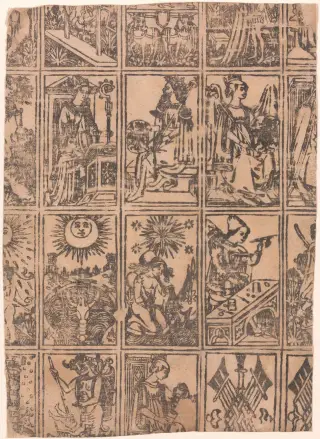
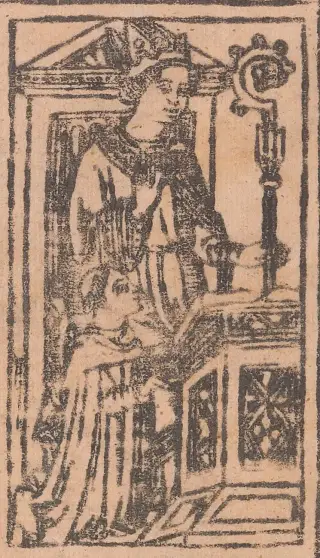
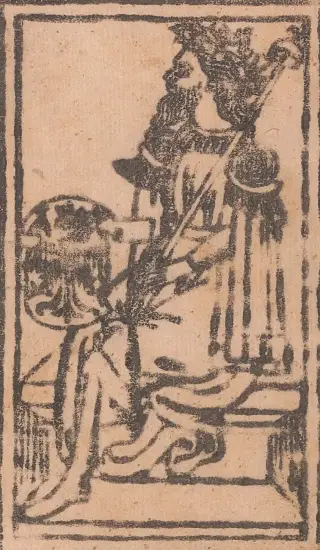
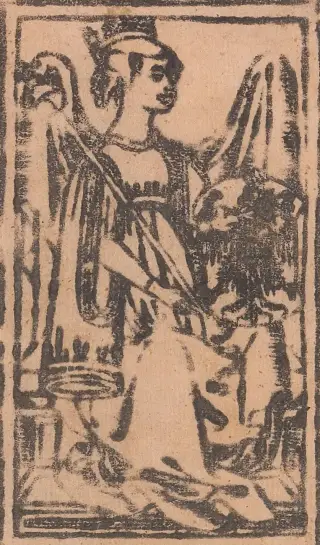
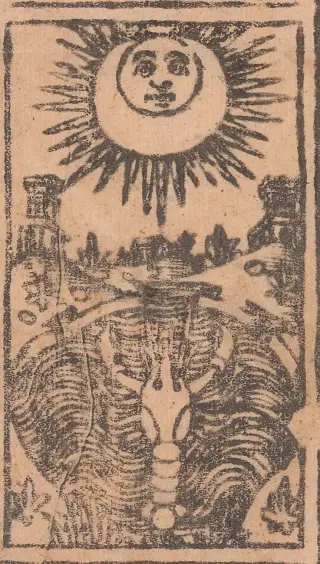
This is not a deck. It is a single printer's sheet, about 1500, from Milan, that was never cut into cards, and it is the most important piece of paper in the history of the Marseille tarot. Twenty woodcut images survive on it, some whole, some sliced by the sheet's torn edges, and the whole later French pattern is recognizably here: the Bateleur at his table, the Emperor in profile with his orb, the Pope enthroned, and above all the Moon, with towers, a pool and a crayfish climbing out of it, furniture that would reappear stroke for stroke in the Tarot de Marseille and stay there for three hundred years.
Nobody knows which Milanese shop printed it or why it survived; uncut sheets usually became book bindings and pasteboard, and this one seems to have been saved by exactly that kind of reuse. It reached the great playing card collection of Melbert and Mary Cary and came to Yale with it in 1967.
The sheet redraws the family tree. The hand-painted court decks of Milan, the Visconti-Sforza and its kin, were long assumed to be the pattern's ancestors, but the sheet shows a printed, popular tarot circulating in the same city within living memory of those commissions, already carrying the imagery the French line would standardize. The luxury decks were dead ends; the cheap sheet was the future.
- The Jean Noblet Tarotwhat the sheet grew into
- The Conver Tarot de Marseillethe pattern once it had settled
- The Visconti-Sforza Tarotthe luxury decks the cheap sheet outlived
- Keeping all 78 cards the same sizewhy printers cut from one sheet
- Where to print your indie tarot decksheet printing, five centuries on