Business license to sell tarot decks? A plain guide
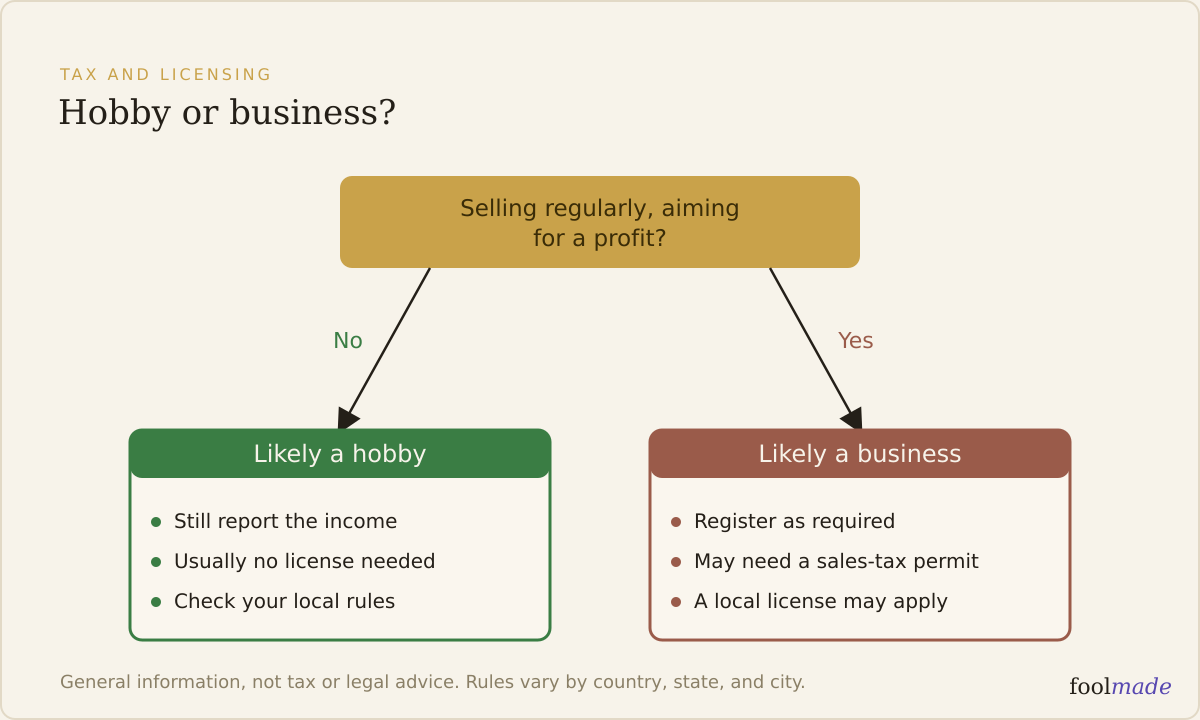
Whether you need a business license to sell tarot decks depends on where you live and how much you sell. Many hobby sellers start without one, listing a few decks on Etsy or a table at a market. But once you sell regularly for profit, most places treat that as a business, and that is when licenses and permits start to matter.
There is no single answer because licensing is set by your country, your state or province, and often your city. A maker in one town may need nothing, while a maker two hours away needs a local permit for the same deck.
Hobby seller or a business: which are you?
The line most tax and licensing authorities care about is intent and regularity, not the size of your art. Selling a couple of extra proof decks to friends looks like a hobby. Printing 200 decks, listing them, and restocking looks like a business.
A few signals push you from hobby toward business:
- You sell regularly rather than once, and you restock when a deck sells out.
- You intend to make a profit, and you price to cover costs plus margin.
- You promote the deck, run a shop, or take pre-orders.
- You buy inventory or print runs with the plan of reselling them.
You do not have to feel like a business for the rules to treat you as one. Hitting a print run of a few hundred decks and selling them for profit usually crosses the line, even if it started as a passion project you painted over years.
Do you need a business license to sell tarot decks?
For most small indie makers selling online, a general "business license" is often not the first thing you need, and in many places it is not required at all for a sole proprietor working from home. What trips people up more often is a sales-tax permit and local rules, which are separate things.
Here is the honest version: this is general information, not legal advice. Rules vary a lot by country, state, and city, so treat this as a map of what usually applies and confirm the specifics with your local authority before you sell.
| Your situation | What usually applies |
|---|---|
| Selling a few decks to friends, no profit motive | Usually nothing formal, treated as a hobby |
| Selling online regularly for profit (Etsy, own shop) | Register as a business in many areas; collect sales tax where required |
| Selling at a market, fair, or convention | Often a temporary seller's permit for that event |
| Using a business name that is not your legal name | A "doing business as" (DBA) registration in many places |
| Higher revenue, want liability protection | Consider forming an LLC or local equivalent |
| Selling internationally | Home-country rules plus the buyer's import and tax rules |
Quotes and rules change, so check your city, county, and state or provincial sites, plus your country's small-business portal. A ten-minute search of your own local government site beats guessing.
When does a sales-tax permit matter?
This is the requirement most deck makers actually hit first. If your area charges sales tax on physical goods, you usually need a seller's permit (also called a sales-tax permit or resale certificate) to collect and remit it, and to buy supplies tax-free for resale.
In the United States, most states require a sales-tax permit once you sell taxable goods there, and marketplace rules mean platforms like Etsy often collect and remit state sales tax for you. That does not always cover your own website or in-person sales, so you may still need your own permit.
Outside the US it looks different. In the UK you register for VAT only after passing a fairly high turnover threshold, so most small makers never do. Canada has GST/HST with its own small-supplier threshold. The pattern holds everywhere: a tax registration kicks in either immediately or after a sales threshold, depending on your country. The mechanics of what you owe are covered in do you owe tax on deck sales.
Sole proprietor or LLC: what is the difference?
By default, if you start selling as one person and do nothing else, you are a sole proprietor. That is the simplest structure, and plenty of indie deck makers stay there for years. Your business income flows onto your personal taxes, and there is little paperwork.
An LLC (or your country's equivalent, like a limited company) is a separate legal step you choose. It separates your personal assets from the business, which matters if you worry about liability, and it can look more official to wholesale buyers. It also costs money to form and maintain, and adds filing work.
For a solo maker selling a few hundred decks, a sole proprietorship plus the right tax permit is often enough. Consider an LLC when revenue grows, when you sign contracts, or when you want the liability shield. It is a business decision, not a requirement to start.
Do markets and conventions need a special permit?
Yes, more often than people expect. Selling at a craft fair, artist alley, farmers market, or convention frequently requires a temporary seller's permit or a local vendor license for that event, even in places where your online shop needs nothing.
Two things usually apply at in-person events:
1. A temporary sales-tax permit so you can legally collect tax on cash and card sales at the table.
2. The venue's own rules, since many organizers ask for your permit number or proof of registration before they give you a booth.
The good news is these are usually cheap or free and quick to get. Check the event's vendor application first, then your state or city site, and sort it before the show rather than at the table. Where you sell shapes which permits you touch, so plan the channel early with where to sell your tarot deck.
Why does a business license vary so much by location?
Because licensing is layered. Your country sets tax and company rules, your state or province adds its own sales tax and registration, and your city or county can require a local business license on top. Three makers in three towns can face three different checklists for the identical deck.
That is why no blog, including this one, can hand you a single yes or no. The reliable move is to search "[your city] business license" and "[your state or country] sales tax permit," read the small-business page, and register only for what applies to you. Most makers find the list is shorter than they feared.
Licensing costs also feed straight into your numbers. A permit fee, a DBA filing, or an LLC's annual cost all come out of your margin, so fold them into your price the same way you fold in printing and fees. See how to price a tarot deck for where these costs sit in the full stack.
Frequently asked questions
Do I need a business license to sell tarot decks on Etsy?
Often not a general business license just to open a shop, but you may need a sales-tax permit depending on where you live, and your city could still require a local license. Etsy usually collects and remits state sales tax for you, though your own site and in-person sales may not be covered.
Can I sell decks as a hobby without registering?
Sometimes, if sales are occasional and not for profit. Once you sell regularly with the intent to make money, most authorities treat it as a business, which can trigger registration and tax rules regardless of how small it feels.
Do I need an LLC to sell my tarot deck?
No. Most solo makers start as sole proprietors, which needs no formation step. An LLC is optional and worth considering for liability protection or as revenue grows, but it is not required to begin selling.
What permits do I need to sell at a craft market?
Usually a temporary seller's permit to collect sales tax at the event, plus whatever the venue requires in its vendor application. These are typically cheap and fast, so arrange them before the show.
Is this legal advice?
No. This is a plain overview, not legal advice. Rules differ by country, state, and city, so confirm your specific requirements with your local government or a local advisor before you sell.
Working out these costs before you print keeps them from eating your margin. Foolmade's margin planner shows your true cost per deck at any price, so a permit fee or filing cost lands in the math instead of surprising you later. It never prints or generates art. It just does the numbers that keep your deck sustainable.