Tarot Deck Sales Tax: What You Owe (Plain Overview)
Yes, you almost always owe tarot deck sales tax somewhere, plus income tax on your profit, the moment money changes hands. On marketplaces like Etsy, the platform usually collects and forwards the sales tax for you. On your own shop, that part can fall to you. Income tax on what you clear is yours either way.
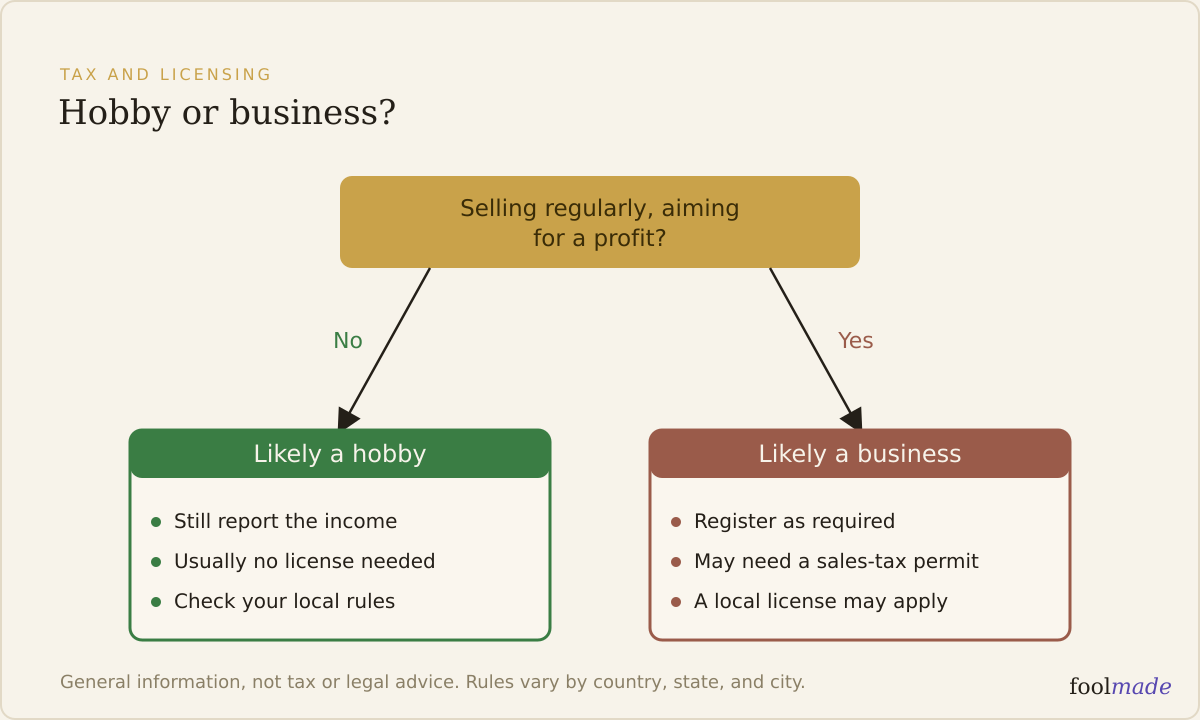
That surprises a lot of makers, because a deck feels like a passion project, not a storefront. But the moment you sell it, most tax systems treat you like a small seller. The good news: the amounts are usually modest, and a little tracking keeps it painless.
This is a plain overview, not tax or legal advice. Rules vary by country, state, and city, and they change. For your actual numbers, talk to an accountant or your local tax authority.
Do you owe income tax on tarot deck sales?
Generally, yes. In the US, income from selling your deck is taxable whether the IRS sees your work as a hobby or a business. The difference is what you get to subtract before the tax applies.
If it's a business, you report sales and expenses, and you pay income tax on the profit, meaning what's left after printing, shipping, fees, and supplies. If it's a hobby, the income is still taxable, but you usually can't deduct those costs, so you're taxed on a bigger number.
So business treatment often means a lower tax bill, not a higher one, because your real costs come off first. That is exactly why tracking every expense matters, which we get to below.
What is tarot deck sales tax, and who collects it?
Sales tax is a small percentage the buyer pays on the purchase price, that the seller collects and sends to the state. It is separate from income tax. Income tax is on your earnings; sales tax is on the transaction.
In the US, sales tax is set at the state level, and often city or county on top, so the rate a buyer pays depends on where they are. Five states have no statewide sales tax at all. This is why there is no single "deck tax" number.
Outside the US, most countries use VAT or GST instead, which works differently and often needs to be built into your sticker price. If you sell internationally, that is a separate rulebook worth a real look.
Does Etsy handle tarot deck sales tax for you?
Usually, yes. Under US marketplace facilitator laws, big platforms like Etsy and Amazon are required to calculate, collect, and remit sales tax on your behalf in the states that charge it. You don't set it up, and it isn't your money to send.
Where it lands on your plate is anything you sell outside a marketplace. Your own website, a Shopify shop, a craft fair table, or direct sales at a market are often your responsibility. That can mean registering for a sales tax permit in your state and filing on a schedule.
| Situation | What usually applies |
|---|---|
| Selling on Etsy, Amazon, or a similar marketplace | Platform collects and remits sales tax for you; you still owe income tax on profit |
| Selling from your own website or Shopify | You may need to register, collect, and remit sales tax yourself |
| Craft fair or in-person sale | Often your responsibility; some events require a temporary permit |
| Wholesale to a shop | Usually no sales tax if the buyer has a resale certificate; the shop charges it later |
| Any sale, any channel | Income tax on profit is yours to report |
Rates and rules shift constantly, and the table above is a starting map, not a filing guide. Confirm your state's current rules before you rely on any row.
When does a hobby become a business?
There is no clean switch, but intent is the core of it. A hobby is something you do mainly because you love it. A business is something you run to make a profit. If you are printing real runs, listing regularly, and trying to earn, you look like a business, and that is often to your advantage.
The IRS uses a set of factors, not one test, and looks at whether you keep records, depend on the income, and actually turn a profit. A common rule of thumb: if you show a profit in three of five years, they'll generally presume you're a business.
Treating your deck as a business also connects to other paperwork, like whether you need a business license to sell decks. The two questions travel together, though they are not the same thing.
What records should you keep?
Keep everything. Every cost tied to the deck lowers your taxable profit if you're a business, and it proves you're running things seriously if the classification is ever questioned.
Track and save receipts for:
- Printing invoices and proof orders
- Shipping, mailers, and packaging
- Platform and payment fees (Etsy, Shopify, Stripe, PayPal)
- Software, fonts, and stock elements you paid for
- Booth fees, samples, and promotional costs
One more thing to watch: in 2026, marketplaces like Etsy report your gross sales to the IRS on a 1099-K once you cross the reporting threshold. That form goes to you and the tax office, so your own records should match it. Where you sell affects how this lands, which is worth weighing when you decide where to sell your tarot deck.
The honest bottom line
You owe tax on deck sales, but it is rarely the scary part of publishing. Sales tax is often handled for you on marketplaces, and income tax lands on your profit, which your costs shrink. The makers who get stung are the ones who never tracked a single receipt and had to guess.
So price with tax and fees in view from the start, not as an afterthought. If your pricing already covers real costs, a modest tax bill won't wreck your margin, because you built room for it.
This article is general information, not tax or legal advice. Tax rules vary by country, state, and city and change often, so consult a qualified accountant or tax professional about your own situation before you file.
Foolmade's margin planner shows your true cost per deck and what each sale actually leaves you, so you can set a price with fees and taxes already in the picture. It never prints or generates art. It just runs the math that keeps your work sustainable.
Frequently asked questions
Do I have to charge sales tax on tarot decks I sell on Etsy?
Generally no, not manually. Etsy acts as a marketplace facilitator and collects and remits US sales tax for you where it applies. You still owe income tax on your profit from those sales.
Do I owe tax if my tarot deck is just a hobby?
Usually yes. In the US, hobby income is still taxable, but you typically can't deduct your costs against it. That often makes hobby income more expensive to earn than business income, where expenses come off first.
How much do I have to sell before I owe tax on my deck?
Income tax can apply from your first dollar of profit; there is no free tier for hobby or side income. Separately, marketplaces issue a 1099-K once your gross sales cross the reporting threshold, which in 2026 is far lower than it used to be.
Do these tax rules apply outside the United States?
No, they vary a lot. Most countries use VAT or GST instead of US-style sales tax, with their own thresholds and pricing rules. Check your national and local tax authority, or ask a local accountant, before selling.
Should I register as a business to sell my deck?
It depends on your volume and where you sell, but registering often helps because it lets you deduct real costs and looks legitimate to buyers and platforms. Weigh it alongside whether your area requires a license or permit to sell.