Kickstarter vs BackerKit vs direct pre-orders
In a BackerKit vs Kickstarter deck decision, the split is simple: Kickstarter gives you reach and an all-or-nothing deadline but never hands over backer emails, BackerKit runs a similar campaign with a much stronger pledge manager and better data, and direct pre-orders keep the customer and the margin as long as you supply the trust and traffic yourself.
That last clause is the whole trade. The platforms rent you an audience and take a cut. Going direct means you own everything and pay for it in effort.
What do these three options actually do?
They are not the same kind of thing, which is why comparing them by fee alone misleads people.
Kickstarter is a discovery marketplace with a hard rule: hit your funding goal by the deadline or every backer gets refunded and you get nothing. That all-or-nothing structure is a feature, not a bug, because it protects backers and forces you to prove demand before you print.
BackerKit started as the pledge-management layer that ran after a Kickstarter ended, the tool that collected shipping addresses, sold add-ons, and charged for shipping. It now also runs full crowdfunding campaigns of its own. So it can be your campaign platform, your post-campaign manager, or both.
Direct pre-orders skip platforms entirely. You open a product page on your own store, take money now, print once orders cover the run, then ship. Same core mechanic as a campaign, none of the middleman.
How do Kickstarter and BackerKit fees compare?
Here is the current picture. Confirm every number against a live quote before you plan around it, because processors and tiers change.
| Kickstarter | BackerKit | Direct pre-orders | |
|---|---|---|---|
| Platform fee | ~5% of raised | ~5% of raised | 0% (store platform may charge) |
| Payment processing | ~3% + per-pledge fee | ~3% + per-transaction fee | ~2.9% + per-transaction fee |
| Realistic all-in cut | ~8-10% | ~8-10% | ~3% + your store subscription |
| All-or-nothing? | Yes | Optional on their platform | No |
| Who owns customer emails | Kickstarter, not you | You, exportable | You, fully |
| Pledge management | Weak, needs add-on tool | Strong, built in | You build it |
| Reach / discovery | Highest, has its own traffic | Growing, smaller than KS | None, you bring the traffic |
| Best for | First campaign needing an audience | Data control + smooth fulfillment | Known buyers, protecting margin |
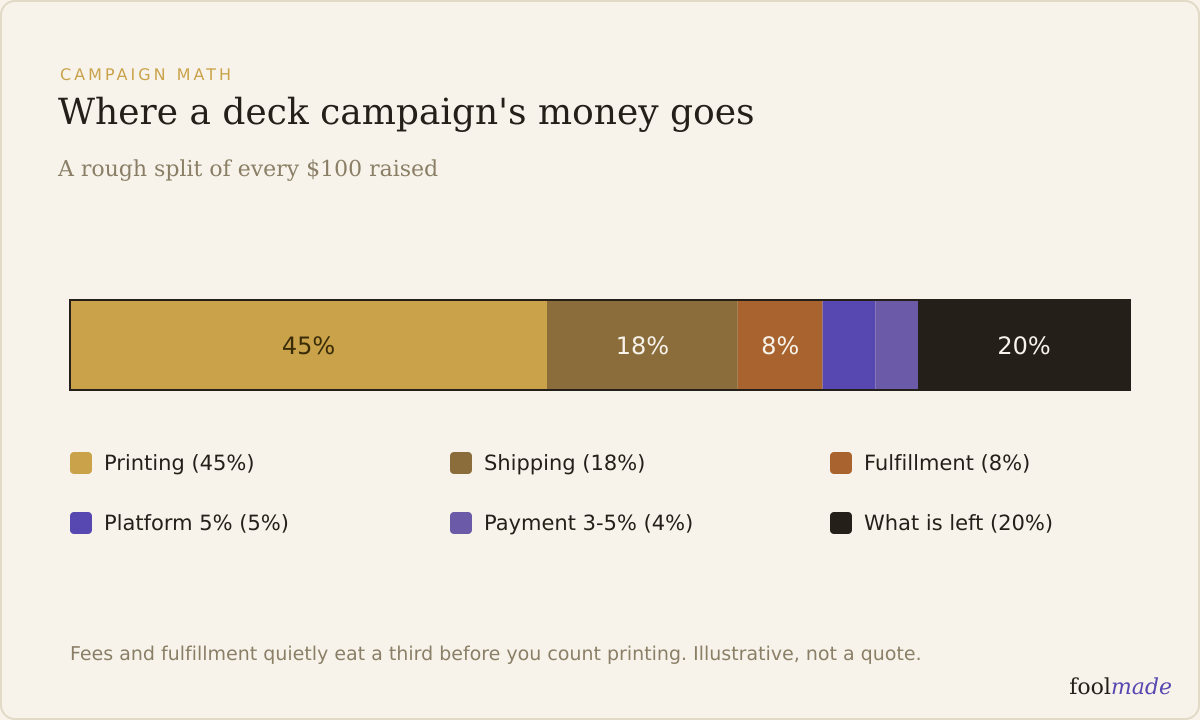
The headline that surprises first-timers: Kickstarter and BackerKit charge nearly the same 5% platform fee. On both, once you add card processing, plan on losing 8 to 10 cents of every dollar before you print a card. Direct selling drops that to roughly the processor fee plus whatever your store costs monthly.
Who owns the customer data?
This is the difference that outlasts your launch, and it is the one most creators underweight.
On Kickstarter you cannot email your backers directly. You post updates inside Kickstarter's system, and the pre-launch page everyone tells you to build collects followers Kickstarter keeps. When your second deck is ready, you are back to renting that audience again.
BackerKit is built around giving you the data. You can export backer information, run your own pledge manager, and keep selling to those people after the campaign closes. If owning your list matters, this is BackerKit's strongest argument over Kickstarter.
Direct pre-orders are the purest version. The order lands in your store, the email is yours, and there is no platform standing between you and the person who bought your deck. For a maker planning a second and third deck, that list is worth more than the reach of any single campaign.
Why does BackerKit's pledge manager beat Kickstarter's?
Because the money coming in is the easy half. The hard half is collecting 300 shipping addresses, selling the extra pin or print people want, charging accurate shipping, and handling the backer who moved. Do that in a spreadsheet and it eats weeks.
Kickstarter barely helps here, which is exactly why BackerKit existed in the first place. A lot of Kickstarter creators run the campaign on Kickstarter, then move everyone into BackerKit to manage fulfillment. That combination is common and completely normal.
BackerKit's own campaigns fold that manager in from the start. Direct pre-orders lean on whatever your store gives you, which is fine for a clean single-tier deck and painful once you add variants, bundles, and international shipping tiers.
Which one should you pick?
Take a position based on what you actually have.
- No audience yet, first deck, want the shop-window effect. Kickstarter. Its discovery traffic and the credibility of the brand are the thing you are paying that 8 to 10% for. See the realistic Kickstarter guide for a tarot deck before you commit.
- Want a campaign but care about data and fulfillment. BackerKit, or Kickstarter-then-BackerKit. You get the deadline energy plus a pledge manager that will not wreck your next three months.
- You already know buyers want it, or you hate performing a public funding bar. Direct pre-orders. You keep the margin and the list, and you dodge the all-or-nothing cliff. The tradeoff is that you provide the trust the platforms lend for free, so be specific about timelines and honest when they slip. More on that path in do you need Kickstarter to publish a deck.
None of these is a moral choice. It is a match between your situation and the shape of the tool. Read the whole route first in how to self-publish a tarot deck, then pick the funding layer that fits.
Whichever you choose, people need one place to find the deck, follow the progress, and buy when it goes live. A Foolmade link-in-bio profile gives your campaign, your pre-order page, and your work in progress a single home that respects the community rule against spammy self-promotion.
Frequently asked questions
Is BackerKit cheaper than Kickstarter for a tarot deck?
The core platform fee is nearly identical, around 5% on both, and once you add payment processing each lands near 8 to 10% of what you raise. BackerKit's real edge is data ownership and a built-in pledge manager, not a lower fee.
Can I use BackerKit without running a Kickstarter?
Yes. BackerKit runs standalone crowdfunding campaigns and works as a pledge manager or pre-order tool on its own. You do not have to launch on Kickstarter first to use it.
Do direct pre-orders count as crowdfunding?
They use the same mechanic, take money now and print once orders cover the run, but there is no platform, no discovery marketplace, and no all-or-nothing refund rule. You supply the audience and the trust yourself.
Why can't I email my Kickstarter backers directly?
Kickstarter keeps the backer relationship inside its own system. You post updates there but never receive email addresses, which is why many creators move backers into BackerKit or a direct store to build a list they actually own.
What happens if a Kickstarter does not hit its goal?
Every backer is refunded and you receive nothing. That all-or-nothing rule is why proving demand before launch matters, and why creators without an audience often prefer direct pre-orders with no funding cliff.
Fees and platform rules shift, so confirm the current numbers on each platform before you build a budget around them.